Help
Nvidia CEO Jensen Huang investigation exposes a bigger risk to the AI boom
Nvidia's investigation into Jensen Huang exposes a deeper vulnerability: the AI investment boom increasingly depends on his leadership and the company's financial support.
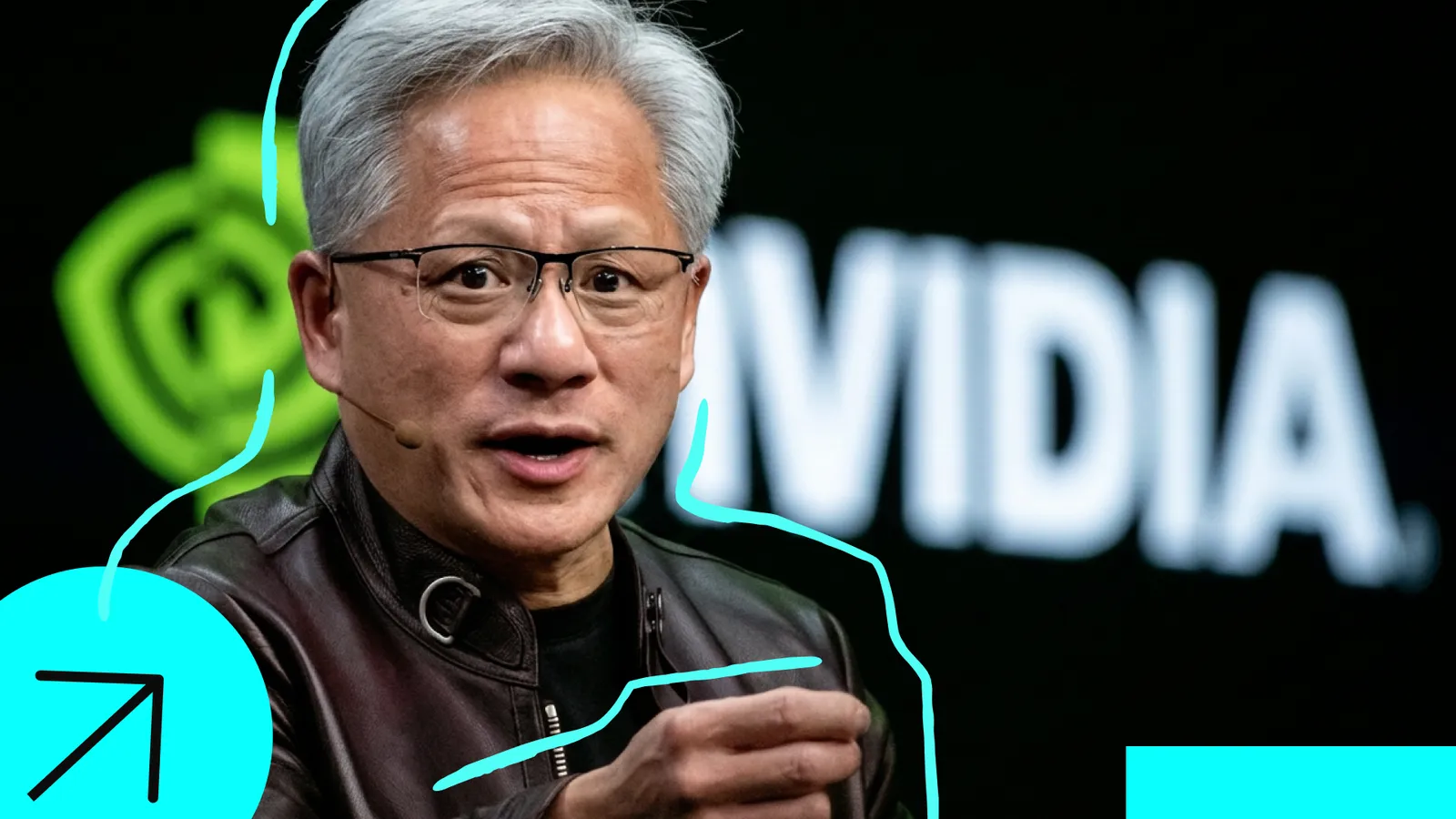
Nvidia has opened an independent investigation into CEO Jensen Huang following reports that he was targeted by a suspected Chinese intelligence operation.
Despite owning just 3.4% of Nvidia, Huang exercises extraordinary influence over a company valued at approximately $4.5 trillion.
Nvidia has reportedly extended about $300 billion in financial support and commitments to customers over three years, making its role in AI infrastructure financing increasingly important.
The cost of insuring Nvidia's debt against default has tripled in 2026, reflecting growing investor concern about exposure to AI-related financing.
The investigation could complicate funding for smaller cloud providers and intensify scrutiny of advanced chip exports to Asia.
Nvidia's investigation raises questions beyond Jensen Huang's leadership
Nvidia's decision to investigate its chief executive, Jensen Huang, comes at an uncomfortable moment for the artificial intelligence industry. Investors are already questioning the financial sustainability of the AI infrastructure boom, and the sector's most influential executive is now facing scrutiny over a reported relationship involving a suspected Chinese intelligence operative.
The company's board announced an independent investigation on November 8 following reports that Huang had been targeted by a foreign intelligence effort. Huang acknowledged being unfaithful to his wife and said he would cooperate with the inquiry. Nvidia emphasized that it currently has no reason to believe company secrets or US national security were compromised and expressed confidence in his leadership.
The distinction matters because the allegations remain under investigation. The market's immediate concern, however, extends beyond what the inquiry may establish. Nvidia has become central to an enormous network of chip purchases, data-center construction and financing arrangements, with Huang personally involved in shaping many of those relationships.
The company's market capitalization of roughly $4.5 trillion reflects the commercial success of its AI processors. Increasingly, though, Nvidia's influence extends into financing the customers that purchase those processors.
That creates a potentially significant concentration of financial and operational risk.
How Nvidia became a major financier of the AI boom
Over the past three years, Nvidia has reportedly provided approximately $300 billion in financial support and commitments to customers, while investing billions more in AI startups and specialized cloud infrastructure providers.
These arrangements can accelerate demand for Nvidia's chips by helping customers finance the infrastructure needed to deploy them. They also create an uncomfortable dependency.
Some of the companies purchasing Nvidia's hardware rely on investment capital, borrowing or vendor-supported financing to expand. Their ability to repay lenders and fund future purchases depends on generating sufficient revenue from the computing capacity they are building.
This raises the possibility of a financing cycle in which Nvidia supports the expansion of its customers, those customers use capital to purchase Nvidia processors, and the resulting orders reinforce expectations for continued growth across the AI sector.
Such arrangements can be commercially sensible when underlying demand is strong. The vulnerability emerges if infrastructure investment expands faster than customers' ability to generate sustainable cash flow.
Nvidia's role therefore increasingly resembles that of both a technology supplier and a major source of capital supporting demand for its products.
Why CoreWeave and smaller cloud providers are particularly exposed
The financing problem is already visible among specialized cloud operators, commonly known as neoclouds.
Companies such as CoreWeave have benefited from soaring demand for AI computing capacity, but their business models require substantial upfront investment in GPUs, data centers and supporting infrastructure.
As borrowing costs increase, the economics become more demanding. Higher financing expenses can reduce returns on new computing facilities, particularly when customers are unwilling to commit to long-term contracts at sufficiently profitable prices.
Australia's Firmus Grid illustrates the challenge. After withdrawing a planned Sydney IPO, the company has reportedly been exploring additional investment from Nvidia.
For businesses in this position, Nvidia's willingness to provide capital can influence whether expansion projects proceed.
An internal investigation involving Huang could encourage Nvidia's investment teams to take a more cautious approach, especially toward transactions requiring significant financial commitments or presenting complicated regulatory risks.
Even temporary delays could have consequences for companies depending on fresh capital to complete infrastructure projects.
The wider AI investment cycle would not necessarily stop, but its expansion could become more selective and expensive.
Nvidia's credit market is already signaling concern
Investors have begun reassessing the financial risks associated with Nvidia's expanding role in AI infrastructure.
The cost of credit default swaps protecting against a potential Nvidia debt default has reportedly tripled this year, while the spread on its corporate bonds has widened.
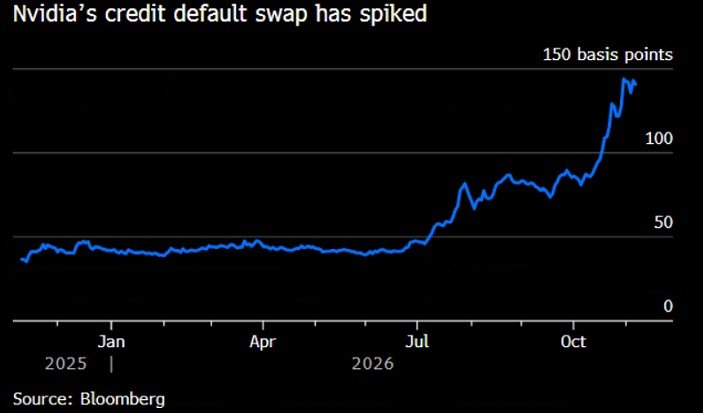
Source: Bloomberg
That does not mean investors expect Nvidia to default. Credit protection prices also reflect hedging demand, market liquidity and changes in perceived risk.
Nevertheless, the direction is revealing.
Nvidia's financial exposure is increasingly linked to customers undertaking massive capital expenditure programs, some of which depend on continued access to external financing.
If borrowing conditions deteriorate, weaker customers may delay purchases, renegotiate expansion plans or require additional financial support.
That could leave Nvidia confronting difficult decisions about whether to extend more capital to support demand or reduce exposure to projects whose returns remain uncertain.
The investigation adds another source of uncertainty at a time when credit investors are already questioning the risks associated with AI financing.
China allegations could complicate Nvidia's business in Asia
The national security dimension may prove particularly consequential for Nvidia's Asian operations.
Reports have identified a former executive at Singapore-based Megaspeed International as the individual involved in the intelligence allegations. US authorities reportedly suspected that the executive had connections to Chinese intelligence, although those claims remain disputed and the investigation has not established that Nvidia information was compromised.
Megaspeed has been involved in developing data-center infrastructure in Southeast Asia. Reports have also raised questions about whether computing capacity associated with the company provided Chinese businesses, including Alibaba, with indirect access to advanced Nvidia technology.
Those concerns intersect with existing US restrictions designed to limit China's access to high-performance AI processors.
The issue is especially complicated because access to computing power can extend beyond the physical location of a chip. A processor installed in a Southeast Asian data center could potentially serve customers in another country through remote computing arrangements.
That creates a challenge for lenders and regulators assessing AI infrastructure projects.
Banks financing GPU purchases must consider the creditworthiness of borrowers, the useful economic life of rapidly advancing processors and the identity of the companies ultimately using the computing capacity.
Additional scrutiny could slow approvals for projects involving cross-border customers or complex ownership structures.
The risk for Nvidia is therefore broader than individual chip exports. It includes the financing and commercial relationships supporting its expansion across Asian AI markets.
Has Nvidia become too dependent on Jensen Huang?
The investigation also raises questions about Nvidia's corporate structure.
Huang owns approximately 3.4% of Nvidia, yet his influence over the company's strategy is unusually concentrated. He has built a management system with a relatively flat reporting structure and, according to research estimates, as many as 60 direct reports.
That arrangement has helped Nvidia move quickly in a rapidly changing technology market. Major decisions can be communicated and implemented without passing through multiple layers of management.
But speed comes with a trade-off.
A company whose strategy depends heavily on one individual may become more vulnerable when that person's authority is challenged. The concern is particularly relevant because Nvidia has no widely recognized successor capable of immediately replacing Huang's combination of technical knowledge, commercial relationships and industry influence.
The board has expressed confidence in his leadership, and Nvidia says he intends to remain chief executive without interruption.
Even so, the investigation could encourage directors and executives to apply greater scrutiny to investment decisions, customer financing and sensitive international relationships.
Such caution may strengthen governance over time, although it could also slow the transactions that helped Nvidia expand its influence throughout the AI industry.
What the investigation means for Nvidia stock and the AI outlook
Nvidia shares came under pressure as investors assessed the investigation, adding to recent volatility driven by doubts about the scale and profitability of AI infrastructure spending.
The immediate financial consequences remain uncertain. The company's products retain a powerful competitive position, and demand for advanced computing has not disappeared.
The more important question is whether the investigation changes Nvidia's willingness or ability to support the financial ecosystem surrounding its chips.
Investors should monitor three developments: the findings of the independent inquiry, any tightening of US oversight over chip sales and data-center access in Asia, and changes in Nvidia's financing commitments to AI infrastructure customers.
A prolonged investigation could create uncertainty around leadership and dealmaking even if the company's existing sales and production remain unaffected.
More restrictive financing would be particularly important for highly leveraged neoclouds, where expensive capital and uncertain future returns already present challenges.
Nvidia's extraordinary rise has been supported by its technological dominance and Huang's ability to persuade customers, investors and governments that AI infrastructure investment will deliver enormous economic value.
The investigation puts the second part of that proposition under scrutiny.
The most consequential risk is that Nvidia's influence over AI has become so concentrated that uncertainty surrounding its chief executive can affect financing decisions across an industry worth trillions of dollars.
If that uncertainty begins slowing capital commitments while borrowing costs are already elevated, the consequences could extend well beyond Nvidia's share price.