
 Help
Help 
Nvidia's biggest week leaves investors asking one question: is there still room to rally?
Nvidia spent the past week doing what it has done better than any company since the AI boom began expanding its reach. New partnerships in South Korea, a sovereign AI investment in Naver, and a broader push into Japan's industrial sector all reinforce the same strategy: Nvidia doesn't just want to sell the chips powering artificial intelligence. It wants to become part of every layer of the AI ecosystem, from memory and data centers to robotics and national AI infrastructure.
Nvidia expanded its AI ecosystem through major partnerships in South Korea and Japan.
A new collaboration with SK Group strengthens Nvidia's long-term AI memory supply chain through 2027.
Nvidia is deepening its sovereign AI strategy with a $1 billion investment in South Korea's Naver.
Nvidia is building more than chips
There was a time when Nvidia's story revolved almost entirely around GPUs. Today, selling chips is only part of the equation. The company's latest announcements show a business trying to secure every critical component surrounding AI deployment. That means locking in memory supply, helping countries build domestic AI infrastructure, expanding data-center capacity and creating partnerships that make Nvidia technology increasingly difficult to replace.
The objective is clear. Rather than competing product by product, Nvidia is building an ecosystem that encourages customers to remain inside its platform as AI adoption accelerates. That strategy also reduces dependence on any single source of demand. Cloud providers remain central to Nvidia's growth, but they are no longer the only market the company is targeting.
South Korea becomes a strategic AI hub
Nvidia's partnership with SK Group goes well beyond securing access to advanced memory chips. It strengthens one of the most important parts of the AI supply chain at a time when demand for high-bandwidth memory continues to outpace supply. For Nvidia, ensuring long-term access to memory may prove just as valuable as designing the next generation of GPUs. AI systems cannot scale without both.
The company also agreed to invest $1 billion in Naver, supporting the expansion of sovereign AI infrastructure through the GAK Sejong data center. That investment reflects a broader trend emerging across industry as governments and domestic technology companies increasingly seek to develop AI capabilities without relying entirely on foreign cloud providers. Sovereign AI has quickly evolved from a niche concept into one of the industry's fastest-growing opportunities, and Nvidia appears determined to establish an early presence wherever those projects emerge.
Japan broadens the opportunity
For much of the AI boom, demand has been driven by hyperscale cloud providers racing to build larger computing clusters. Nvidia now appears to be preparing for the next stage, where AI expands beyond internet companies and into manufacturing. Partnerships involving companies such as Toyota, Fanuc and Kioxia illustrate that shift.
Factories, industrial robots and autonomous production systems require a different type of computing infrastructure than chatbots or large language models, but they represent an equally significant opportunity over the long term.
If enterprise AI defined the first phase of the industry's expansion, industrial AI could become the next. That would broaden Nvidia's customer base considerably while reducing reliance on a relatively small number of cloud providers.
Strong fundamentals no longer guarantee a higher share price
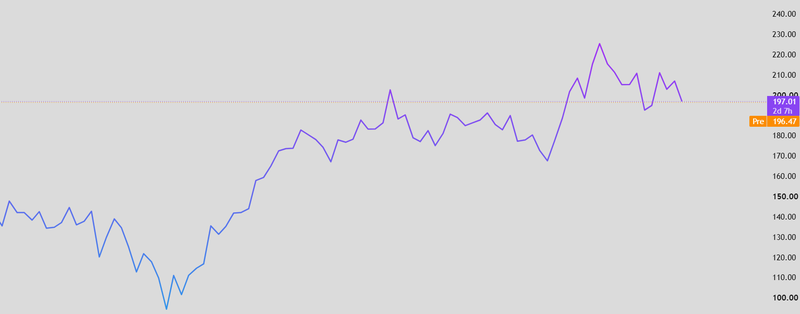
Despite another week filled with major announcements, Nvidia's share price has struggled to generate the kind of momentum investors became accustomed to over the past two years. That doesn't necessarily reflect fading confidence in artificial intelligence.
It reflects rising expectations
The AI investment cycle has reached a point where every new project carries a larger price tag than the last. Building advanced AI infrastructure requires enormous spending on chips, networking equipment, electricity and data centers, forcing investors to think more carefully about future returns. Markets are no longer rewarding companies simply for spending more. They want evidence that today's capital expenditure will translate into tomorrow's earnings.
Source: Trading view
Guidance matters more than another record quarter
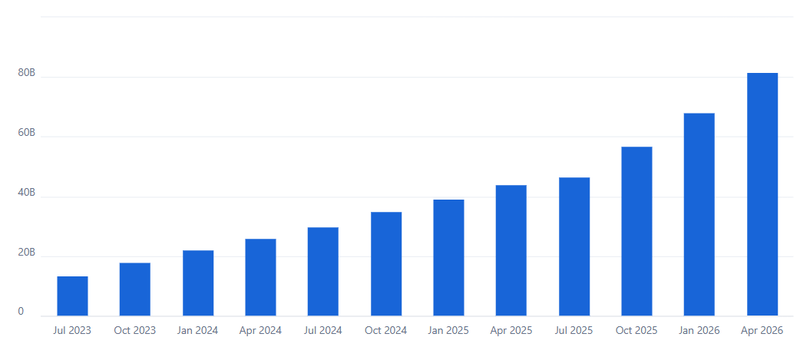
Analysts expect Nvidia to generate roughly $91 billion in revenue for the second quarter of fiscal 2027, extending one of the strongest periods of growth ever seen in the semiconductor industry. A few years ago, numbers like that would have been enough to drive the stock higher almost on their own.
Today, expectations have changed
Wall Street already assumes Nvidia will report exceptional growth. What investors want now is confidence that demand remains durable beyond the current investment cycle. Management's outlook on hyperscale spending, sovereign AI projects and customer investment plans may ultimately carry more weight than the quarterly revenue figure itself. When expectations become this high, strong results are often treated as the minimum requirement rather than a positive surprise.
Source: Fullratio


