
 Help
Help 
Palantir's earnings revive confidence in tech
Palantir's latest earnings arrived at an important moment for the technology sector. Investors have spent weeks questioning whether the enormous sums being poured into artificial intelligence are still generating enough returns to justify today's valuations. Instead of adding to those doubts, Palantir delivered the kind of results the market had been looking for.

Palantir reported $1.94 billion in revenue, up 93% from a year earlier.
U.S. commercial revenue surged 149% to $764 million.
Remaining contract value climbed 153% to $2.132 billion, pointing to continued demand from corporate customers.
AI spending is still turning into real business
The biggest takeaway from Palantir's report wasn't simply that revenue exceeded expectations. It was where that growth came from. Corporate America continues to increase spending on AI, not because companies want to experiment with technology, but because they are beginning to build it into everyday operations.
That shift is far more meaningful than another strong quarterly number because it suggests AI adoption is becoming part of long-term business strategy rather than a temporary investment trend.
The company's expanding contract pipeline tells a similar story. Winning new business is one thing; persuading customers to commit to larger, longer-term projects is another. That is exactly what investors want to see at a time when markets are debating whether the AI investment cycle is beginning to mature.
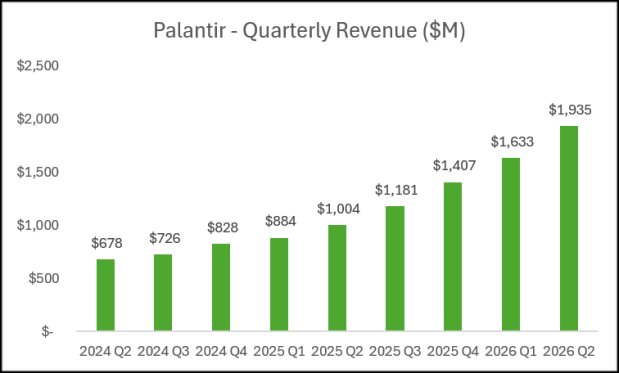
Source: Zacks Research
Why Palantir's earnings matter beyond Palantir
Strong earnings from one AI company can quickly influence the rest of the market because investors rarely view these businesses in isolation.
When demand accelerates for companies building AI software, it reinforces confidence that spending across the wider ecosystem remains healthy. That naturally improves sentiment toward the companies providing the computing power, cloud infrastructure and networking equipment behind those applications.
It doesn't guarantee stronger earnings for every technology company, but it does challenge the idea that businesses are becoming more cautious about investing in AI.
Why the Nasdaq pays attention
Artificial intelligence has become one of the biggest themes driving Nasdaq, so investors often use earnings from companies like Palantir as a guide to broader market sentiment.
A report that points to stronger enterprise demand can encourage buying across companies such as Nvidia, Microsoft, AMD, Broadcom and Oracle, even though they operate in different parts of the AI ecosystem. Investors aren't reacting to Palantir's revenue alone. They react to what those numbers may say about future demand across the sector.
The same logic works in reverse. When one of the market's leading AI companies is disappointed, investors often become more cautious toward technology stocks, particularly when valuations are already demanding.
Guidance is becoming the real catalyst
Quarterly earnings explain where a company has been. Guidance shapes expectations for where it is going. That distinction matters more than ever in today's market.
Technology companies are investing billions of dollars in AI infrastructure, and investors want reassurance that customer demand is expanding quickly enough to support those investments. A company that raises guidance sends a very different message from one that simply beats estimates before adopting a more cautious outlook. For that reason, markets increasingly reward confidence about the future rather than strong numbers from the past.
Retail sentiment can amplify the reaction
Palantir has one advantage few technology companies can match: an exceptionally loyal retail investor base. Strong earnings often attract individual investors alongside institutional buyers, creating a powerful combination that can accelerate short-term price moves. That enthusiasm frequently spills into AI-focused ETFs and the broader technology sector, helping to lift sentiment beyond a single stock.
Whether those gains last depend on the next round of earnings, but the immediate reaction illustrates how closely today's AI leaders are connected in investors' minds.
For now, Palantir has done more than report another strong quarter. It has reminded the market that, despite growing concerns over valuations and infrastructure spending, businesses are still writing large cheques for AI and that remains one of the strongest arguments supporting technology stocks today.


