
 Help
Help SpaceX technical outlook: why $172 is the major test
SpaceX is preparing to raise as much as $40 billion to fund a major Nvidia chip purchase, underscoring the scale of capital now flowing into AI infrastructure. At the same time, Elon Musk's discussions with TSMC over Terafab could reshape the semiconductor supply chain and challenge Intel's expected role in the project.

SpaceX is reportedly seeking around $10 billion of bank loans and $30 billion of investment-grade debt to finance Nvidia chip purchases.
SpaceX AI plans to scale Nvidia's Vera Rubin platform toward gigawatt-scale computing capacity, including planned orbital infrastructure.
TSMC is discussing a potential role in Terafab, creating uncertainty around Intel's position in the project.
A pullback toward $168.50 would not necessarily change the bullish picture.
SpaceX is turning AI demand into a financing story
The reported $40 billion financing is significant because it shows how quickly AI infrastructure is moving from a technology investment into a capital-markets story.
SpaceX is seeking roughly $10 billion in bank financing and another $30 billion through investment-grade debt, with the transaction expected to close in 2027. The scale of the funding reflects the cost of building computing capacity before that capacity can generate returns.
The demand is not limited to conventional data centers
SpaceX AI has said it intends to expand toward gigawatt-scale computing using Nvidia's Vera Rubin architecture, while also developing its first-generation Starmind AI satellite around an adapted Vera Rubin system. That gives Musk's AI strategy an unusual structure, computing demand is expanding on Earth while the company is simultaneously exploring computing infrastructure in orbit.
The financial implication is important. SpaceX is effectively bringing forward enormous capital expenditure in expectation that AI computing, data services and related businesses will generate sufficient cash flow to justify the investment.
The bigger question for markets is therefore no longer whether AI requires more chips, but whether the revenue generated from that infrastructure can keep pace with the capital being deployed.
Nvidia benefits first, but TSMC controls a critical bottleneck
Nvidia is the immediate beneficiary of this spending cycle because SpaceX has committed to its accelerated-computing architecture. But the next bottleneck sits further down the supply chain. Advanced processors still require specialized leading-edge manufacturing, and that is where TSMC becomes strategically important.
Musk confirmed that discussions with TSMC
Possible arrangements include TSMC operating the facility or providing its process technology while Musk's companies commit to buying the resulting chips.
That possibility matters because TSMC has already entered high-volume production of its 2nm technology and expects a rapid ramp, with further N2P and A16 technologies scheduled for volume production in the first half of 2027.
If Terafab ultimately uses TSMC technology, Musk's companies would gain access to one of the industry's most advanced manufacturing platforms while securing dedicated capacity for their own requirements. For TSMC, it would create another large anchor customer at a time when AI is driving demand for advanced nodes.
The real test is the return on all this capital
SpaceX's financing plan, Nvidia's chip demand and the TSMC discussions point to the same underlying trend, AI infrastructure is becoming increasingly capital intensive.
For SpaceX and its investors, it creates a much higher hurdle. Tens of billions of dollars of debt and chip spending require future computing revenues to scale quickly enough to support the investment.
That is ultimately where the market will focus. The next phase of the AI cycle will not be judged only by how much computing capacity companies can build, but by whether that capacity generates enough economic value to justify the debt and capital required to build it.
Technical outlook
SPCX has undergone a clear structural reversal after falling from above $210 during the June–August decline and eventually finding support around $105–110. The stock then spent several weeks building a base before establishing a sequence of higher lows. The more important shift came with the break above $147.20, which had acted as a major resistance level.
The breakout quickly carried SPCX toward $168.50–$172.45, where the stock is now consolidating. So far, that pause has not damaged the bullish structure. The rising trendline has also moved higher toward $160–162, giving investors a more immediate level to watch if the stock comes under pressure.
The next major test is $172.45. A sustained break above that level would confirm that buyers are willing to push the recovery into another leg higher. Above it, resistance becomes relatively limited until the previous $200–210 area, with $180–185 and then $190–200 providing the next potential targets. If momentum remains strong, a retest of $210–220 could eventually come into view.
Scenarios ahead
A pullback toward $168.50 would not necessarily change the bullish picture. Holding that level and then breaking $172.45 would suggest that the current consolidation is being used to build momentum for another advance.
A deeper retracement toward $160–162 would still leave the medium-term structure constructive if the rising trendline holds. The first meaningful warning would come from a decisive break below $160, which could send SPCX back toward $147.20.
That level is now the key structural test. Holding $147.20 would keep the broader breakout intact, while losing it would raise the risk that the recent move was a failed breakout, opening the way toward $140 and potentially back to the $120–110 base.
For now, the structure remains bullish, but the next confirmation must come from a sustained break above $172.45 rather than another rejection from resistance.
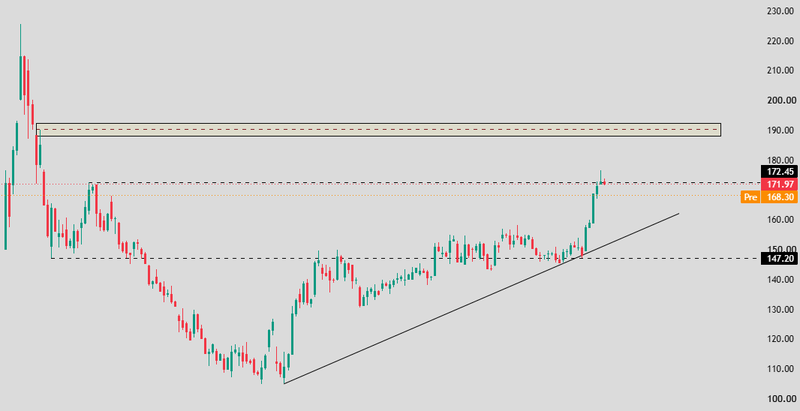
Source: Trading view


