
 Help
Help 
SpaceX revenue surges 92%: can Starlink and AI justify their massive spending?
SpaceX has given investors two very different reasons to pay attention this month. On one side, the company is showing extraordinary operating growth, from record launch cadence to rapidly expanding Starlink and AI revenue. On the other, the scale of its investment spending and the steady release of locked-up shares are raising a harder question: how much growth is already priced into SpaceX, and how much capital will it take to deliver the next stage?
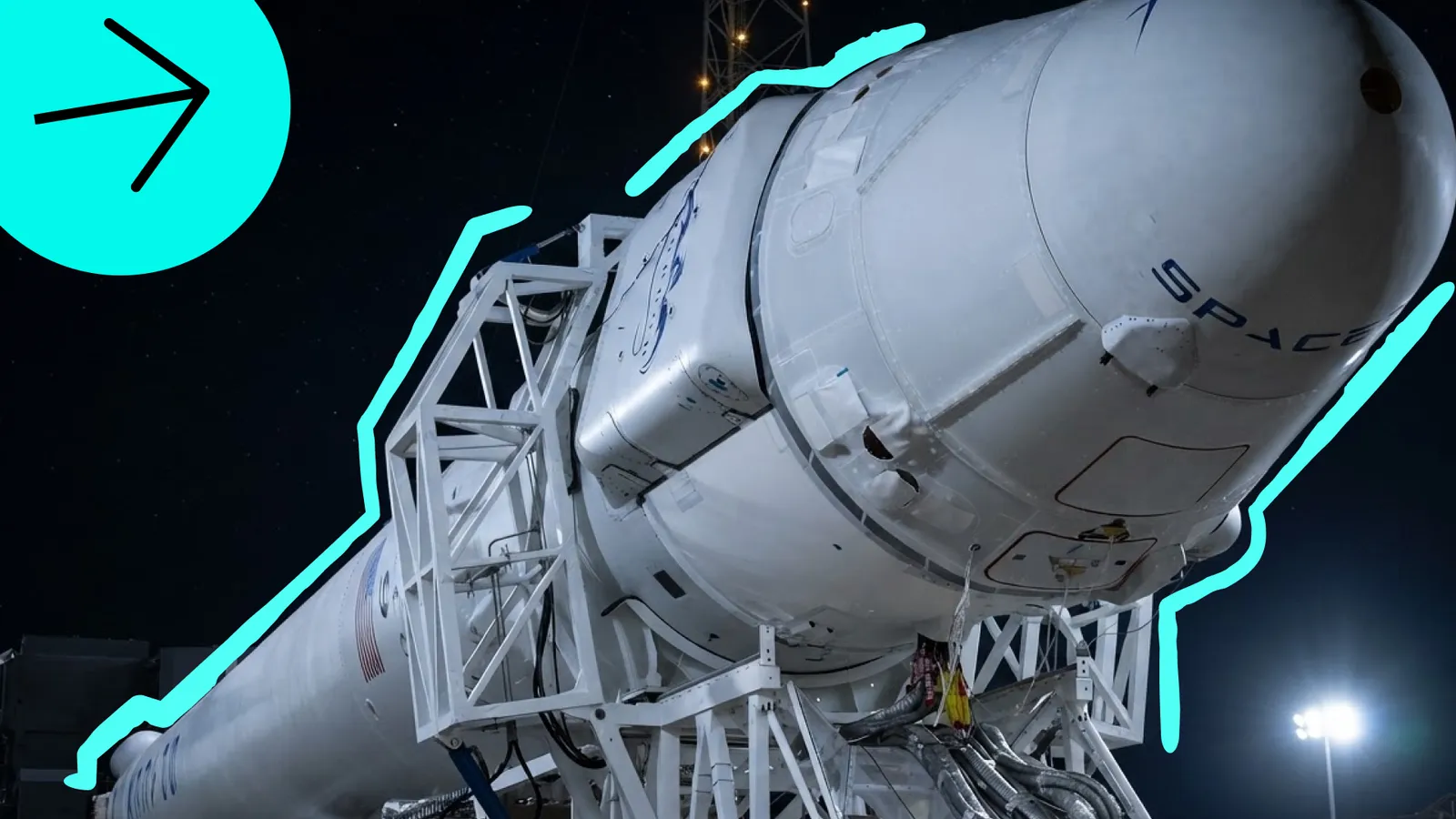
Company launched two Falcon 9 rockets from opposite U.S. coasts just 38 minutes apart.
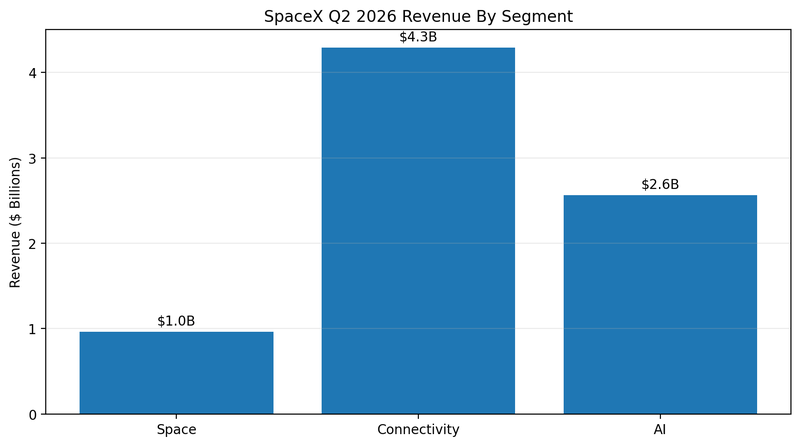
Starlink remains SpaceX’s largest source of revenue, generating roughly $4.29 billion in the second quarter.
On August 20, approximately 319 million additional SpaceX shares held by early investors and insiders become eligible for trading.
SpaceX is turning launch capacity into a much larger business
On August 15, the company launched two Falcon 9 rockets from opposite U.S. coasts just 38 minutes apart, setting a new company record. First stages were successfully recovered. The missions were SpaceX's 95th and 96th Falcon 9 launches of 2026, showing how reusable rockets are allowing the company to treat launches increasingly like a high-frequency commercial operation rather than occasional events.
That matters financially because launch cadence is becoming part of the infrastructure supporting the rest of the business. More launches mean more Starlink satellites can be deployed, more government and commercial missions can be serviced, and more capacity can be added without SpaceX having to depend entirely on outside launch providers.
SpaceX crushed Q2 2026 revenue expectations
Despite the growing focus on AI, Starlink remains SpaceX’s largest source of revenue, generating roughly $4.29 billion in the second quarter, more than half of total sales. Its subscriber base reached 12 million, double the level a year earlier, giving SpaceX something many AI infrastructure businesses do not have: a large and growing customer base generating recurring revenue. The challenge is that average revenue per subscriber has fallen about 22% as SpaceX expands into lower-priced markets. That means the next stage of Starlink’s growth will depend less on adding users and more on turning that larger network into stronger cash flow.
AI infrastructure: the growth engine
AI is becoming a much bigger part of the SpaceX story. The company generated about $2.56 billion in AI-related revenue during the second quarter, up roughly 250% from a year earlier, as demand for computing capacity and data-center infrastructure accelerated. That is changing how investors look at the company. SpaceX is no longer simply a launch provider with a satellite-internet business; it is increasingly becoming an AI infrastructure company. Management is targeting a $100 billion annualized revenue run rate by December, a huge jump from its current level and one that leaves little room for delays or weaker demand.
Launches: the infrastructure underneath both businesses
The launch business remains critical because it supports the expansion of both Starlink and SpaceX’s broader infrastructure ambitions. Two Falcon 9 rockets launching only 38 minutes apart from opposite U.S. coasts highlighted how far the company has pushed its launch cadence.
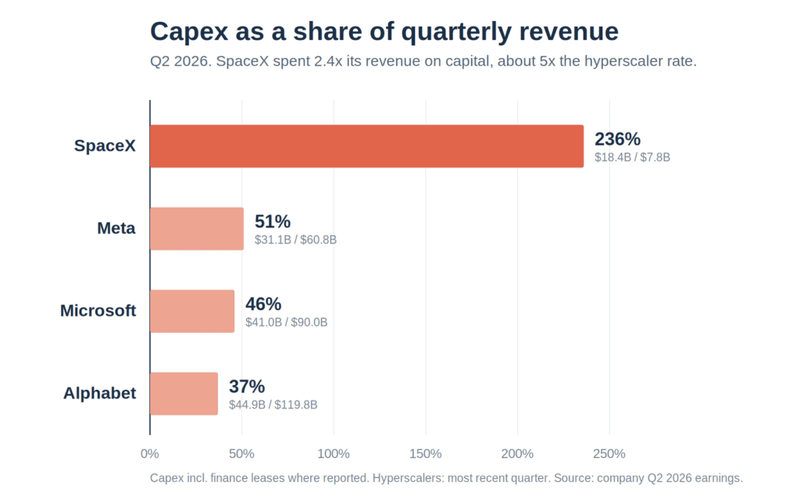
More frequent launches allow SpaceX to deploy Starlink satellites faster while also serving commercial and government customers. But maintaining that lead requires enormous investment. SpaceX spent about $18.4 billion on capital expenditure in the second quarter, around 2.4 times its quarterly revenue, with roughly $15.8 billion directed toward AI infrastructure.
The company plans to expand computing capacity from about 2 gigawatts to more than 10 gigawatts by 2027, making the launch business an important part of the much larger infrastructure strategy.
Source: Seeking Alpha
The real test is whether AI spending becomes cash flow
Investors have become increasingly comfortable with enormous AI capital expenditure as long as revenue growth keeps validating the spending. But eventually the infrastructure will produce attractive returns.
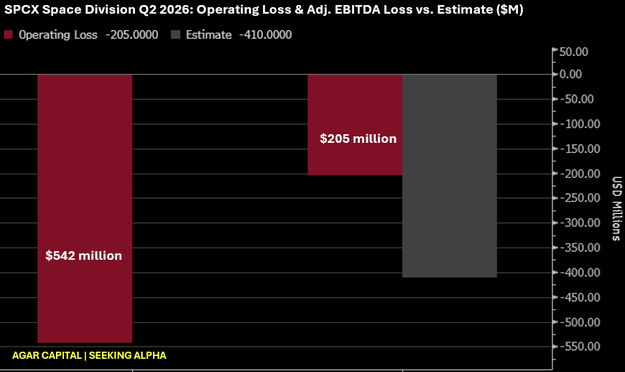
SPCX Space Division’s second-quarter results showed a smaller-than-expected net loss of $541 million, while adjusted EBITDA reached $205 billion. That is encouraging, but the company is simultaneously spending at a rate that dwarfs its current revenue.
The question is therefore not whether SpaceX can grow. It clearly can. The question is whether it can grow fast enough to justify the capital required to support that growth.
Source: Bloomberg
SpaceX is spending at a completely different pace
SpaceX spent approximately $18.4 billion on capital expenditures in the second quarter, more than twice its quarterly revenue.
Around $15.8 billion of that spending was directed toward AI infrastructure. The company is expanding computing capacity from roughly 2 gigawatts toward more than 10 gigawatts by 2027, a scale that puts SpaceX increasingly alongside the world's largest AI infrastructure investors. Put simply, SpaceX is spending about 2.4 times its quarterly revenue on capital expenditure.
That is an extraordinary ratio. For comparison, major hyperscalers are also spending hundreds of billions on AI infrastructure, but their capital expenditure is spread across much larger and more established revenue bases. SpaceX's spending intensity is therefore unusually high relative to its current sales.
Source: Capex Finance
August 20 creates another test for the stock
On August 20, approximately 319 million additional SpaceX shares held by early investors and insiders become eligible for trading. That follows the release of roughly 911.5 million shares on August 6.
The first unlock more than doubled the number of shares available to public investors, yet the stock did not collapse under the additional supply. That was an important signal because it suggested there was enough demand to absorb at least part of the selling pressure.


