
 Help
Help 
SpaceX starship reaches orbit: what it means for Starlink and AI
Starship reached Earth orbit for the first time on September 28, completing an orbital insertion despite an engine failure during the mission and deploying 26 next-generation Starlink V3 satellites. The flight was shortened from the planned 10 hours to roughly three hours because of the engine issue, but the core orbital objective was achieved.
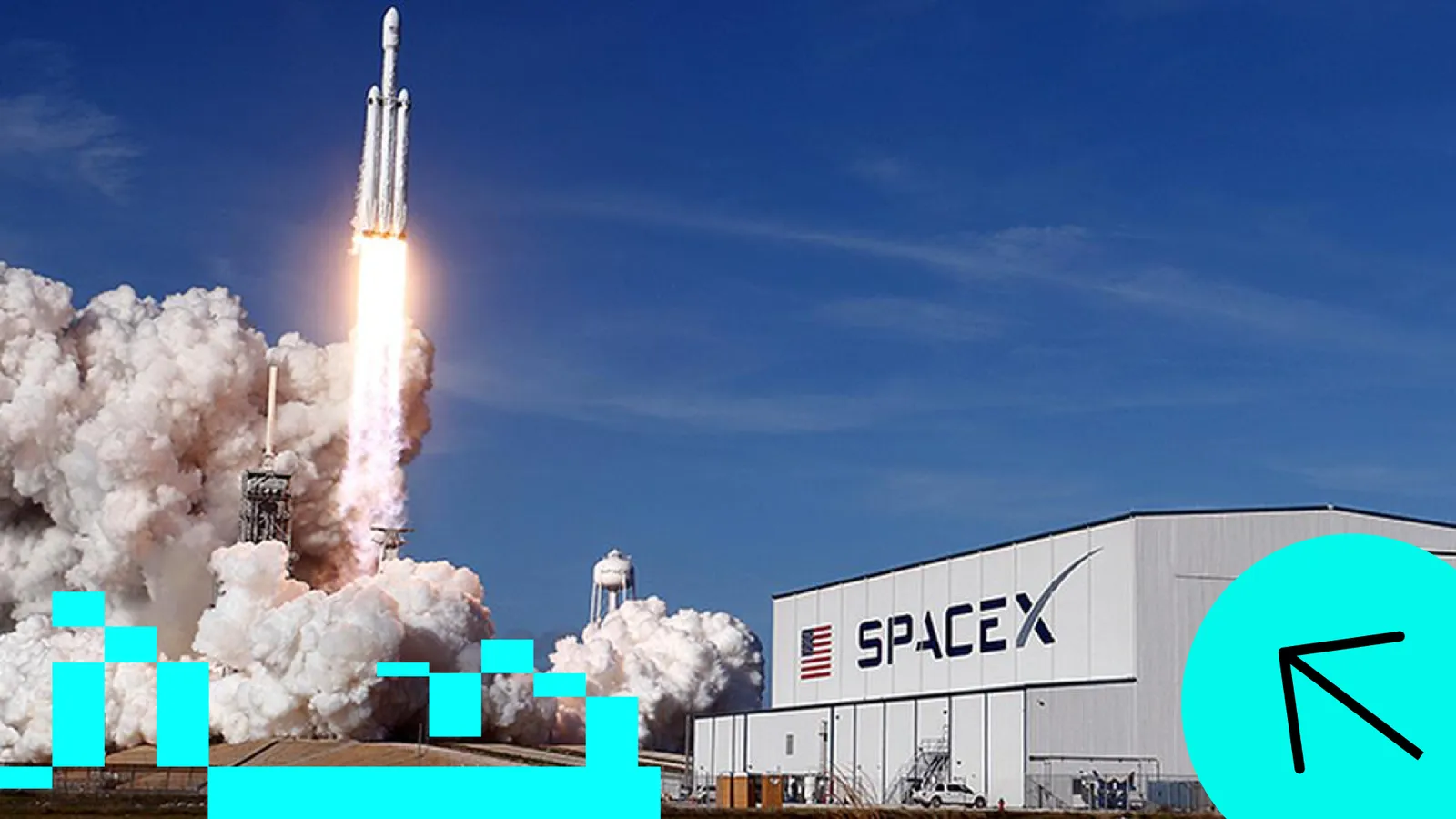
SpaceX tested the vehicle through 13 suborbital flights.
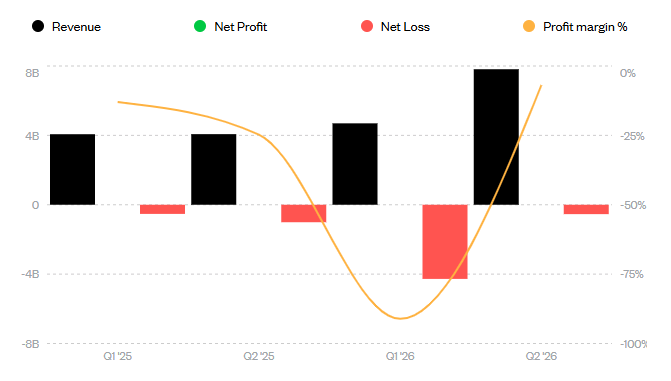
SpaceX generated $7.8 billion in revenue in the quarter.
SpaceX's trailing GAAP P/E is not meaningful while the company remains loss-making.
Starship has solved a bottleneck, not the entire problem
Reaching orbit changes the economics of Starship. Until now, SpaceX had tested the vehicle through 13 suborbital flights. The latest mission demonstrated that the spacecraft could reach orbital velocity and deploy an operational payload. That matters because Starship is intended to launch Starlink satellites at a scale Falcon 9 cannot match.
The 26 V3 satellites deployed on the flight are particularly important. SpaceX says the new satellites can handle around 10 times the data capacity of earlier V2 mini satellites, while the company ultimately wants Starship to deploy much larger batches.
That creates a direct commercial link
More reliable Starship flights mean faster Starlink expansion. Faster deployment creates more network capacity. More capacity can support subscriber growth, mobile connectivity and enterprise demand.
The real growth story is increasingly AI
The market is increasingly valuing SpaceX as an AI infrastructure company as much as a space company.
Second-quarter results show why
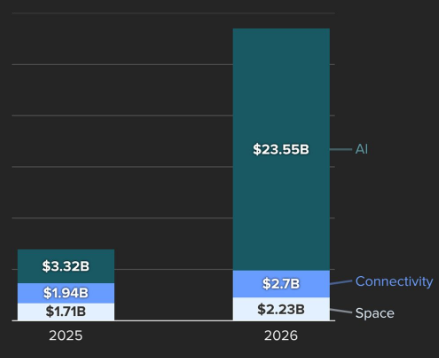
SpaceX generated $7.8 billion of revenue in the quarter, up 92% year on year, but its AI segment generated $2.56 billion and expanded 247% a year earlier. AI adjusted EBITDA turned positive at $1.15 billion, while compute capacity reached 1.4 gigawatts. The company also reported $14.1 billion in contracted cloud-services sales during the quarter.
That is where the valuation story becomes much more aggressive
SpaceX management is targeting at least $100 billions of annualized revenue run rate by December 2026, with AI cloud services expected to provide a large share of the increase. Deutsche Bank has separately estimated that the company's exit run rate could approach that level.
A $100 billion run rate would represent a dramatic acceleration from the roughly $31 billion quarterly run-rate level reported earlier in the year. But run rate is not the same thing as $100 billions of realized annual revenue.
Source: Pluang
The valuation leaves little room for disappointment
This is where the $2 trillion valuation becomes important. At the September 28 market price, SpaceX had a market capitalisation of about $2 trillion. Consensus estimates compiled by Market Screener put 2026 revenue around $44.8 billion and 2027 revenue above $108 billion, with 2027 EPS around $1.86. On that basis, the stock trades at roughly 80 times forward earnings.
Other data providers show somewhat different multiples depending on the forecast period and methodology. That is why the frequently cited “P/E above 200” figure needs caution. SpaceX's trailing GAAP P/E is not meaningful while the company remains loss-making. The more useful question is what earnings investors are assuming several years from now.
The capital bill is becoming the next test
SpaceX is spending aggressively to build that future. AI capex reached $15.8 billion in the second quarter alone, bringing first-half AI capital expenditure to $23.6 billion. Compute capacity is being expanded rapidly, while additional data-centre infrastructure and power capacity are being built at the same time.
The spending is enormous relative to current profitability
SpaceX reported a $4.8 billion net loss for the first half of 2026, including a $541 million loss in the second quarter. This is the central financial tension.
The company is converting capital into infrastructure faster than it is converting that infrastructure into GAAP earnings.
Source: CNBC
Starship could become the bridge between the businesses
The most interesting part of the story is how the pieces fit together. Starship is not merely a rocket project. It is potentially the infrastructure layer connecting several of SpaceX's businesses.
More launches support Starlink. Starlink generates connectivity revenue. Starship also creates the launch capacity required for future large-scale satellite systems and SpaceX's longer-term orbital AI ambitions. The company's filings explicitly identify orbital AI compute infrastructure as a future business and say orbital AI compute satellites could potentially be deployed as early as 2028.
That makes Monday's orbital success strategically important even before it produces meaningful Starship revenue. The rocket could eventually become the transportation system for the AI infrastructure the market is valuing.
Next milestone is reusability
Reaching orbit is only the beginning of the harder economic test. A reusable rocket becomes commercially transformative only when it can fly frequently, reliably and cheaply enough to reduce the cost per launch.
Monday's mission did not demonstrate that yet
The upper stage was not recovered, the mission ended early and the engine failure remains a technical issue SpaceX will need to address. Reuters noted that Starship has experienced recurring engine problems across several recent flights.
NASA also depends on Starship for future lunar missions. The agency is developing the Starship Human Landing System for Artemis, with a 2027 demonstration and later lunar missions planned.


