Help
Trump tariffs 2027: a new threat to inflation and US stocks
The Trump administration wants to implement more tariffs while the stock market is already pressured by valuation declines and expectations of more fed rate hikes.
Washington is considering implementing tariffs in the range of 15% to 25% on some imported goods.
The agreement between the U.S. and China has a time limit and could lead to new trade restrictions and duties starting on January 10, 2027.
Fed researchers estimate previous tariffs raised overall level of inflation by 0.8% through February 2026.
Kevin Warsh recently warned that disappointing returns on AI investment could lead to falling equity valuations.
Tariffs are coming just as Wall Street is pressured again
The Dow and S&P 500 entered correction on November 20, following a selloff in technology stocks. Investors were already concerned about the returns on AI investment, elevated corporate valuations and rising interest rates.
The Trump administration is preparing to release the results of Section 301 investigations covering 16 major trading partners, including the European Union and Japan, raising the possibility of additional import costs at a time when corporate earnings expectations are already under pressure.
Current US tariffs under the Section 301 forced-labor measures stand at 10% for the European Union and 12.5% for Japan, inclusive of applicable standard duties, while China faces an additional 12.5% duty, however these rates do not include all other applicable tariffs
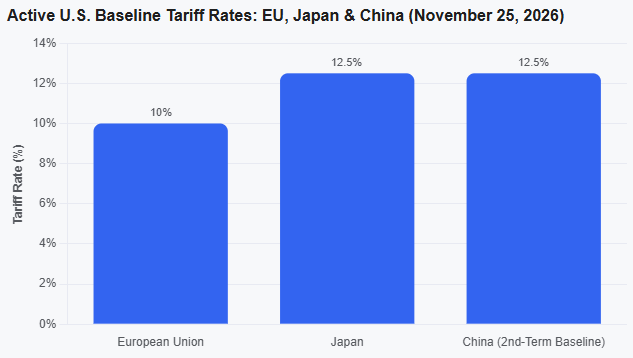
Source: Google
The proposed tariffs could therefore increase costs beyond existing duties, adding pressure on corporate margins and potentially forcing investors to reassess earnings expectations before the full impact reaches consumers.
tariffs of 15% to 25% have been discussed, with different rates for each country
Another round of trade restrictions and retaliatory measures could also be implemented on January 10, 2027, when the current U.S. and China trade truce ends.
Unlike certain emergency trade authorities, Sections 301 and 232 do not provide a general mechanism allowing Congress to cancel tariffs through a simple-majority disapproval vote.
Reversing these measures may therefore require legislation or executive action, potentially extending uncertainty for businesses and investors.
Ahead of new tariffs, importers may accelerate purchases and build inventories to avoid higher duties, this could temporarily support logistics and inventory investment.
Although additional imports also subtract from GDP in national accounting, some firms may simultaneously postpone longer-term investment until trade restrictions and production costs become clearer.
Once tariffs take effect, businesses may reduce purchases, leaving investors to distinguish temporary inventory adjustments from a genuine change in economic activity.
How previous tariffs could explain future inflation pressures
Fed research estimates that tariffs implemented through November 2025 increased core goods PCE prices by 3.1% through March 2026, raising the overall core PCE price level by approximately 0.8%.
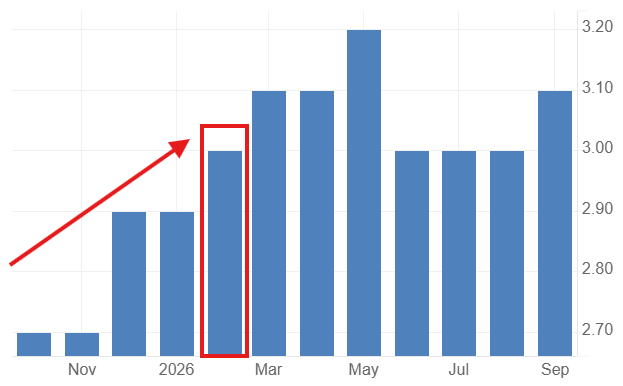
Source: U.S. Bureau of Economic Analysis
Importers have the following three main options to respond to tariffs: absorb the costs, increase prices charged to customers, or modify their supply chains.
Industries particularly impacted by shifts in import costs include automobiles and other means of transportation, electronics, apparel, and construction materials.
Cost pushing inflation could also continue, as companies with more pricing power may be able to increase prices paid by consumers.
Inflationary impact depends on the increase in effective tariffs
Ultimately, the inflationary impact depends on the increase in effective tariffs, which measures the duties actually paid by importers rather than announced tariff rates. How much of that increase reaches consumers depends on businesses' ability to absorb or pass on additional costs.
A five-percentage-point increase in effective tariffs would not translate directly into an equivalent rise in core inflation.
The impact would depend on the proportion of affected imports in household spending, the extent of consumer pass-through and whether domestic producers also increase their prices.
Effective tariffs potentially increase inflation
Financial markets may react immediately to higher import duties, but the full inflationary impact can take months to appear in consumer prices.
New York Fed research suggests that higher import costs feed into consumer prices relatively quickly, with much of the direct impact appearing within six months.
Indirect effects through domestic production and supply chains can take nine to twelve months. Tariffs introduced in early 2027 could therefore continue influencing prices toward the end of the year.
New tariffs, higher prices
Falling crude prices could partially offset tariff-related inflation by reducing energy and transportation costs. However, cheaper oil cannot fully reverse higher prices for imported consumer and industrial goods.
Headline inflation could therefore moderate while core goods prices remain under pressure, complicating expectations for the Fed's interest-rate path.
The risk extends beyond inflation. Higher import costs reduce household purchasing power, while businesses facing weaker demand and narrower margins may cut investment and hiring.
If growth slows while inflation remains elevated, the economy could face increasing stagflation risks without necessarily entering a recession.
Impact of tariff inflation on inflation extend the fed tightening window into mid 2027?
Expectations are 97% probability of a December rate hike, while investors were also pricing the possibility of further tightening in early 2027.
Tariffs can raise inflation without strengthening economic activity, creating a difficult trade-off for the Fed.
Higher interest rates cannot reverse import duties, but they can restrain demand and reduce the risk that higher goods prices spread into wages and services.
However, if inflation remains elevated, the Federal Reserve would be even more unlikely to lower interest rates. Restrictive monetary policy may therefore remain in effect throughout the first half of 2027.
This creates an unwelcome scenario. Should it come to pass that tariffs lead to sustained elevated inflation expectations, the case for expecting lower interest rates may no longer be present, as it has in the past, to bolster equity valuations.
Tariffs and higher interest rates also increase the risk of deeper fall in US markets
Profitability and valuation multiples remain the two broad factors impacting equity markets. Passing costs onto customers may help maintain profitability in the short term.
However weaker consumer purchasing power may decrease sales and increases in interest rates will increase financing costs and the discount rate used to value future earnings.
If expected earnings decline by 10% and the earnings multiple contracts by 10%, the share price would be expected to decline by approximately 19%.
Higher Treasury yields may divert funds away from equities, especially if the yields provide greater return relative to the risks of owning equities.
Imported inflation may be mitigated by a stronger dollar, but at the same time it may reduce the dollar value of foreign earnings.
Technology and other growth-oriented companies may be particularly vulnerable to higher interest rates because a larger share of their valuations depends on earnings expected further into the future.
Higher discount rates reduce the present value of those earnings; potentially amplifying valuation declines even before profitability weakens.
A decline does not necessarily mean a market crash
A more severe decline could develop if falling equity prices force leveraged investors to reduce their exposure.
Margin calls and tighter risk limits may accelerate selling, while widening credit spreads increase financing costs for companies already facing weaker earnings.
The greatest risk to Wall Street is not tariffs or higher interest rates individually, but their interaction when investors are already reassessing corporate earnings and equity valuations.
If tariffs weaken profitability while keeping inflation elevated, the Fed may have limited room to ease monetary policy.
Warsh’s comments and the fed put
Kevin Warsh recently warned that disappointing returns on AI investment could lead to falling equity valuations, slower economic growth and rising unemployment.
The warning also raises questions about the Fed put, the expectation that policymakers will ease monetary policy when financial markets experience significant losses.
That assumption becomes less reliable when inflation remains elevated, as cutting interest rates to support equities could undermine the Fed's efforts to restore price stability.
Disorderly markets, rising unemployment or worsening credit conditions would likely influence the Fed’s policy response.