
 Help
US stock market outlook: Citadel warns of a repeat of the 2018 selloff
Citadel Securities warns that weakening growth expectations and persistent inflation could expose Wall Street to another wave of selling, drawing parallels with the market rout of 2018.

Citadel Securities sees parallels with late 2018, when monetary tightening helped drive the S&P 500 nearly 20% below its peak.
The S&P 500 remains around 7% below its October record despite a rebound following Jensen Huang's return to Nvidia.
Underlying US inflation above 3% limits the Federal Reserve's ability to respond to falling equity prices.
Slowing AI investment, fading fiscal support and tighter financing conditions could flatten the Treasury yield curve and deepen losses across risk assets.
Wall Street's rebound conceals growing economic concerns
The recovery in US stocks on Monday, helped by Jensen Huang's unexpected return to Nvidia, may offer investors temporary relief. But the forces behind the recent market correction bear an uncomfortable resemblance to 2018, when an apparently resilient US economy concealed a deteriorating growth outlook.
The S&P 500 ended a seven-session losing streak on Monday, November 23, after briefly entering correction territory. Despite the rebound, the benchmark remains approximately 7% below its early October record close.
Citadel Securities believes the weakness extends beyond concerns about technology valuations. In a November 20 research note, Frank Flight, the firm's head of macro strategy, highlighted a combination of dollar strength, elevated bond yields and deteriorating cyclical equity performance that closely resembles conditions preceding the late-2018 selloff.
Cyclical stocks are sending a warning about growth
Industrial, materials and energy stocks have struggled over the past three months, suggesting investors are becoming increasingly cautious about future economic activity despite resilient headline growth figures.
The combination of a stronger dollar and elevated borrowing costs is particularly problematic. Higher interest rates increase financing expenses, while dollar appreciation can weaken export competitiveness and reduce the dollar value of overseas earnings for US multinationals.
Geopolitical pressures are reinforcing that vulnerability. In 2018, the US-China trade war threatened business investment and global demand. Today, the conflict with Iran is weighing on growth while sustaining inflationary pressures through higher energy costs.
The danger is that investors mistake current economic resilience for evidence that future growth remains secure.
Why the 2018 stock market selloff matters today
The historical comparison places Federal Reserve Chair Kevin Warsh in a particularly interesting position.
In October 2018, then-Fed Chair Jerome Powell unsettled financial markets by suggesting interest rates remained far from their neutral level. The central bank continued tightening in December despite falling equities and widening corporate credit spreads.
By that point, the S&P 500 had lost nearly 20% from its September peak, prompting billionaire investor Stanley Druckenmiller and Warsh himself to publicly call for a pause in monetary tightening.
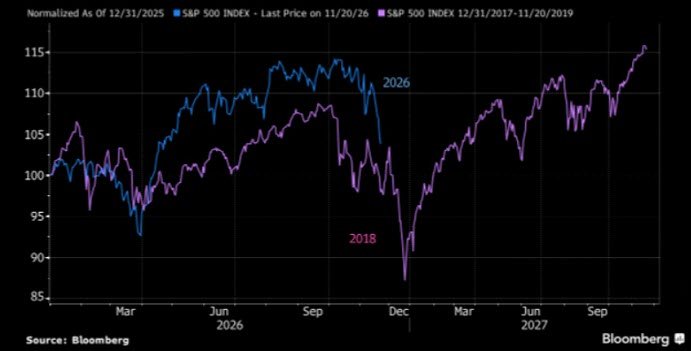
Source: Bloomberg
Eight years later, Warsh is confronting a similar dilemma from the other side of the debate. Since taking charge of the Fed in May, he has overseen the first interest rate increase in three years, delivered in September, as policymakers seek to bring inflation back to 2% more quickly.
Even during last week's market rout, two Fed officials reiterated the need for higher borrowing costs. Traders continue to anticipate another increase in December.
Persistent inflation weakens the Fed put
The critical difference between 2018 and today is the inflation backdrop.
Underlying US inflation remains above 3%, considerably higher than the Fed's 2% objective. That leaves policymakers with less flexibility to respond to deteriorating financial conditions.
The traditional Fed put, the expectation that the central bank will intervene when financial markets experience significant losses, becomes considerably less reliable when inflation remains elevated.
A market correction may help cool demand through weaker household wealth and tighter financing conditions. However, unless those effects translate into lower inflation or material labor-market weakness, the Fed could continue tightening despite falling equities.
Slowing AI investment could expose weaknesses in US growth
Perhaps the greatest vulnerability lies in the growing dependence of the US economy on artificial intelligence investment.
Spending on data centers, semiconductors, computing infrastructure and electricity generation has become an important driver of business investment and economic expansion. Yet the financial conditions supporting that spending are becoming increasingly restrictive.
Citadel Securities identifies three developments that could undermine the investment cycle: fading fiscal support, tighter financing conditions and weakening momentum in AI-related expenditure.
Higher borrowing costs threaten AI infrastructure spending
The economics of data-center development are particularly sensitive to financing costs. Projects require substantial upfront capital, while the revenue needed to justify those investments may take years to materialize.
Higher interest rates raise the minimum return required to make new projects commercially viable. If anticipated AI revenues disappoint at the same time, companies may delay construction, reduce equipment orders or scale back expansion plans.
The consequences would extend beyond technology companies. Semiconductor manufacturers, industrial equipment suppliers, construction businesses and energy infrastructure developers could all face weaker demand.
This is where the current cycle becomes more dangerous. AI investment has helped sustain economic growth despite restrictive monetary policy. A slowdown in that investment could expose weaknesses previously obscured by exceptional technology-sector spending.
Nvidia's leadership-driven rebound may improve market sentiment, but it cannot independently resolve the industry's financing and profitability challenges.
What the Treasury yield curve could reveal about recession risks
Citadel Securities expects renewed market pressure to potentially emerge through a flattening Treasury yield curve alongside further declines in risk assets.
Under this scenario, short-term yields would remain elevated as the Fed continues fighting inflation, while longer-term yields could underperform or decline relative to shorter maturities as investors price in weaker future growth.
A flattening curve would reflect a widening disconnect between current monetary policy and expectations for the economy.
Corporate credit spreads deserve equal attention. If lenders demand greater compensation for financing businesses, particularly highly leveraged AI infrastructure companies, the tightening could spread from equity valuations into corporate investment and employment.
The combination of dollar strength, cyclical stock weakness, widening credit spreads and a flatter yield curve would provide a more convincing warning of deteriorating economic conditions than an equity correction alone.
US stock market outlook: Is the correction already priced in?
The S&P 500's recent losses have raised an important question: has Wall Street already discounted the deterioration in economic prospects?
The experience of 2018 suggests that markets can underestimate how far financial conditions will tighten when the Fed remains committed to raising interest rates. What initially appeared to be a manageable correction eventually developed into a near-20% decline.
Today's challenge is potentially more complicated. Fiscal support is fading, AI investment faces growing scrutiny, and persistent inflation restricts the central bank's ability to respond to market weakness.
The most unfavorable scenario would be a simultaneous deterioration in corporate earnings expectations and equity valuations, as weaker growth reduces anticipated profits while elevated interest rates compress valuation multiples.
That would leave investors facing pressure from both sides of the valuation equation.
The defining risk for Wall Street heading into 2027 is that the economy remains strong enough to justify further Fed tightening, even as its most important source of investment-led growth begins to weaken.


