
 Help
Help 
Why semiconductor stocks are becoming the real test of the AI bubble
The debate over whether artificial intelligence has become a bubble is increasingly being fought through semiconductor stocks rather than software companies. Investors are no longer asking only whether AI will change the economy. They are asking whether the companies building the infrastructure behind that transformation can generate enough earnings to justify the extraordinary valuations created during the rally.
The debate AI has become a bubble is increasingly being fought through semiconductor stocks.
Nvidia’s expected $91 billion revenue run rate, TSMC’s 45% year-over-year July growth.
SanDisk’s roughly 58% decline from its peak.
SK Hynix’s approval of $38.3 billion in capital expenditure through 2031.
The three stocks defining the AI cycle
If investors want to understand how much of the AI boom is supported by real demand, they are increasingly watching Nvidia, TSMC and ASML.
Nvidia captures the surge in demand for AI computing. TSMC manufactures the most advanced chips. ASML supplies the EUV lithography systems that make those chips possible. Together, the three companies sit at the center of the entire AI infrastructure chain.
As long as all three continue reporting strong orders, rising revenue and expanding investment plans, the market has a powerful argument that the AI boom is still being supported by actual spending rather than pure speculation.
That is why semiconductor earnings have become more important than AI headlines. Nvidia’s expected $91 billion revenue run rate, TSMC’s 45% July growth, and continued demand for ASML’s advanced lithography tools suggest that hyperscalers are still building AI infrastructure aggressively.
The more difficult question is not whether enthusiasm disappears overnight. It is whether semiconductor orders can keep rising fast enough to support valuations that already assume years of exceptional growth.

Source: MacroMicro
SanDisk shows where the market is becoming more selective
SanDisk’s roughly 58% decline from its peak is important precisely because it breaks the idea that every company connected to AI infrastructure will rise together.
During the strongest phase of the rally, memory and storage stocks were treated as automatic beneficiaries of expanding data-center investment. Investors assumed that as cloud providers spent hundreds of billions on AI clusters, demand would remain exceptionally strong across the entire memory supply chain.
The recent selloff suggests that assumption is being tested
SanDisk still reported solid revenue growth, yet investors focused on margins, pricing power and the possibility that the most profitable phase of the memory cycle may be starting to normalize. Growing competition from Chinese memory producers has added another layer of uncertainty.
The message is not that AI demand has disappeared. The message is that the market is beginning to distinguish between companies benefiting from scarce, mission-critical technologies and those where future returns are becoming less certain.
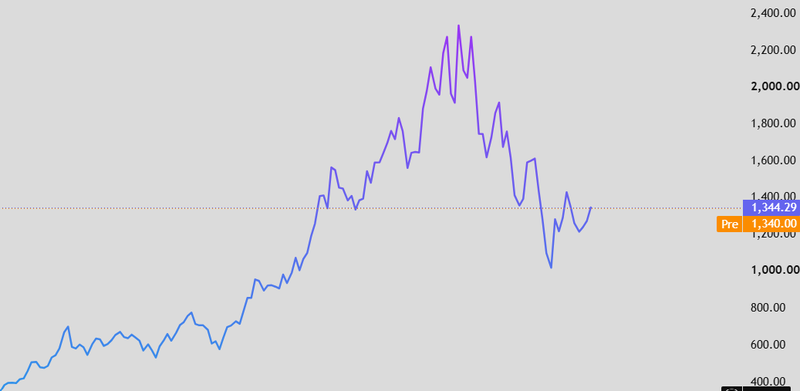
Source: Trading view
SK Hynix is making a long-term bet on AI
SK Hynix’s approval of $38.3 billion in capital expenditure through 2031 points in the opposite direction.
The investment is aimed at expanding advanced DRAM and high-bandwidth memory production, the components that sit next to Nvidia’s AI accelerators and have become some of the most constrained parts of the semiconductor supply chain.
This is what makes the current cycle so unusual. While some investors are questioning whether parts of the AI trade have become overextended, one of the industry’s most important memory suppliers is committing tens of billions of dollars to future capacity.
The announcement reinforces a broader picture: Nvidia is driving compute demand, TSMC is manufacturing advanced chips, ASML is enabling production technology, and SK Hynix is expanding the memory capacity required to keep the entire system running.
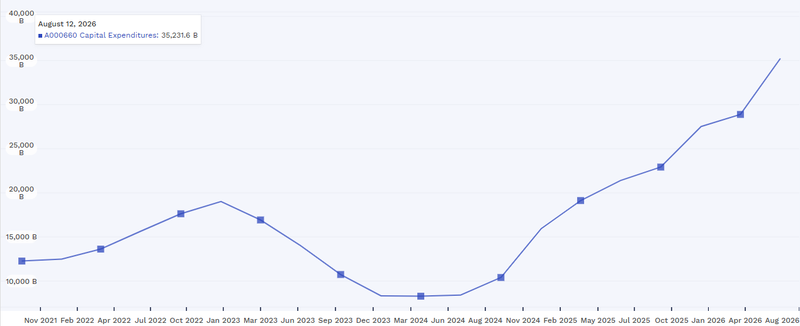
Source: Finbox
The real question is not whether AI is real
The market is moving beyond the simple question of whether artificial intelligence is transformative. The more important question is whether future cash flows can rise quickly enough to justify the scale of spending now taking place across the semiconductor industry.
As long as Nvidia’s demand remains strong, TSMC’s capacity stays tight, ASML’s order book holds up and SK Hynix continues investing aggressively, the AI infrastructure boom retains a powerful earnings foundation.
The first real warning sign would not be a single stock correction. It would be a simultaneous weakening in semiconductor orders, capacity utilization and investment plans across multiple layers of the AI supply chain.
That is why the AI bubble debate is no longer an abstract argument about technology. It has become a live test of whether the semiconductor industry can keep turning unprecedented AI spending into sustained earnings growth.


