Help
Australian dollar falls despite RBA rate hike
The Reserve Bank of Australia has raised interest rates to 4.85%, yet the Australian dollar has depreciated—a divergence driven by a complex domestic economic landscape.

The Reserve Bank of Australia (RBA) increased its cash rate target by 25 basis points to 4.85%, reaching a multi-year high.
Consumer Price Index (CPI) inflation remains elevated at 4.3%, standing significantly above the central bank’s 2% to 3% target range.
The unemployment rate has risen to 4.7%, its highest level since October 2021, highlighting emerging weakness in the labour market.
Gross domestic product (GDP) growth moderated to 0.4%, accompanied by deteriorating business confidence and consumer sentiment.
Date: 4 November 2026 (GMT+3)
Why is the Australian dollar falling despite the RBA's rate hike?
The Reserve Bank of Australia (RBA) decided to increase its cash rate target by 25 basis points to 4.85%, in line with consensus market expectations. The decision was split, with six members voting in favour of a rate increase and three voting to keep policy settings unchanged. Consequently, the benchmark rate has reached its highest level since November 2008, indicating a significant tightening of financial and credit conditions in Australia.
Against this backdrop, the RBA faces a complex economic environment, as inflationary pressures persist due to rising fuel prices linked to ongoing geopolitical tensions in the Middle East. Australia's annual inflation rate reached 4.3% in September, remaining well above the central bank's 2% to 3% target range. Additionally, robust global demand for artificial intelligence products has elevated prices for technology goods and services—components that are assuming greater prominence within global value chains.
However, despite the RBA’s restrictive stance, the Australian dollar depreciated by 0.48% against the US dollar, with the AUD/USD currency pair closing at 0.6963.
Commonly, currencies tend to appreciate when a central bank raises its benchmark interest rate, as higher yields enhance the attractiveness of government bonds to international investors, thereby boosting demand for the domestic currency.
Nevertheless, the Australian dollar weakened following the RBA’s latest policy tightening. This market reaction suggests that institutional investors may be pricing in broader macroeconomic vulnerabilities. Alongside headline inflation remaining elevated above the RBA's target and the cash rate reaching a multi-year peak, the unemployment rate has risen to 4.7%—its highest level since October 2021.
Furthermore, the National Australia Bank (NAB) Business Confidence Index and the Westpac–Melbourne Institute Consumer Sentiment Index have both deteriorated significantly over the past year. Additionally, quarterly gross domestic product (GDP) growth slowed to 0.4% in Q2 2026, breaking an upward trajectory that had peaked at 0.9% in Q4 2025.
This confluence of economic factors appears to be weighing on international investor sentiment as tighter credit conditions place growing strain on Australian businesses and households.
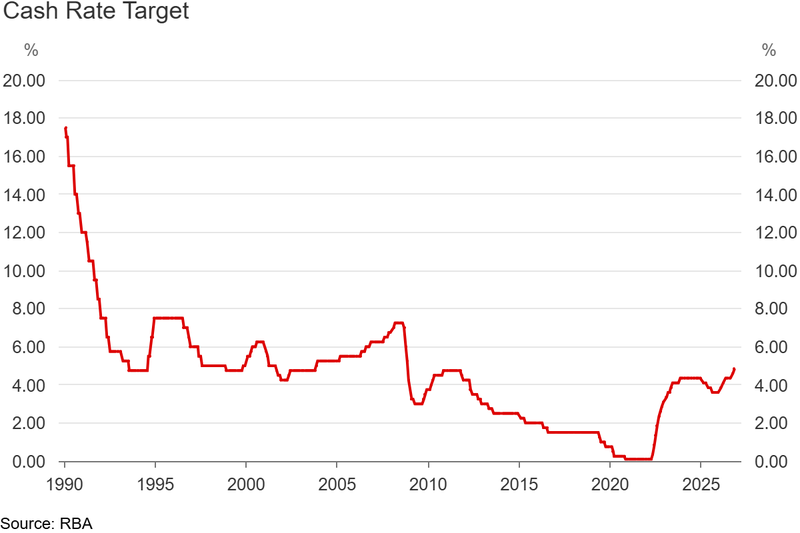
Figure 1. Australia Cash Rate Target (1990–2026). Source: Reserve Bank of Australia (RBA) official portal.
Technical analysis of the AUD/USD pair
From a technical perspective, the AUD/USD pair is trading within a consolidation range, reflecting market indecision. Key technical observations include:
- Trend Context: The AUD/USD pair is oscillating within a consolidation pattern while trading below its 50-day, 100-day, and 200-day Simple Moving Averages (SMAs). This indicates underlying selling pressure, particularly after the price was rejected at the 200-day SMA, which served as technical resistance.
- Momentum Indicators: Both the Moving Average Convergence Divergence (MACD) and the Relative Strength Index (RSI) are hovering near neutral thresholds, reinforcing the presence of market uncertainty evident in recent price action. However, the MACD is approaching a potential bearish crossover, which could signal intensifying downside momentum in the short term.
- Resistance Levels: Should the pair regain bullish momentum, immediate resistance lies at 0.7055, where the 200-day SMA aligns with the Volume Profile's Point of Control (POC). A sustained upside break above this level would direct focus towards the next major resistance at 0.7170, corresponding to the Volume Profile's Value Area High (VAH).
- Support Levels: Conversely, if short-term selling pressure intensifies, immediate support is located at 0.6920 (the Volume Profile's Value Area Low), followed by key structural support at 0.6850.
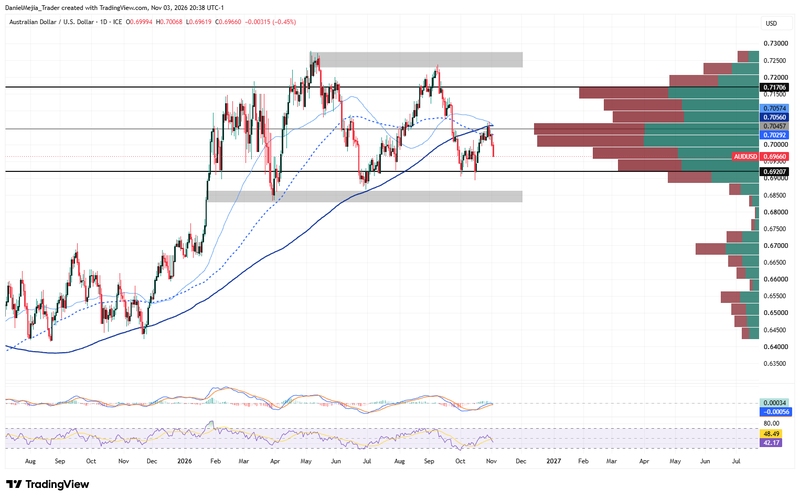
Figure 2. AUD/USD Exchange Rate (2025–2026). Source: Data from the Intercontinental Exchange (ICE); author's analysis conducted via TradingView.