
 Help
Help BoJ raises interest rate to highest level since 1995, yet the yen falls
The Bank of Japan has raised its benchmark interest rate by 25 basis points to 1.25%, reaching a 31-year high. Despite this historic rate hike, the yen weakened against the US dollar as market participants prioritised the Federal Reserve's restrictive monetary stance.

The Bank of Japan implemented a historic rate hike to 1.25% via a split 7–2 vote.
Japanese headline CPI held steady at 1.9%, whilst core inflation decelerated slightly to 1.7%.
The yen fell to ¥156.85 against the US dollar, driven by stronger relative rate expectations from the US Federal Reserve.
Date: 18 September 2026
The Bank of Japan decides to increase its benchmark interest rate to a multi-year high
According to data released by the Ministry of Internal Affairs and Communications of Japan, the Japanese headline inflation rate held steady at 1.9% year-on-year in August, alongside a marginal monthly increase of 0.1%. Simultaneously, the report indicated that core inflation—which excludes the volatile components of energy and unprocessed food—decelerated slightly from 1.8% to 1.7%.
An analysis by Trading Economics notes that prices increased moderately across several categories, including food, transport, housing, household goods, clothing, healthcare, recreation, miscellaneous items, and gas. Conversely, electricity prices declined as a result of government energy subsidies aimed at offsetting elevated energy costs.
Why is the yen falling despite the BoJ's historic rate hike?
Even though Japanese inflation levels remain slightly below target, the Bank of Japan (BoJ) decided, by a 7–2 majority vote, to raise its benchmark interest rate by 25 basis points to 1.25%—its highest level since April 1995. BoJ Governor Kazuo Ueda stated that the central bank has entered a new phase focused on preventing inflation from overshooting its 2% target, as quoted by Reuters. This statement suggests that the BoJ is considering the possibility of further interest rate hikes in future meetings.
Following the economic releases, the Japanese yen depreciated by 0.60% against the US dollar in a highly volatile session, during which the USD/JPY pair closed at ¥156.85. This market reaction suggests that market participants are placing greater weight on the Federal Reserve's restrictive monetary stance than on the BoJ's hawkish posture. Investors appear to view inflationary pressures as more acute in the US than in Japan, anticipating that the US central bank may maintain a more aggressive tightening posture to contain price pressures.
Additionally, analysts expect at least two further interest rate hikes from the Bank of Japan across the 2026–2027 period, potentially bringing the benchmark interest rate to 1.75%, as noted by Reuters and CNBC. However, the BoJ refrained from providing explicit forward guidance, reiterating its commitment to adjust monetary policy as appropriate to stabilise underlying inflation. Notably, Washington has exerted pressure on the BoJ to raise interest rates to mitigate yen depreciation, while seeking to avert the risk that further yen weakness could trigger large-scale Japanese liquidations of US Treasuries and broader financial market instability.
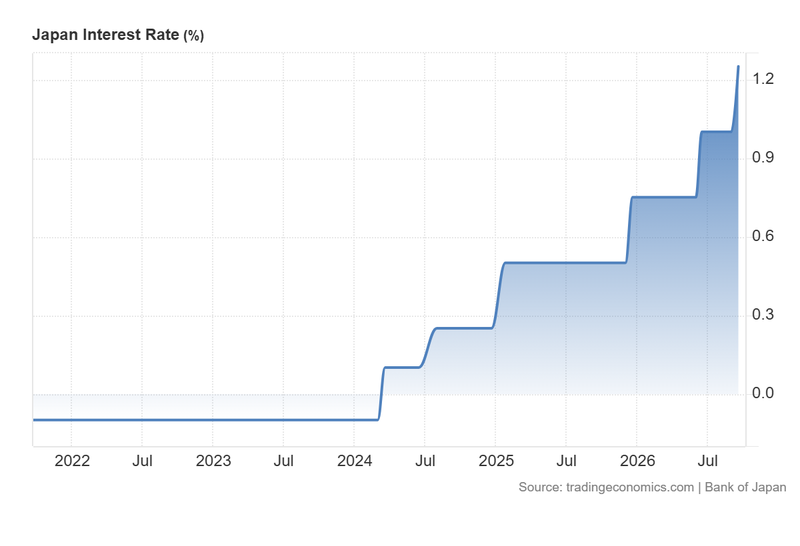
Figure 1. Japan Interest Rate (2021–2026). Source: Data from the Bank of Japan; chart obtained from Trading Economics.
Technical analysis of the USD/JPY pair
From a technical perspective, the USD/JPY pair is currently exhibiting bullish momentum. Key observations include:
- Trend context: Over the longer term, the pair maintains a technically bullish market structure, characterised by higher highs and higher lows. However, following renewed selling pressure, the pair is currently trading below its 50-day, 100-day, and 200-day Simple Moving Averages (SMAs).
- Resistance levels: Should short-term bullish momentum recover, the next significant resistance level lies at ¥158.50, which converges with the 200-day SMA. Beyond this technical zone, key resistance stands near ¥164.00; in this scenario, a breakout above this level could restore long-term bullish momentum.
- Support levels: If a short-term bearish contraction persists, the next critical floor is identified at ¥153.00, situated in a convergence zone between a short-term support level and the 50% Fibonacci retracement of the preceding bullish impulse. A breach of this support zone would significantly increase the likelihood of a deeper market correction.
- Momentum indicators: The Moving Average Convergence Divergence (MACD) and the Relative Strength Index (RSI) exhibit upward trajectories, pointing to potential bullish momentum in the short-term. Notably, the MACD is generating a bullish crossover from low territory, reinforcing the probability of a price recovery. Nevertheless, macroeconomic fundamentals are expected to remain the primary drivers of the pair's future trajectory.
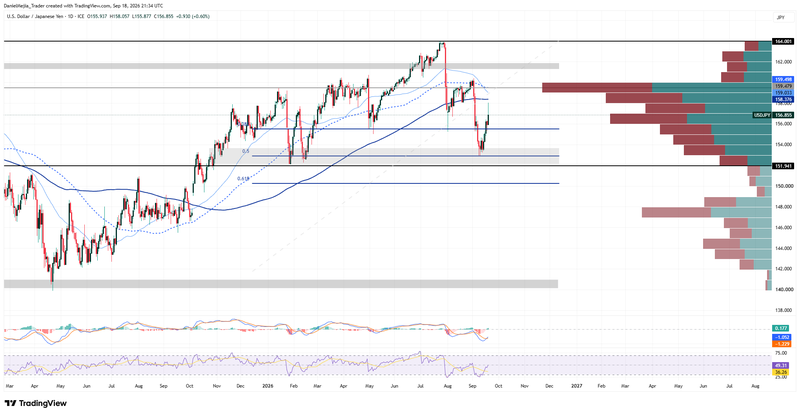
Figure 2. USD/JPY Pair (2025–2026). Source: Data from the Intercontinental Exchange (ICE); author's analysis conducted via TradingView.


