
 Help
Help Brent approaches $80 amid growing hopes of Strait of Hormuz reopening
Brent crude oil approached the $81 mark, touching levels not seen since early March 2026. Prices gained ground as market participants weighed the implementation of a ceasefire agreement between Israel and Hezbollah against the highly anticipated reopening of the critical Strait of Hormuz maritime chokepoint.

Brent crude futures rose 0.90% to settle at $80.57 per barrel, while West Texas Intermediate (WTI) advanced to $76.54, despite optimistic prospects for the potential recovery of vital energy shipping lanes.
While the Israel-Hezbollah ceasefire has bolstered hopes of regional de-escalation, a postponed US-Iran diplomatic meeting keep geopolitical risks elevated.
Brent continues to trade above its 200-day Simple Moving Average (SMA), while the MACD and RSI indicators signal that short-term selling pressure may be starting to weaken.
Brent advances towards $80 as prospects for Strait of Hormuz reopening improve supply outlook
Global crude oil benchmarks advanced marginally, driven by mounting optimism that the Strait of Hormuz—a vital transit corridor for global energy architecture—might soon fully reopen. The Brent crude futures contract (BRNQ6) appreciated by 0.90% to close at $80.57 per barrel. Concurrently, the West Texas Intermediate (WTI) futures contract (CLQ6) gained 0.91% to reach $76.54 per barrel. For both benchmarks, these valuations represent price floors that have not been observed since the beginning of March 2026.
According to reports from Reuters, Israel and Hezbollah formalised a ceasefire in Lebanon on Friday, raising expectations that a broader diplomatic framework across the Middle East might be attainable. However, a high-level meeting between Iranian and US officials in Switzerland was postponed, tempering enthusiasm and casting doubt over the long-term sustainability of a comprehensive Washington-Tehran accord. Furthermore, while a limited number of commercial tankers successfully transited the Strait of Hormuz during the session, Iranian authorities said that all commercial vessels are required to coordinate their passage with the Revolutionary Guards Navy. This requirement suggests that achieving a full normalisation of maritime traffic may remain logistically complex in the near term.
Energy analysts estimate that a significant volume of displaced crude supply could return to global markets upon the definitive reopening of the Strait. Nevertheless, substantial market uncertainty persists, as underlying operational friction and security verification procedures may hinder a smooth transition to baseline shipping volumes.
For the time being, market participants remain heavily focused on the viability of a wider Middle Eastern diplomatic breakthrough. Such an outcome could pave the way for a multi-party framework involving the United States, Iran, Israel, and Hezbollah, ultimately securing safe passage through the region’s maritime corridors. However, conflicting statements from key political actors continue to stoke concerns that a final resolution may not be imminent.
Technical analysis of the Brent futures contract
From a technical perspective, the Brent futures contract is undergoing a volatile period of consolidation, structurally underpinned by recent supply chain disruptions in the Middle East. Key observations include:
- Trend Context: In the short term, the Brent contract has experienced a highly volatile regime over recent months; however, it continues to hold its position above the critical 200-day Simple Moving Average (SMA). While momentum indicators reflect an established downward trajectory, they suggest that the underlying bearish momentum may be starting to decelerate.
- Resistance Levels: Should the bulls successfully reclaim the immediate structural resistance at $82, the next major technical ceiling is identified at the $90 threshold. This level represents a psychological barrier and a pivotal resistance zone within the current market structure. A decisive, sustained close above $90 would signal potential for an extension into higher price territories.
- Support Levels: If the short-term support at $80 fails to hold—a level where the 200-day SMA currently converges—the next major horizontal floor is located at $70 per barrel, representing a prominent psychological and technical support line. A definitive breach of the $70 zone would significantly increase the probability of a broader, deeper market correction.
- Momentum Indicators: Both the Moving Average Convergence Divergence (MACD) and the Relative Strength Index (RSI) exhibit downward profiles. However, because both metrics are rapidly approaching oversold territory, they imply that the prevailing selling pressure may be weakening. Regardless of these technical configurations, fundamental and geopolitical developments are expected to remain the dominant catalysts for the near-term market direction.
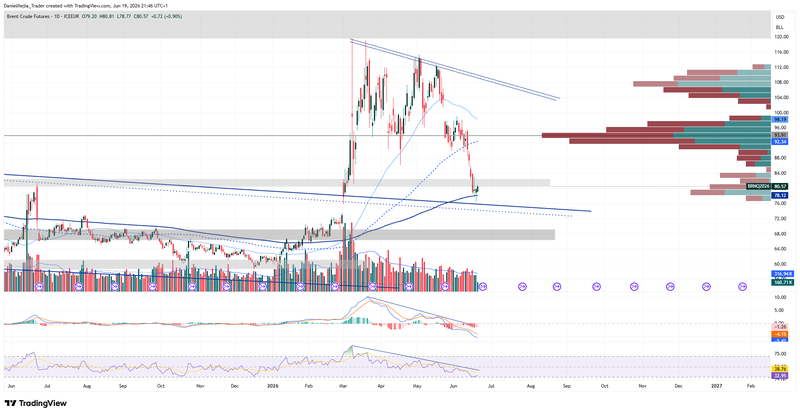
Figure 1. Brent Futures Contract (2025–2026). Source: Data from the ICE-EUR Exchange; own analysis conducted via TradingView.


