
 Help
Help Brent crude rises amid geopolitical instability in the Middle East
Brent crude rebounded as Iranian officials refuted peace deal claims, focusing on controlling the Strait of Hormuz. While long-term trends remain bullish above the 200-day SMA, it is expected that geopolitics will drive future movement.

The Brent crude contract (BRNV6) climbed 4.99% to $87.72 per barrel following reports denying US–Iran diplomatic progress.
Potential disruptions across the Strait of Hormuz and the Bab-el-Mandeb Strait present significant threats to global oil logistics.
Neutral momentum readings across the MACD and RSI highlight prevailing market uncertainty within a highly volatile trading regime.
Date: 10 August 2026
Middle East instability drives Brent crude higher
Crude oil benchmarks advanced amid heightened geopolitical uncertainty across the Middle East, with the Brent futures contract (BRNV6) surging 4.99% to settle at $87.72 per barrel. While US officials indicated that a diplomatic agreement with Iran was approaching completion, Iranian officials denied such progress. Instead, Tehran has focused on securing control over the Strait of Hormuz while pursuing separate diplomatic discussions with Oman, maintaining that the Strait will remain closed until its policy demands are fully satisfied.
In this environment, crude prices have demonstrated a strong correlation with diplomatic announcements—fluctuating rapidly on news of potential conflict resolution or renewed escalation between Washington and Tehran. Beyond the ongoing instability surrounding the Strait of Hormuz, the Bab-el-Mandeb Strait off Yemen has introduced further operational risk. Continued bilateral engagements between Houthi forces and Saudi Arabian military elements sustain high levels of uncertainty across this vital maritime corridor.
The prolonged risk of closure across both the Hormuz and Bab-el-Mandeb straits presents a severe risk of global oil supply chain disruption. Market participants remain focused on the duration of the conflict, as persistent logistical bottlenecks severely impact global economy, most notably in the US and Iran.
Technical analysis of the Brent futures contract
From a technical perspective, the Brent crude futures contract is navigating a highly volatile consolidation phase. A detailed examination of the underlying market architecture reveals several key observations:
- Trend Context: Over recent months, the Brent contract has entered a highly volatile price regime. However, from a structural standpoint, the asset continues to trade above its 200-day Simple Moving Average (SMA), suggesting that a primary bullish bias remains predominant.
- Resistance Levels: Should buyers reclaim immediate structural resistance at $93.00, the next major technical ceiling is identified at $110.00—a level representing a significant psychological and structural barrier.
- Support Levels: If immediate short-term support at $80.00 fails to hold, the next primary floor is located at $68.00 per barrel, representing a long-term structural pivot area. A decisive breakdown below this $68.00 threshold would materially increase the probability of a broader trend correction.
- Momentum Indicators: Both the Moving Average Convergence Divergence (MACD) and the Relative Strength Index (RSI) display neutral readings, underscoring a lack of immediate directional bias. Nevertheless, geopolitical catalysts and supply fundamentals are expected to remain the dominant drivers shaping near-term price action.
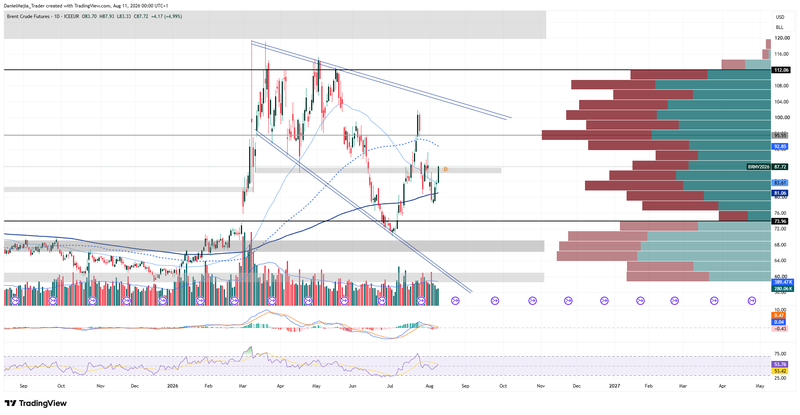
Figure 1. Brent Futures Contract (2025–2026). Source: Data from the ICE-EUR Exchange; own analysis conducted via TradingView.


