Help
Help Brent nears $80 per barrel amid renewed tensions in the Strait of Hormuz
Brent crude closed significantly higher at $78.02 per barrel, following a 5.20% appreciation, as a resurgence in US-Iran hostilities poses a severe threat to global energy flows within the critical Strait of Hormuz transit corridor.

Brent crude futures jumped 5.20% to settle at $78.02 per barrel, driven by renewed geopolitical friction between Washington and Tehran, which has reignited supply disruption anxieties.
Reports indicating potential US military strikes against Iranian infrastructure could create operational risks across the pivotal global maritime oil corridor.
Elevating energy costs threaten to exacerbate inflationary pressures within the United States, thereby complicating the Federal Reserve’s monetary policy path during a fragile geopolitical environment.
Brent price rises sharply as Strait of Hormuz risks resurface
Renewed geopolitical tensions in the Middle East have driven crude oil benchmarks sharply higher, casting doubt on the sustainability of the recent ceasefire between the United States and Iran. At the market close, the Brent crude front-month futures contract (BRNU6) advanced 5.20% to settle at $78.02 per barrel. During the intraday session, the benchmark tested resistance near the $80.50 threshold before retracing slightly to its final closing level.
According to reports from Reuters, US President Donald Trump stated that the interim agreement designed to de-escalate the conflict with Iran was "over" following a series of overnight hostilities involving both nations. Furthermore, international media reports indicated that the United States is preparing further strikes against Iranian targets, aiming to diminish Tehran's capacity to exert military influence over the Strait of Hormuz. These developments have reignited fears among market participants of a wider escalation, increasing the risk of prolonged disruptions to one of the world's most critical energy chokepoints.
Although neither Washington nor Tehran stands to gain economically from a return to open hostility, the latest friction underscores the fundamental fragility of the current diplomatic framework. Escalating crude prices are poised to complicate the Federal Reserve's ongoing efforts to anchor domestic inflation. Concurrently, Iran faces the arduous challenge of stabilizing its domestic economy while navigating stringent international sanctions and deep geopolitical isolation.
Technical analysis of the Brent futures contract
From a technical perspective, the Brent crude futures contract is navigating a volatile period of consolidation. A detailed breakdown of the current market architecture reveals several key observations:
- Trend Context: In the short term, the Brent contract has entered a highly volatile regime over recent months. From a structural standpoint, the contract continues to trade below its primary 50-day, 100-day, and 200-day Simple Moving Averages (SMAs), confirming a dominant downward bias in the medium term.
- Resistance Levels: Should buyers reclaim immediate structural resistance at the psychological $80.00 handle, the next major technical ceiling is identified at the $86.00 mark. This level represents a pivotal supply zone within the current technical framework.
- Support Levels: In the event that immediate short-term support at $71.50 fails to hold, the next significant structural floor is located at $68.00 per barrel. A decisive breakdown below this $68.00 pivot zone would materially increase the probability of a broader market correction.
- Momentum Indicators: Both the Moving Average Convergence Divergence (MACD) and the Relative Strength Index (RSI) are tracking within deeply oversold territory. Notably, the MACD indicator is exhibiting a bullish crossover, signalling nascent positive momentum and a potential price recovery. Furthermore, volume metrics reveal a pronounced increase in buying pressure, accompanied by a significant volume concentration near the $95.00 per barrel zone as mapped by the Volume Profile. While the convergence of these technical indicators points to a potential near-term price recovery, market direction remains fundamentally dependent on geopolitical developments.
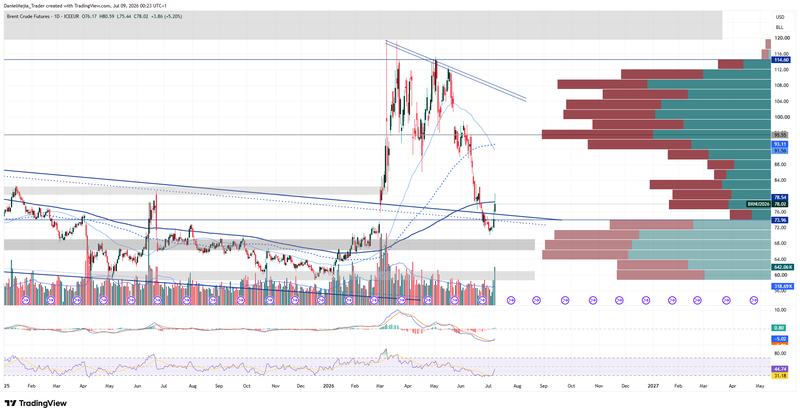
Figure 1. Brent Futures Contract (2025–2026). Source: Data from the ICE-EUR Exchange; own analysis conducted via TradingView.