Help
Crude oil price forecast: rising supply drives oil Down to $79
Oil prices have fallen to three-month lows as recovering production and rising US inventories strengthen expectations of a global supply surplus. Yet the recovery remains uneven, with crude availability improving faster than demand and refined fuel shortages continuing to expose weaknesses in the energy market.

Libya reopened its Sharara pipeline, removing a potential disruption of approximately 350,000 barrels per day.
The IEA reported that oil supply increased by 2.3 million barrels per day in October to reach 105.4 million barrels.
The US, China and Russia pledged to increase refined petroleum supplies.
A decisive close below $79.62 would confirm that the latest support has failed, potentially triggering another wave of selling toward $75.00.
Crude oil supply is recovering faster than demand
Oil markets are falling despite the Strait of Hormuz remain restricted, continuous attacks on energy infrastructure and disruptions at refineries. Traders are turning their attention to the growing supply of crude oil. The Sharara pipeline in Libya has now also reopened adding to the supply of oil to the market.
While one pipeline isn’t going to make a big difference in the global oil market, it is happening as other Middle Eastern exports of oil are increasing.
The IEA reported that oil supply increased by 2.3 million barrels per day in October to reach 105.4 million barrels. Against this, global oil demand is expected to decrease by 2.7 million barrels per day in 2026.
Prices will likely become even more unbalanced next year as the IEA expects oil supply to increase by 6.6 million barrels per day against a meager increase in demand of 2 million barrels per day.
The observed weak demand is also probably not due to a recession. Supply and demand have been disrupted by a lack of fuels available on the market, and therefore high prices. When the supply chain returns to normal there could be a greater demand for oil.
US oil inventories remain below average as supply expectations improve
Commercial crude oil inventories increased by 3.4 million barrels to 417.8 million barrels. Stocks are 3% lower than the five-year average.
Also, drilling in the US increased by 6 active rigs to 469, suggesting US producers are gearing up for greater output.
Evidently the market is expecting higher crude oil inventory levels in the future, despite the fact the current level has not yet reached the previous average. Meanwhile, US inventories of crude oil, gasoline and distillate fuels are increasing.
US, China and Russia pledge additional refined fuel supplies
US, China and Russia announced plans to increase refined fuel production and supplies, during October, Russian refined product exports were 43% less than the previous year, and Chinese refined petroleum product exports declined by 2% during the first ten months of 2026, while jet fuel exports fell by approximately 11%.
Cheaper crude doesn't necessarily benefit end users, European diesel futures traded near $160 per barrel, almost twice their level at the beginning of 2026, despite the decline in crude prices.
Though crude oil prices have decreased since the war, transporting and processing crude oil as well as the refined products, together with storage and distribution capacity, continue to constrain affordable energy and therefore refined products for the end users.
Lower crude oil prices may temporarily alleviate headline inflation; however, elevated prices of refined petroleum products may keep energy related costs high, thereby slowing the improvement in inflation.
Technical outlook
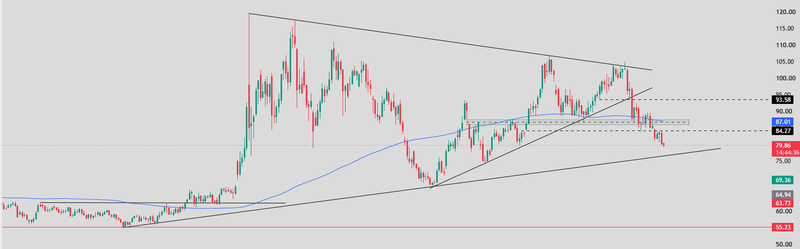
Crude oil has extended its decline toward $79.83 after breaking below the $84.27 support level and failing to recover above the $87–$88 resistance zone. The latest selloff follows repeated rejections near the descending trendline around $103–$104, where buyers have struggled to sustain upward momentum.
The technical structure has weakened considerably, with prices forming lower highs and trading below the declining moving average near $87.01, the breakdown of the ascending trendline has also ended the recovery that began around $69.36, shifting short-term control firmly toward sellers.
Oil is now approaching the broader ascending trendline near $78, which has supported prices since the earlier lows around $55.
A sustained break below this trendline would further weaken the longer-term recovery structure, while $84.27 and the $87–$88 zone remain the main barriers to any meaningful rebound.
Source: Trading view
Scenario ahead
The repeated failure to sustain recoveries, followed by the formation of progressively lower highs, suggests that sellers are becoming more aggressive at increasingly lower prices.
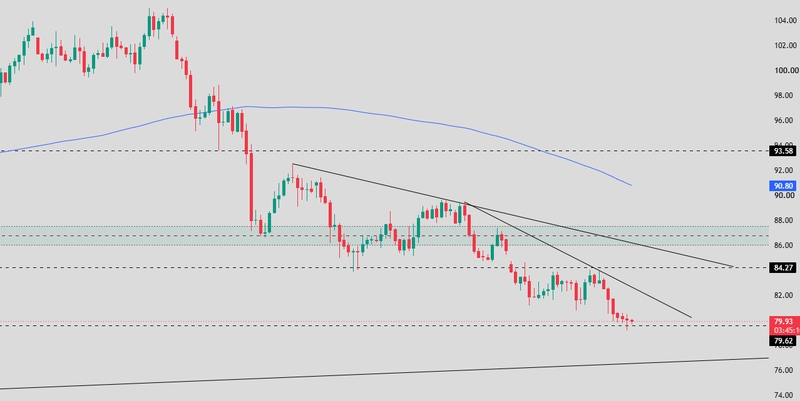
A decisive close below $79.62 would confirm that the latest support has failed, potentially triggering another wave of selling toward $75.00.
If buyers remain absent at this level, the decline could extend toward $70.00, where the broader ascending trendline may provide stronger support.
However, for a recovery to develop, buyers must first defend $79.62 and break above the descending trendline near $80.50–$81.00.
Such a move would interrupt the immediate sequence of lower highs, although it would not reverse the broader downtrend.
A recovery toward $84.27 would then test whether former support has turned into resistance, only a sustained move above this level would strengthen the recovery toward $86.50–$87.00, where previous consolidation and selling activity could limit further gains.
Source: Trading view