Help
DAX holds key technical support as German consumer confidence improves
The German DAX rose by 2.08% to 25,215 points, defending its key 200-day Simple Moving Average (SMA) level as slightly improved consumer confidence, rising business sentiment, and Q3 GDP growth have underpinned support for German equities.

The DAX Index increased by 2.08% to 25,215 points, holding above the critical 200-day SMA support level.
The GfK Consumer Climate Index edged up to –30.2, though consumers continue to cite concerns over elevated energy prices.
The German Ifo Business Climate Index reached 90.6, while Q3 GDP expanded by 1.1% year-on-year.
The DAX's long-term trend remains bullish, with price action trading above the 200-day SMA.
Date: 26 November 2026 (GMT+3)
Is improving German consumer confidence supporting the DAX?
The German DAX equity index rose by 2.08% to 25,215 points, holding above the key 200-day Simple Moving Average (SMA) level. This performance suggests that long-term bullish momentum remains intact.
This underlying resilience on DAX index, followed a modest improvement in German consumer sentiment. According to data released by the GfK Group (GfK), the Consumer Climate Index improved from –30.9 points in November to –30.2 points in December, signalling a slight advance. Nevertheless, the reading came in weaker than expected, missing the market consensus forecast of –29.9.
The GfK report indicated a slight recovery in income expectations (from –15.7 in November to –13.9 in December) and willingness to buy (from –11.9 to –11.5)—as cited by Trading Economics. However, the propensity to save eased from 17.2 to 15.6, while economic expectations turned negative, falling from 2.1 to –1.6 points.
Against this backdrop, while the GfK survey reflects an underlying improvement in consumer sentiment, households remain concerned about elevated energy prices weighing on the cost of living as inflation persists above the European Central Bank's 2% target (with German inflation currently standing at 2.8%, October reading).
Meanwhile, this release coincided with a rise in German business confidence. Earlier this week, the Ifo Institute reported that its Business Climate Index reached 90.6 points—its highest level since May 2023—suggesting that German producers anticipate improving conditions across the broader economic landscape.
Additionally, the German economy has exhibited signs of recovery in recent months, with gross domestic product (GDP) recording a 1.1% annual increase in Q3 2026 (year-on-year change)—marking the strongest reading since Q3 2022.
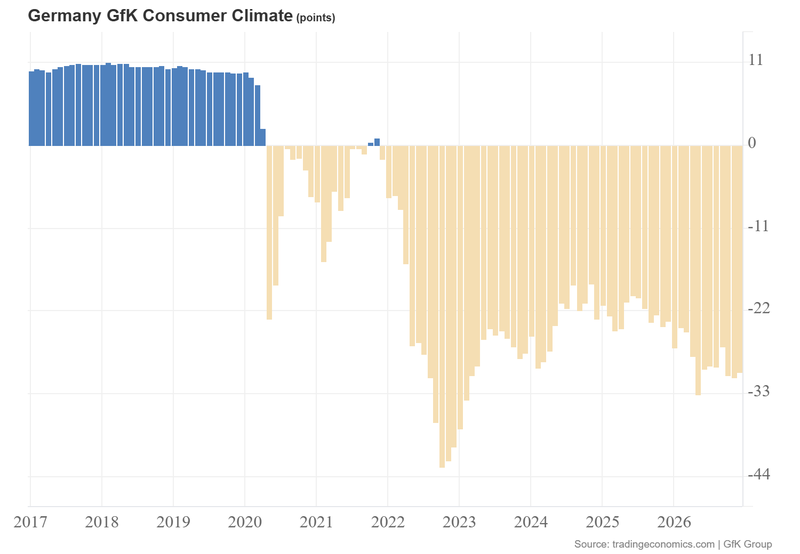
Figure 1. Germany GfK Consumer Climate Index (2016–2026). Source: Data from the GfK Group; chart retrieved via Trading Economics.
Technical analysis of the DAX index
From a technical perspective, the DAX remains within a robust long-term bullish trajectory, although it is currently oscillating within a volatile regime in the short term. The following observations detail the current market structure:
- Trend Context: The index maintains long-term bullish momentum, characterised by a structural sequence of higher highs and higher lows. In this context, price action continues to trade above its 200-day Simple Moving Average (SMA), signalling that the primary upward trend remains intact. However, in the short term, the index has faced significant selling pressure that has pushed it below its 50-day and 100-day SMAs. Notably, the index is testing key support and resistance levels, suggesting heightened uncertainty regarding its next directional move.
- Momentum Indicators: The Moving Average Convergence Divergence (MACD) is exhibiting a downward trajectory, suggesting that bearish momentum could persist in the short term. Meanwhile, the Relative Strength Index (RSI) is hovering near neutral levels, signalling the absence of a predominant short-term directional bias.
- Resistance Levels: Should bullish momentum strengthen, the next significant technical ceiling stands at 25,400—a level where structural resistance converges with a long-term ascending trendline. If this threshold is breached to the upside, the next major resistance lies at 26,000 points, a prominent psychological barrier.
- Support Levels: Should selling pressure intensify, the next structural floor is located at 25,000—a prominent psychological zone that converges with the 200-day SMA. If this zone fails to hold, the next relevant support lies at 24,000, a major psychological barrier reinforced by a High Volume Node (HVN).
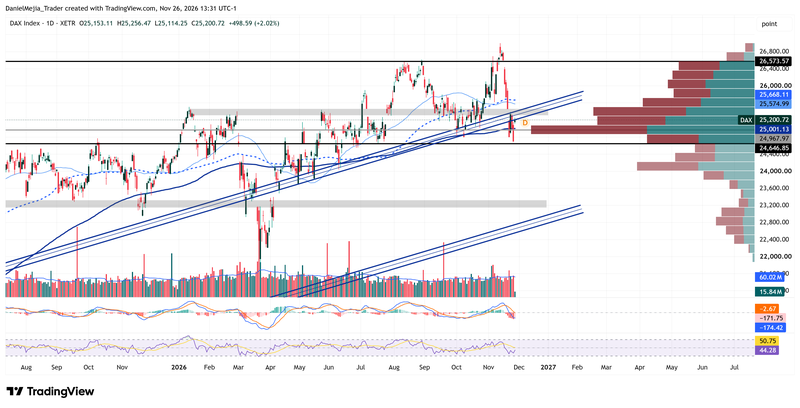
Figure 2. DAX Index (2025–2026). Source: Data from the Xetra Stock Exchange; author's analysis via TradingView.