
 Help
Help Dollar index advances beyond consolidation on rising hawkish Fed outlook
The dollar index broke above a consolidation range and reached its highest level since May 2025, as markets priced in a more hawkish Federal Reserve outlook.
The DXY rose by 0.39% to 101.38, its highest level since May 2025, and is up 5.8% from February’s low.
Markets increasingly expect a hawkish Federal Reserve, with a 50% probability of a 25-basis-point rate hike at the September meeting.
Investors now await the 25 June PCE report, with headline PCE expected at 4.0% and core PCE at 3.4%.
Dollar index breaks consolidation range as markets price in a more hawkish Fed
The US dollar index (DXY)—which compares the US dollar against major currencies such as the euro, British pound, and Japanese yen—appreciated by 0.39% to 101.38 points, a level not seen since May 2025. The index has accumulated a 5.80% gain since its February low, rising from 98.82 to 101.38 points. This strengthening has been driven by rising expectations that the Federal Reserve (Fed) could adopt a more hawkish stance in order to contain inflationary pressures, marking a significant shift from only a few months ago, when market participants had expected a more dovish central bank.
According to data from CME’s FedWatch Tool, implied probabilities show a 50% likelihood of a 25-basis-point increase at the September meeting, the highest probability in the September assessment. In turn, the implied probability that the target rate reaches 4.25% at the December meeting stands at 34%, slightly below the 36% probability that it rises to 4.0%. This shift in market expectations has been reinforced by the latest press conference from Kevin Warsh, the new Federal Reserve Chairman, who announced a restructuring of the institution and emphasised that the central bank remains focused on containing inflation in forthcoming monetary policy decisions.
Market participants are now focused on the PCE Price Index update, which will be published by the US Bureau of Economic Analysis (BEA) on Thursday, 25 June. Analysts expect the PCE Price Index—the Fed’s preferred inflation indicator—to accelerate from 3.8% to 4.0% on an annual basis, alongside an increase in core PCE from 3.3% to 3.4%. In both cases, inflation indicators remain considerably above the Federal Reserve’s 2% target.
Technical analysis of the Dollar index (DXY)
From a technical perspective, the Dollar Index remains positioned within a primary long-term bullish trajectory. Relevant factors are highlighted in the following points:
- Trend context: Over the medium term, the index continues to trade within a descending channel pattern. Nevertheless, the recent rally has propelled the DXY above its 50-day, 100-day, and 200-day Simple Moving Averages (SMAs), suggesting an upward recovery. The index is currently surpassing a key structural resistance zone, indicating potential bullish momentum.
- Resistance levels: To the upside, the 101.80 level represents a significant technical hurdle. A decisive breakout above this threshold would shift the market’s focus towards the 104.0 handle. A sustained move above 104.0 would signal a major transition into a higher and more aggressive trading range.
- Support levels: On the downside, relevant structural support is identified at 100.40. Should this floor be breached, the next critical area of interest would be 99.00, a level that converges with the 200-day SMA. A failure at the 99.00 level would likely facilitate a deeper bearish correction.
- Momentum indicators: Both the Moving Average Convergence Divergence (MACD) and the Relative Strength Index (RSI) are trending upwards, indicating a strengthening of short-term bullish pressure. However, as both indicators approach overbought territory, macroeconomic fundamentals will be pivotal in determining the sustainability of further technical gains.
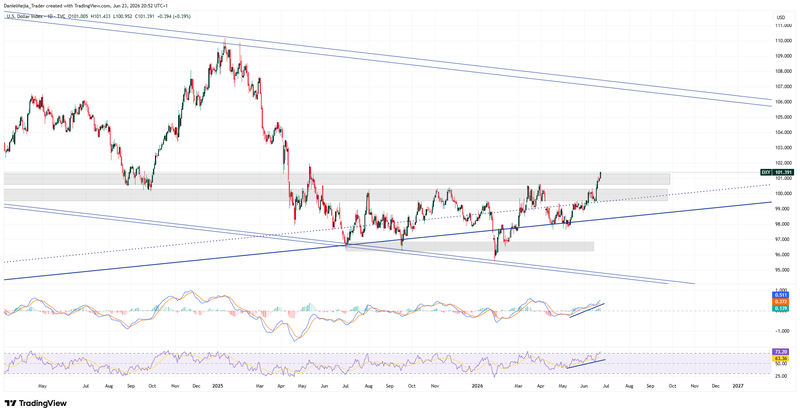
Figure 1. Dollar Index DXY (2024–2026). Source: Data from the Intercontinental Exchange (ICE); own analysis conducted via TradingView.


