Help
Help Euro falls amid a sharp slowdown in Eurozone retail sales
The Euro fell to $1.1613 as Eurozone retail sales growth slowed sharply to 0.6% year-on-year (YoY) in July. Concurrently, heightened expectations of a restrictive monetary policy stance by the US Federal Reserve further reinforced the currency’s depreciation.

Eurozone retail sales contracted by 0.6% month-on-month in July, dampening annual growth to 0.6% YoY amid subdued demand for non-food products and fuel.
Germany’s sharp 3.4% monthly decline led regional weakness, exerting downside pressure on the broader Eurozone economy.
The EUR/USD currency pair continues to reflect market uncertainty, although short-term price action retains a modest bullish impulse.
Date: 4 September 2026
Why are Eurozone retail sales exhibiting weakness?
Eurozone retail sales demonstrated pronounced weakness in the latest data release. According to figures published by Eurostat, retail sales fell by 0.6% month-on-month in July, falling short of consensus estimates of a 0.3% expansion. Consequently, year-on-year (YoY) retail sales growth decelerated sharply from 1.4% in June to 0.6% in July, marking its lowest reading since July 2024. This contraction was primarily attributable to sluggish sales across non-food products and fuel.
From a regional perspective, the contraction in Eurozone retail trade was predominantly driven by a sharp decline in German retail sales, which plummeted by 3.4% month-on-month in July, alongside contractions in Spain (-0.9%) and Italy (-0.3%). This highlights the extent to which structural and macroeconomic headwinds in Germany—the Eurozone’s largest economy—weigh upon the performance of the broader Euro region.
Following the macroeconomic release, the Euro depreciated by 0.10% against the US Dollar, with the EUR/USD pair closing the session at $1.1613. Beyond the underlying weakness in Eurozone retail activity, the US Dollar gained momentum amidst heightened expectations that the Federal Reserve may adopt a more restrictive policy stance at its upcoming meeting, supported by a monthly employment report demonstrating robust underlying momentum.
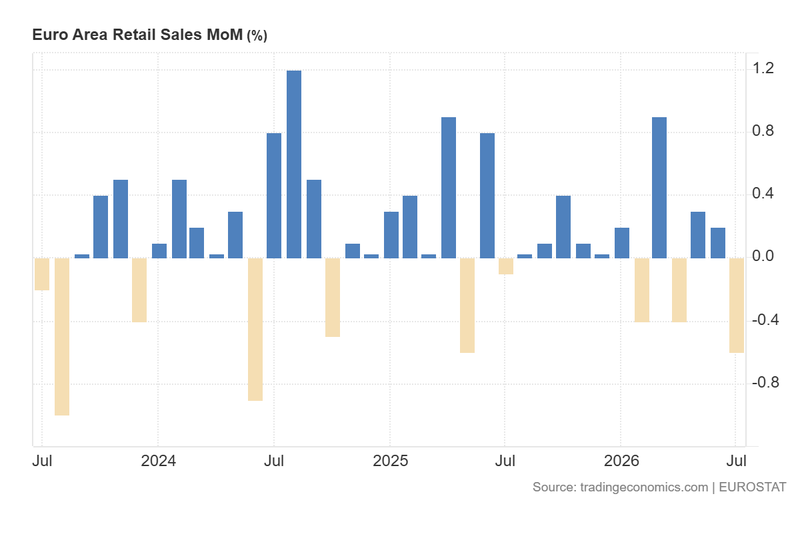
Figure 1. Euro Area Retail Sales (2023–2026). Source: Data from Eurostat; chart obtained via Trading Economics.
Technical analysis of the EUR/USD pair
From a technical perspective, in the long-term the EUR/USD pair continues to reflect market indecision as price action oscillates within a defined consolidation range. Key technical observations include:
- Trend Context (Short-term): In the short term, the pair demonstrates an upward trajectory, trading comfortably above its 200-day Simple Moving Average (SMA). Furthermore, price action is respecting and rebounding off a key support zone, preserving a market structure defined by higher highs and higher lows.
- Resistance Levels: Should the current bullish momentum persist, the immediate technical ceiling is situated at $1.1705—a short-term resistance level. A decisive breakout above this zone would confirm potential for extended upside towards higher valuations, likely the $1.1790 level.
- Support Levels: In the event of a market retracement, two prominent support levels are located at $1.1575 and $1.1550 (aligned with the 200-day SMA zone). A clean breach below these levels would increase the likelihood of a deeper market correction.
- Momentum Indicators: Both the Moving Average Convergence Divergence (MACD) and the Relative Strength Index (RSI) display upward trajectories, reinforcing the potential continuation of short-term bullish momentum. Nevertheless, macroeconomic catalysts are expected to remain the primary drivers of directional price action, particularly the US inflation report scheduled for publication next week.
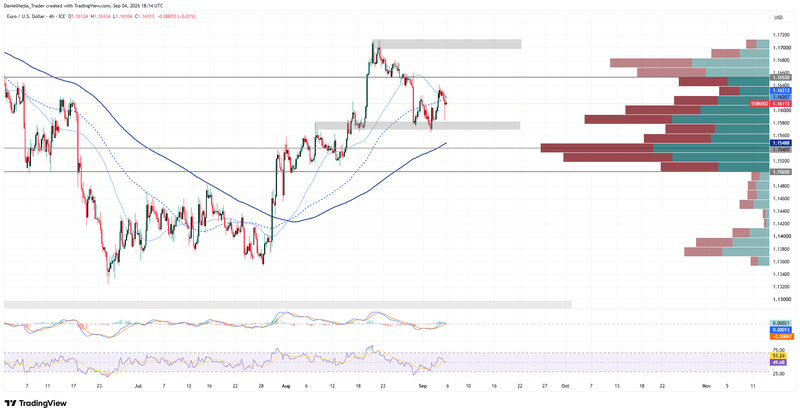
Figure 2. EUR/USD Currency Pair (4-Hour Chart). Source: Data from the Intercontinental Exchange (ICE); author’s analysis conducted via TradingView.