Help
Help EUR/USD technical outlook: can 1.1190–1.1200 hold?
France is entering 2027 with a record €340 billion bond issuance requirement, public debt projected at 121.7% of GDP and a minority government trying to deliver a politically difficult fiscal adjustment. The problem for markets is no longer simply whether France has too much debt, it is whether the government has the political capacity to stabilise it.

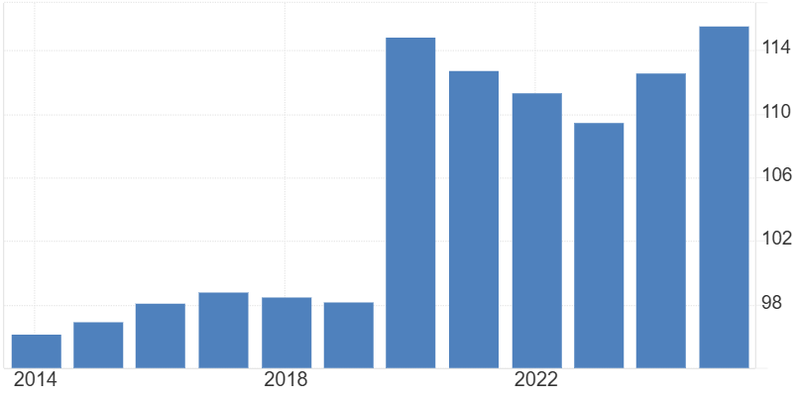
Public debt projected at 121.7% of GDP and €340 billion of medium- and long-term debt must be issued next year.
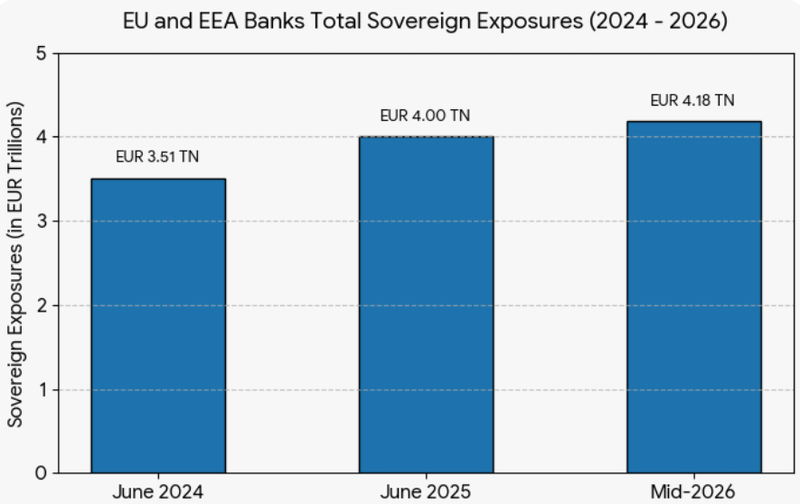
EBA data show EU and EEA banks held around €4.18 trillion of sovereign exposures.
The question is whether 1.1190–1.1200 can hold.
The sovereign-bank link is the next risk
France is approaching the bond market with very little room for execution risk. The government wants to reduce the deficit from 5.4% of GDP in 2026 to 5% in 2027, while interest costs are projected to rise from €79.2 billion to €91.2 billion.
At the same time, public debt projected at 121.7% of GDP and €340 billion of medium- and long-term debt must be issued next year, around 10% more than in 2026. If investors begin to demand a larger risk premium, higher yields do not simply increase the government's future borrowing cost, they make the fiscal adjustment itself harder to achieve.
Source: INSEE, France
This is where fiscal stress can become a financial stability problem
European banks hold large sovereign portfolios, partly because government bonds are important liquid assets and collateral. EBA data show EU and EEA banks held around €4.18 trillion of sovereign exposures at the end of 2025, equivalent to roughly 232% of CET1 capital. Around 45% of those exposures were still concentrated in domestic sovereigns. Rising yields therefore create valuation pressure across bank balance sheets, particularly where portfolios are marked to market or where losses become crystallised through sales or collateral needs.
Source: EBA
The market is already beginning to price that connection
STOXX Europe Banks index fell 3.5%, while Société Générale, Deutsche Bank and UniCredit all lost more than 4%. Reuters reported that investors were concerned about losses on sovereign holdings and the possibility of contagion from France into the wider euro area. The important point is not that French fiscal stress immediately threatens bank solvency, it is that a sustained repricing of sovereign risk can weaken bank capital, market confidence and funding conditions at the same time.
Collateral can turn a bond selloff into a liquidity problem
The funding channel is more subtle. Government bonds are widely used as high-quality collateral in secured funding markets, but their value and liquidity matter. When yields rise sharply, the market value of collateral falls.
If lenders respond to greater volatility or credit risk by applying larger cuts, banks need to pledge more assets to obtain the same amount of funding. That can tighten liquidity even before a bank faces an actual cash shortage. The ECB itself uses collateral haircuts to control the amount that can be borrowed against eligible assets, illustrating why collateral valuation matters for financial conditions.
France is becoming the test for European fiscal credibility
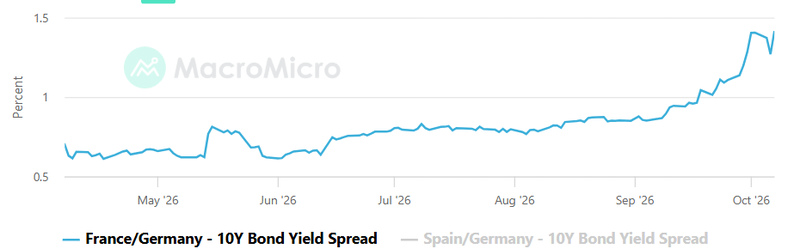
The larger risk is contagion through pricing rather than direct exposure. If investors conclude that France cannot deliver the fiscal consolidation embedded in its budget, the French German spread can widen further and encourage investors to reassess other heavily indebted sovereigns. That raises borrowing costs across the region, pressures banks holding those bonds and makes credit more expensive for households and companies.
France maybe does not move immediately into a systemic banking crisis. European banks enter this episode with stronger capital and liquidity buffers than during the sovereign crisis era. But the combination of record issuance, rising debt-service costs and political resistance means the tolerance for fiscal disappointment is falling.
The key market signal is therefore no longer the French deficit alone, it is whether higher sovereign yields begin feeding into bank funding spreads, credit conditions and broader European risk premiums. If that transmission accelerates, France's fiscal problem stops being a question of government finances and becomes a question of how much financial tightening the euro area can absorb.
Source: MacroMicro
Technical outlook
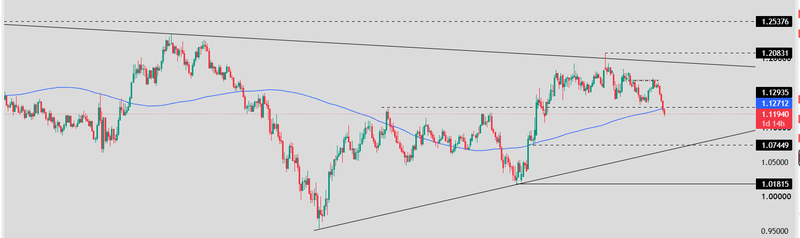
EUR/USD is approaching an important technical test around 1.1194 after losing the bullish momentum that carried the pair higher earlier in the year. The recovery failed to break the major descending trendline, leaving the broader structure vulnerable again. Price is now trading below the 1.1270–1.1290 area, which has become the first barrier for any attempt to stabilise.
EUR/USD was rejected near 1.2083 and has since formed a series of lower highs beneath the long-term descending trendline. The rebound into the 1.19–1.20 region initially looked capable of challenging that structure, but buyers again failed to break through. The subsequent loss of 1.1472 and the failure to regain the 1.16–1.17 area shifted momentum back toward the sellers.
The question is whether 1.1190–1.1200 can hold
A sustained move below this zone would put the rising trendline around 1.1070–1.1100 in focus. That is the more important support for the medium-term structure. If buyers defend it, the current decline could still prove to be a correction within a broader recovery. If it breaks decisively, the technical picture becomes much more bearish.
Below 1.1070–1.1100, attention would turn to 1.07449
This is the level that could determine whether EUR/USD is undergoing a deeper correction or a genuine structural reversal. A break below 1.07449 would open the way toward 1.05, with 1.01815 becoming a longer-term downside reference if selling pressure continues.
The bullish case starts with a move back above 1.12935. That would be the first indication that sellers are losing control, but it would not yet change the broader structure. The more meaningful recovery would come above 1.1470–1.1500. Reclaiming that zone would suggest that the latest decline is becoming a correction rather than the beginning of another major bearish leg.
Above 1.15, EUR/USD could recover toward 1.17–1.18 before facing the longer-term descending trendline again. A break above that trendline would bring 1.20 and the previous high around 1.2083 back into play. A sustained break above 1.2083 would be the real structural shift, it would invalidate the current sequence of lower highs and reopen the path toward 1.25376.
Source: Trading view