Help
Gold price forecast: ETF inflows, central bank buying and key support levels
Gold is facing pressure from higher US yields and a stronger dollar, but demand beneath the market has not disappeared. ETF inflows are returning, Poland continues to build its reserves, and Singapore is investing in the infrastructure needed to store, clear and trade physical gold during Asian hours.

Gold ETFs attracted $2.7 billion in October, their fourth consecutive month of inflows.
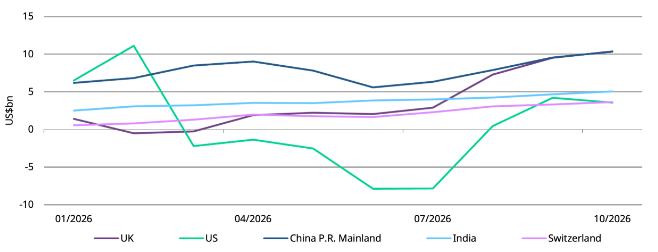
The UK and China were the largest sources of country-level ETF demand in the first ten months of 2026.
Poland remained one of the world’s largest central-bank buyers after leading purchases in 2025.
Singapore is building a physical gold market around sovereign custody, tax incentives, clearing and deliverable futures.
ETF investors continued buying despite lower gold prices
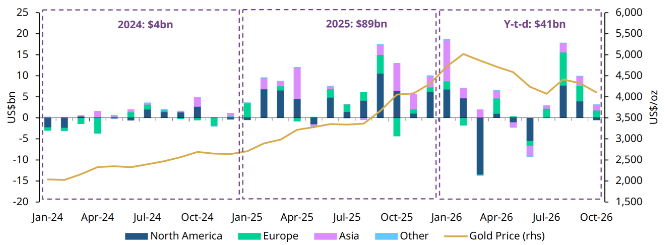
During October, physically backed gold ETFs attracted $2.7 billion. This added 19 tonnes to total holdings at 4,275 tonnes. Total assets under management fell 6% to $542 billion, as lower gold prices outweighed the inflows.
The gap says more than the inflow figure. Investors were adding exposure even though the value of their holdings were falling. This indicates that momentum buying was not the only, if any, factor, that drove demand in October.
Source: World gold council
The reasons differed by region
U.K.-listed funds benefitted from the perceived risks of high government borrowing costs, constrained fiscal space and stress in the gilt market. Chinese demand was derived from depressed equities and lower domestic bond yields.
During the first ten months of 2026, gold ETFs recorded inflows of $41 billion. The U.K. and China led the pack at the country level. Europe and Asia captured the remainder of the global inflows.
North American funds saw outflows in October, which made gold vulnerable to changes in U.S. interest rate expectations.
Source: World gold council
Poland is treating gold as reserve policy, not a short-term trade
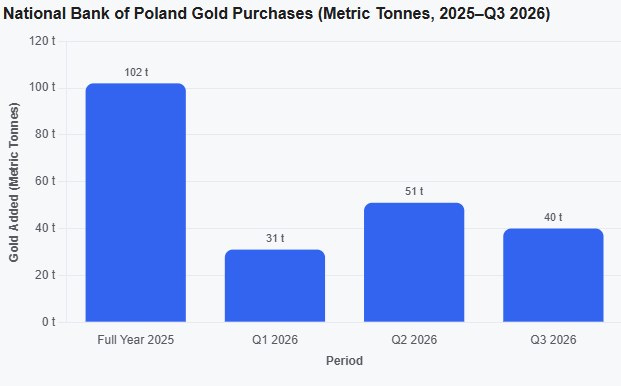
For a second year in a row the National Bank of Poland was the world’s largest reported central bank gold buyer, having added 102 tonnes in 2025. Central bank gold purchases continued in 2026. In the first quarter, Poland added 31 tonnes, followed by 51 tonnes in the second, and 40 tonnes in the third.
Polland's central bank has communicated its intent to build up its gold reserves to make up 7% of its foreign exchange reserves. Buying has continued at varying market prices. This reduces the significance of any one market level and indicates.
Poland is aiming to increase the share of an asset that carries no credit risk from foreign governments and is not exposed to the financial system of other countries. Poland has reached its 700-tonne goal, but, per Governor Adam Glapiński, this is not a constraint on future purchases. Poland may buy less but has established a new central bank demand in the market.
Source: Google
Singapore is building the market around the metal
The Monetary Authority of Singapore has launched an allocated custody service for foreign central banks, sovereign institutions and international financial organizations. Gold will be stored in the national currency vault, which has capacity for up to 500 tonnes.
Singapore will also extend tax relief to wholesale activities including storage, refining, assaying and broking.
An over-the-counter clearing system is expected to begin operating in the first quarter of 2027, followed by physically deliverable kilobar futures in the second quarter.
Together, these measures could keep more Asian gold trading, settlement and custody within the region. Central banks would gain another sovereign storage option, while banks and institutions could clear transactions and manage price risk during Asian hours without relying as heavily on London or New York.
ETF inflows can reverse and central-bank purchases will not prevent short-term declines when yields and the dollar rise.
But the market beneath the price is changing investors are returning, official buyers are holding more metal, and Asia is building the infrastructure to trade it on its own terms.
Technical outlook
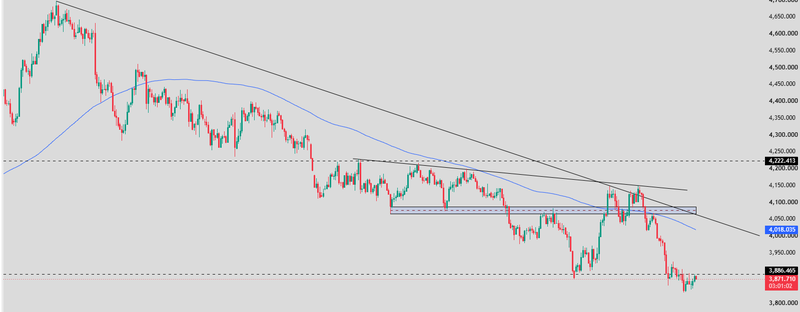
Gold is down at $3,872 after breaking below the key $3,886 support level. It's still under pressure having failed to make any recovery towards $4,140 where the descending trendline attracted fresh selling.
The break below $3,886 has knocked over the prior support and the very modest recovery from around $3,830 has yet to generate any real buying. $3,886 is now the first significant hurdle for any recovery.
If gold is unable to take back $3,886 and selling pressure reasserts itself then a sustained break below the recent low at $3,830 could see the price accelerate lower towards the psychological $3,800.
A decisive move below $3,800 would confirm the bearish trend and leave space for further downside towards $3,700.
However, if buyers can push gold back above $3,886 and hold that as support a technical bounce could develop up to $3,950 and then towards the declining moving average at $4,018.
For that to be any kind of strong bullish confirmation though a sustained move above the $4,065/$4,085 resistance area would be required.
The bias is still very much bearish, and gold is trading below $3,886. The recent rally does appear to be buyers attempting to hold the $3,830 level but the bigger picture of lower highs and continued trading below the MA has sellers in complete control.
Source: Trading view