
 Help
Help 
Gold regains support as ETF demand returns and Fed hike bets ease
Gold is finding support again after a difficult stretch in which rising Treasury yields and a stronger dollar pressured the market. What is changing is not a single headline, but the combination of improving investment demand, continued central-bank buying and a modest easing in U.S. inflation expectations.

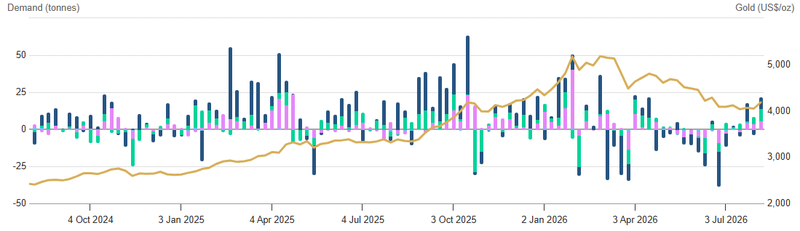
Global gold ETFs attracted $3 billion in inflows during July, reversing two consecutive months of outflows.
The Bank of China added 20 metric tons of gold in July, its largest monthly purchase since October 2023.
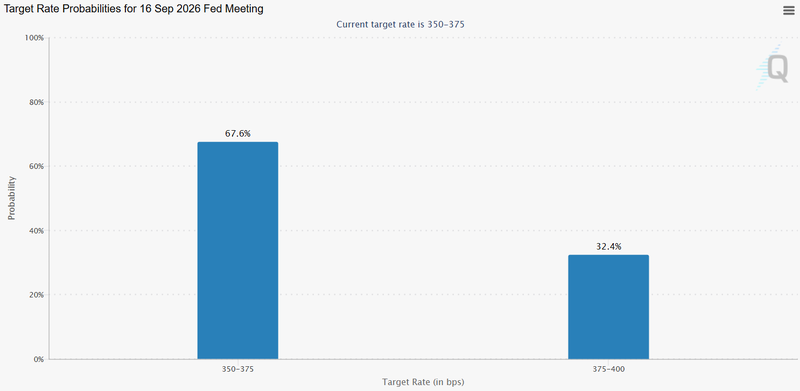
U.S. CPI slowed to 3.4% from 3.5%, reducing the probability of another Fed rate hike from 49% to 38%.
The market is no longer relying on one source of demand
The most important change may be that gold is being supported by two very different types of buyers. ETF investors returned after two months of withdrawals, with European funds accounting for most of the $3 billion in July inflows. On the surface, that may look like a modest number compared with the size of global equity markets. In practice, it is a meaningful shift in positioning.
During the first half of the year, investors were comfortable concentrating exposure in technology and other risk assets as expectations for lower interest rates and stronger AI-related growth dominated market sentiment. The return of ETF buying suggests some investors are beginning to rebalance portfolios rather than continue increasing risk exposure indefinitely.
ETF flows matter because they often reflect changes in asset allocation by institutional investors, wealth managers and multi-asset funds. A sustained move from outflows to inflows can become self-reinforcing, especially if it coincides with stabilizing yields and a softer dollar.
Source: World Gold Council
China is sending a stronger signal
The second source of support is arguably more important. The Bank of China’s 20-ton purchase extended its buying streak to 21 consecutive months and marked its largest monthly addition since October 2023. This is not the behavior of a trader responding to short-term price fluctuations.
Central-bank gold buying has become one of the strongest structural pillars of the market over the past several years. Countries that continue to accumulate gold are generally seeking greater diversification away from dollar-denominated reserve assets and a larger share of reserves that is not directly tied to another country’s financial system.
China’s purchase is particularly significant because it came at a time when gold prices were already elevated. Buying aggressively near higher price levels suggests that reserve diversification remains a strategic objective rather than a tactical opportunity.
This distinction matters. ETF demand can change quickly when market sentiment shifts. Central-bank demand tends to persist through periods of volatility and can provide a more durable floor for the market.
Softer inflation is helping gold breathe again
CPI data did not dramatically alter the inflation outlook. Headline inflation eased only slightly, from 3.5% to 3.4%.
Yet markets reacted because the number arrived after several weeks of concern that higher energy prices and geopolitical risks could keep inflation sticky. The softer reading helped push the implied probability of another Fed rate hike down from 49% to 32%.
Gold is highly sensitive to expectations for real interest rates rather than inflation alone
If investors believe inflation is falling while the Fed keeps rates high, real yields rise and gold usually struggles. If investors become less convinced that further tightening is coming, yields often stabilize or decline, reducing the opportunity cost of holding a non-yielding asset such as gold.
Source: CME Group
latest inflation number is not a victory over inflation
Oil prices have stabilized rather than collapsed, and geopolitical risks involving Iran and the Strait of Hormuz have not disappeared. Higher energy costs tend to feed through transportation, manufacturing and logistics before eventually influencing a broader range of consumer prices.
That is why markets are not treating the latest CPI report as the beginning of an aggressive Federal Reserve easing cycle. A renewed rise in crude prices could quickly lift inflation expectations again and reverse part of the recent decline in rate-hike probabilities.
For gold, the relationship is more complicated than it first appears. Rising oil prices can support the metal by increasing inflation concerns and strengthening demand for safe-haven assets during periods of geopolitical uncertainty. At the same time, if higher energy costs convince investors that inflation will remain sticky, Treasury yields could stay elevated and offset some of gold’s support. Lower yields would help gold more directly by reducing the opportunity cost of holding a non-yielding asset, while stronger risk appetite across equities could limit defensive demand.
In other words, gold is no longer responding to a single dominant driver. It is shaped by the interaction between energy prices, inflation expectations, Federal Reserve policy and geopolitical risk, and the balance between those forces is likely to determine the next meaningful move in the market.
Technical outlook
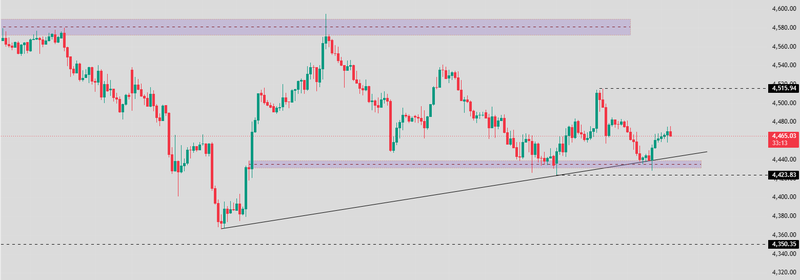
After spending several weeks trading below a descending trendline, the metal has broken higher and reclaimed the 4,303 and 4,381 levels, both of which had previously acted as resistance. What makes the move more interesting is the backdrop: oil prices have weakened and geopolitical tensions have eased following reports of a U.S.-Iran peace agreement. Normally, that combination would be expected to reduce support for gold.
The fact that gold has strengthened anyway suggests the market is being driven by something other than geopolitical fear. Softer real yields, easing inflation expectations and position rebuilding after a prolonged correction appear to be playing a larger role.
The break above the short-term descending trendline is the first constructive signal. The push toward the 4,390–4,400 area shows that buyers are beginning to test a more significant resistance zone.
The broader trend, however, has not fully turned higher. Gold is still trading below the 126 period moving average near 4,512 and remains under the larger descending trendline that extends from the 5,600 peak. In other words, the short-term structure has improved, but a medium-term reversal has not yet been confirmed.
The immediate resistance remains 4,390–4,400, followed by 4,512 and then 4,890, which is the major upside barrier from the earlier breakdown. On the downside, 4,381 is the first support, while 4,303 is the most important breakout level. As long as gold holds above 4,303, the recent rebound remains technically valid.
For now, the move looks more like a strong rebound within a still-corrective medium-term structure. A sustained break above 4,400 would strengthen the bullish case, while a recovery above 4,512 would be needed to suggest that a broader trend reversal is beginning to take shape.
Source: Trading view


