
 Help
Help Netflix shares decline in after-hours trading following mixed Q2 results
Netflix shares fell sharply in after-hours trading after mixed Q2 results, as a revenue miss and slowing growth outweighed a modest EPS beat, raising concerns about momentum.

Netflix reported $12.56 billion revenue, slightly below the $12.58 billion consensus forecast.
EPS reached $0.80, beating expectations of $0.79 and growing 11.11% year-on-year.
Shares fell 8.38% in post-market trading as investors focused on slowing growth and weaker momentum.
Netflix is down 44% from its June 2025 peak, with key technical support located near $67.
Date: 16 July 2026
Netflix falls in post-market trading as mixed Q2 earnings weigh on sentiment
Netflix Inc. declined in post-market trading after releasing a mixed set of quarterly earnings results. The streaming giant exceeded expectations on earnings per share (EPS), but fell slightly short of revenue forecasts. Netflix reported total revenue of $12.56 billion, marginally below the market consensus estimate of $12.58 billion. Meanwhile, EPS reached $0.80, slightly above analysts’ expectations of $0.79.
These results imply year-on-year revenue growth of 13.3% and EPS growth of 11.11%. However, the pace of revenue expansion continued to moderate, falling below the company’s historical average of approximately 16% and also below the average recorded over the previous three quarters, when growth had been closer to 20%. This deceleration suggests that, while Netflix continues to expand, investors may be increasingly focused on whether the company can sustain stronger growth rates in the coming quarters.
According to CNBC, Netflix reported healthy engagement metrics, with live events standing out as one of the most relevant drivers of user activity. Total viewing reached around 97 billion hours during the first half of 2026. In addition, revenue growth was supported by membership gains, pricing adjustments and stronger advertising revenue, reflecting the company’s ongoing efforts to diversify its monetisation strategy beyond traditional subscriptions.
Nevertheless, despite stable operating metrics, investors reacted negatively to the report. Netflix shares fell 8.38% in post-market trading to $68.12, indicating that the market was not fully satisfied with the company’s revenue performance and slowing growth momentum. The stock now accumulates a drawdown of approximately 44% from its June 2025 high, when it reached $134. Current price level is $74.35 (at market close). From a technical perspective, Netflix shares are approaching a key structural support zone near $67, a level that could prove decisive for short-term price action if selling pressure persists.
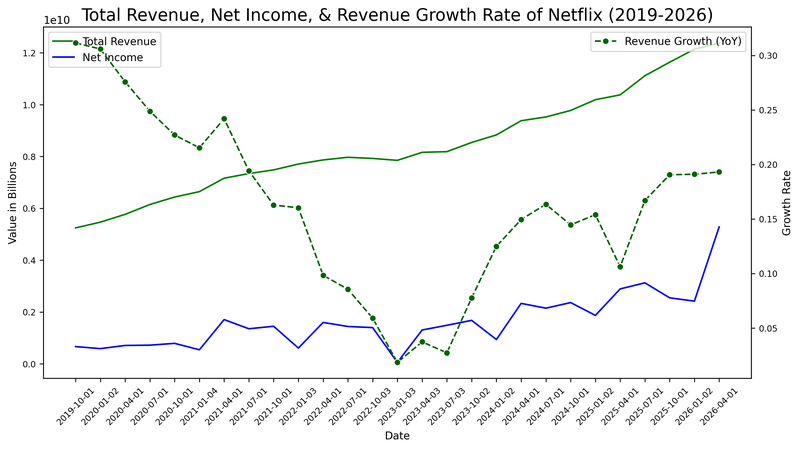
Figure 1. Netflix’s Revenue, Net Income, And Revenue Growth Rate (2019–2026). Source: Own analysis using data from the Nasdaq Exchange.
Technical analysis of Netflix’s share price
Regarding the technical outlook, Netflix’s share price has lost its primary bullish trend. Key observations include:
- Trend context: In the long term, Netflix Inc. has lost its bullish structure of higher highs and higher lows. The share price is currently trading well below its 50-day, 100-day and 200-day moving averages, reinforcing the prevailing downward momentum and signalling a deterioration in the broader technical structure.
- Resistance levels: If the $67 structural support level is respected and the share price rebounds to the upside, the next prominent technical resistance area is located near $76, followed by a second structural resistance around $83. A decisive breakout above these levels would suggest an extension into higher territory and could support a partial recovery in market sentiment.
- Support levels: If the $67 support level is broken to the downside, the next relevant support zones are located at $60 and $43, respectively. A failure to hold these levels would increase the probability of a more pronounced market correction, particularly if selling pressure continues to accelerate.
- Momentum indicators: Both the MACD (Moving Average Convergence Divergence) and the RSI (Relative Strength Index) are showing signs of improvement, suggesting that bearish momentum may be moderating. However, Netflix’s price action continues to reflect significant selling pressure. Therefore, any potential recovery remains conditional on the stock’s ability to hold key support levels and attract renewed buying interest.
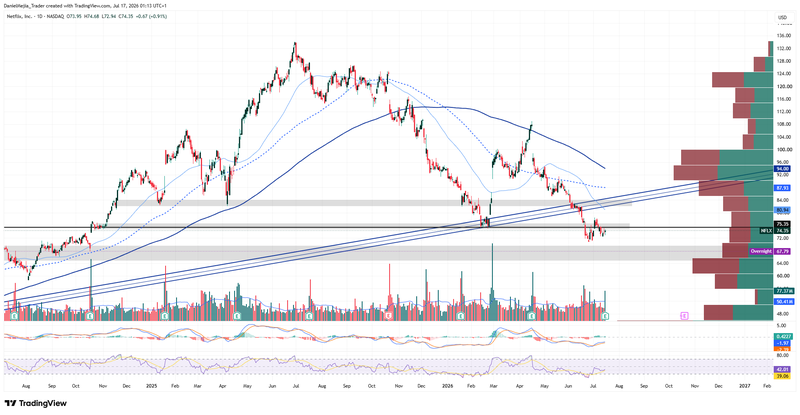
Figure 2. Netflix’s share price (2025–2026). Source: Data from the Nasdaq Exchange; own analysis conducted via TradingView.


