
 Help
Help Nikkei slides on AI valuation concerns and prospects of yen intervention
The Nikkei 225 index dropped 4.15% to close at 69,360 points as investors questioned stretched artificial intelligence (AI)-linked valuations and initiated profit-taking following recent market gains.

The Nikkei 225 dropped 4.15% to 69,360 as market participants grew increasingly cautious over overextended AI-related multiples.
Intense profit-taking followed solid technology earnings, with global markets actively reassessing whether AI-driven equity gains could remain sustainable in the long term.
Extended yen weakness near the ¥161.73 threshold, a forty-year low, raised significant concerns over a potential foreign exchange market intervention by the Ministry of Finance.
From a structural perspective, the long-term uptrend holds firm; however, overbought Relative Strength Index (RSI) and Moving Average Convergence Divergence (MACD) prints point to immediate short-term consolidation risks.
Nikkei slides amid mounting scepticism around AI-driven valuations
The Japanese benchmark Nikkei 225 declined sharply, falling 4.15% to close the session at 69,360 points. This retracement appears to be driven by a combination of factors, most notably mounting concerns that valuations across artificial intelligence (AI)-related sectors may be significantly overstretched. Despite robust earnings reports from leading technology firms such as Micron, institutional investors engaged in aggressive profit-taking, reflecting a more risk-averse and cautious stance towards elevated equity valuations.
Investor sentiment was further pressured by mounting concerns over potential liquidity intervention by Japanese authorities in the foreign exchange market, as the yen continues to trade near a four-decade low. In recent months, the Nikkei and the yen have exhibited a distinct inverse correlation; a weaker domestic currency typically enhances the global competitiveness and attractiveness of Japanese equities to international investors, particularly those capitalised in US dollars. At the closing bell, the yen stood at ¥161.73, maintaining its lowest level in approximately forty years.
Technical analysis of the Nikkei 225 index
From a technical perspective, the Nikkei 225 continues to display a robust long-term bullish trajectory. A detailed analysis of the current market structure reveals the following key observations:
- Trend Context: Over the long term, the index remains firmly locked in an uptrend, defined by a structural sequence of higher highs and higher lows. It is currently trading comfortably above its 50-day, 100-day, and 200-day Simple Moving Averages (SMAs), confirming that the underlying macro momentum remains intact.
- Resistance Levels: Should the index resume its ascent and surpass its record high of 72,300 points, the next critical technical ceiling is identified at the psychological barrier of 75,000 points. A decisive breakout above these zones would suggest a potential extension into uncharted price territory.
- Support Levels: In the event that the index undergoes an extended market retracement, immediate short-term structural support is located at 68,400 points. If this floor is invalidated, the next critical structural support lies at the 63,000-point level. A breach of the 63,000 zone would significantly heighten the probability of a deeper market correction.
- Momentum Indicators: Both the Moving Average Convergence Divergence (MACD) and the Relative Strength Index (RSI) are currently trading deep within overbought territory, suggesting that a short-term technical retracement or consolidation phase is likely to unfold.
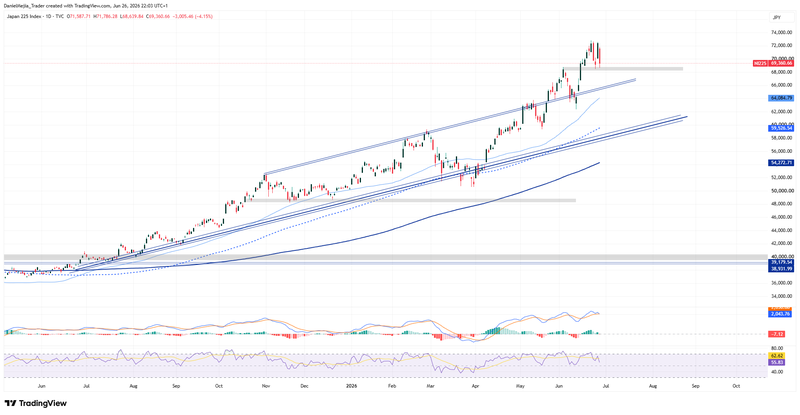
Figure 1. Nikkei 225 Index (2025–2026). Source: Own analysis conducted via TradingView.


