
 Help
Help 
Nvidia deepens its AI supply chain as DGX Spark brings supercomputing to the desk
Nvidia’s AI story is no longer about selling chips into data centres. The company is now trying to control more of the ecosystem around those chips, from supply chain financing to developer hardware.

Nvidia is investing heavily across the AI supply chain.
The bigger story is about Nvidia trying to own more of the AI infrastructure stack.
If price falls below 195–198 the bullish outlook would weaken
Nvidia is building around the bottleneck
The scale of Nvidia’s supply chain investment says something important about where the AI race is heading. Demand is no longer the only issue. The harder question is whether the infrastructure can keep up.
That is why Nvidia’s reported $40 billion-plus investment campaign matters. The company is not simply buying stakes in random AI winners. It is putting money into the areas that support its own growth: data centres, components, infrastructure partners, and the wider network needed to deliver AI systems on a scale.
The company wants more control over the AI buildout
Nvidia’s strongest position is still its GPU leadership, but the AI boom has created pressure across the whole hardware chain. Power, networking, memory, cooling, advanced packaging and data-centre capacity are all becoming constraints.
That makes Nvidia’s strategy easier to understand. If customers want more chips than the world can install, finance, power or connect, then Nvidia has an incentive to strengthen the companies around it. The goal is not only to sell more hardware. It is to make sure the market around that hardware does not become the reason growth slows.
DGX Spark brings AI power closer to developers
DGX Spark fits into the same idea from a different angle. Nvidia describes it as a compact desktop system with up to 1 petaflop of AI performance, 128GB of unified memory, and the ability to run inference on models up to 200 billion parameters locally.
That matters because not every AI workload starts in a giant data centre. Developers need to prototype, test, fine-tune and validate models before moving larger work into cloud or enterprise infrastructure. DGX Spark is Nvidia’s attempt to make that process more local, more accessible, and still tied to its wider software ecosystem.
Technical outlook
NVDA still has a strong bullish structure, even after the recent pullback. NVDA did not only clear a key resistance zone but also broke above the descending trendline that had been limiting each recovery attempt since the previous high near 212. That breakout gave buyers more confidence and helped drive the stock quickly toward 236.
After reaching 236, the stock started to cool off, which is not necessarily negative. A pullback after such a strong move is normal. What matters more is where buyers return. In this case, NVDA found support around 212, which is important because this level was previously resistance and has now become a key pivot.
The rebound from 212 toward the 224–228 area suggests buyers are still defending the breakout structure. If price remains above 212, the short-term bullish setup stays intact, and the recent weakness can still be viewed as profit-taking rather than a trend reversal.
212 is the first support level to watch. Below that, the 195–198 zone becomes the next important area because it represents the breakout base and the old supply zone. If price falls back below 195–198 and stays there, the bullish outlook will weaken, and the stock could return to a wider consolidation phase. The deeper long-term support remains near 164, where buyers previously stepped in several times.
On the upside, the first resistance sits around 228–230, followed by the recent high near 236. If NVDA breaks above 236, the stock could return to price discovery and potentially open the way toward 245–250.
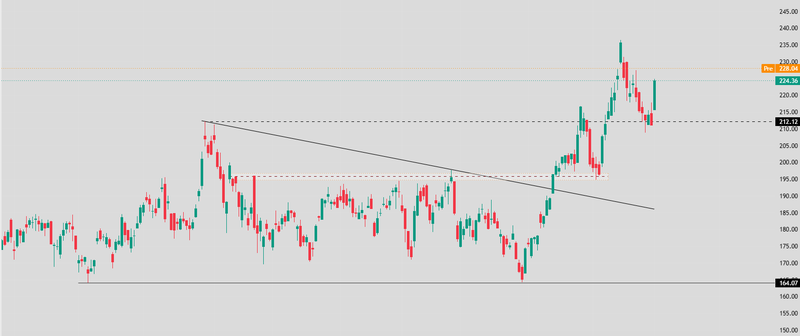
Source: Trading View


