
 Help
Help SpaceX shares return to $135 IPO price as concerns over tech valuations grow
SpaceX shares fell back to their $135 IPO price as concerns over elevated technology valuations, geopolitical risks, and inflationary pressures outweighed initial enthusiasm, reducing the company’s market capitalisation and weakening investor sentiment.

SpaceX shares returned to their $135 IPO price, falling by around 20% since 30 June amid increasing selling pressure.
The company’s market capitalisation declined to approximately $1.79 trillion as investors reassessed high-growth technology valuations.
SpaceX trades at around 92 times sales and 52 times book value, highlighting concerns over stretched valuations.
Date: 15 July 2026
SpaceX returns to its IPO price amid increasing scrutiny of technology valuations
Shares of Space Exploration Technologies Corp. (SpaceX) returned to their initial public offering (IPO) price of $135, reflecting a sharp reversal in investor sentiment following the company’s highly anticipated market debut. Although the shares closed at $135.27, they briefly reached an intraday low of $132.50, indicating increasing selling pressure over the past two weeks. Since 30 June, SpaceX shares have accumulated a decline of approximately 20%, reducing the company’s market capitalisation to around $1.79 trillion.
The recent weakness in SpaceX shares has been driven by a combination of broader macroeconomic and market-specific factors. Renewed geopolitical tensions in the Middle East have weighed on the global economic outlook, particularly through the risk of higher energy-driven inflation. Concurrently, investors have become increasingly cautious towards technology and high-growth companies, whose valuations remain historically elevated despite recent market volatility.
For SpaceX, valuation concerns remain particularly relevant. According to data published by Yahoo Finance, the company trades at a price-to-sales (P/S) ratio of around 92 times, even after the recent share-price correction. Meanwhile, its price-to-book (P/B) ratio stands at approximately 52 times, considerably above those of most companies operating in the aerospace and broader industrial sectors. Notably, a price-to-earnings (P/E) ratio is not currently available, as the company has yet to report positive net income.
Although SpaceX was able to join the Nasdaq-100 Index shortly after its IPO, supported by a recent rule change that shortened the eligibility period for newly listed companies, the anticipated demand from index-tracking institutional investors has not been sufficient to prevent further selling pressure.
Technical analysis of SpaceX shares
Given the absence of sufficient historical trading data for an extended technical analysis of SpaceX shares, this assessment focuses exclusively on the stock’s performance over the past month. Key observations include:
- Resistance levels: Should the shares surpass the short-term resistance at the $150 threshold, the next key technical level would be $170. A decisive breakout above $170 would increase the likelihood of an extension towards higher valuation levels.
- Support levels: Critical support is identified at the $135 level, corresponding to SpaceX’s IPO price. A failure to defend this support level would substantially increase the probability of a more pronounced short-term market correction.
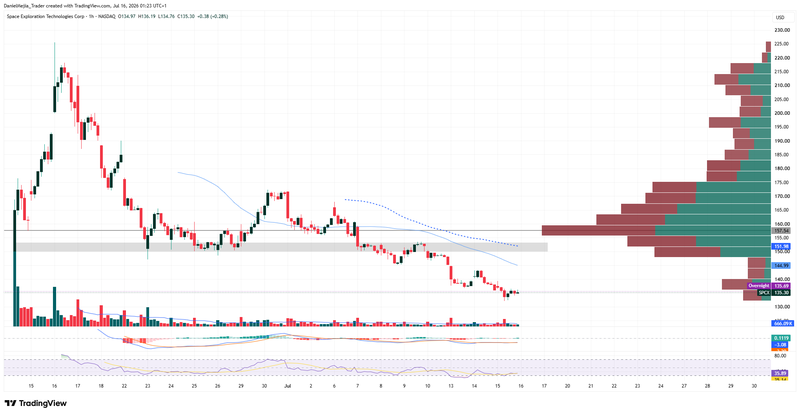
Figure 1. SpaceX Share Price (one-month performance). Source: Data from the Nasdaq Exchange; own analysis conducted via TradingView.


