Help
Help DXY forecast: Fed rate outlook, Treasury demand and DXY levels
The US dollar is benefiting from an inflation problem that could eventually complicate the administration’s economic ambitions, the immediate question is whether higher expected interest rates can sustain demand for the greenback. For Washington, the stakes extend beyond the exchange rate, as the government needs investors to keep financing its growing borrowing requirements.

Markets are now pricing roughly a 70% probability that the Fed will hold rates in October.
A stronger dollar can help the US attract foreign capital into Treasury markets.
A recovery above 102.50 will open the way towards 104.00.
Inflation is changing the dollar’s rate advantage
Markets are now pricing roughly a 70% probability that the Fed will hold rates in October, alongside an 86% probability of a hike in December. That combination suggests investors expect policymakers to delay tightening rather than abandoning it. The distinction matters for DXY because currencies respond not simply to current interest rates, but to how those rates compare with returns available elsewhere.
The hotter inflation report initially lifted the dollar as Treasury yields rose and the possibility of another rate increase gained traction. The move subsequently reversed as yields retreated and Fed officials signaled that policymakers could wait. The dollar’s response shows that the inflation surprise alone is not enough to sustain a rally. The dollar needs the expected interest rate advantage to persist.
If core inflation remains firm while the labour market weakens, the Fed faces a difficult choice. Holding rates could allow inflation pressure to persist, while raising them could deepen the slowdown. For DXY, the outcome depends on which risk dominates market expectations. A December hike could support the dollar, but evidence of deteriorating employment or easing underlying inflation could undermine that support.
Why the dollar matters to Washington’s borrowing needs
A stronger dollar can help the US attract foreign capital into Treasury markets, an important consideration as the government seeks to finance tax cuts, infrastructure initiatives and other spending commitments. Foreign investors assess the returns available on dollar-denominated assets alongside currency risk, liquidity and confidence in US institutions.
The depth of the Treasury market remains a major attraction, with foreign investors holding roughly $8 trillion of Treasury securities, but a rising DXY does not automatically guarantee stronger demand for government debt. Investors may buy Treasuries because yields are attractive or because they need liquid, relatively safe assets, while the dollar can move for different reasons. Higher yields may draw capital into the US, but they also increase the government's cost of financing new borrowing and refinancing existing debt.
This creates tension for the administration
A strong dollar can support foreign demand for US assets, yet the monetary conditions helping the currency may make financing more expensive across the economy. Tax cuts and infrastructure spending could support activity, but if they increase borrowing needs without improving confidence in the fiscal outlook, the Treasury market will need to absorb additional supply.
What will determine DXY next move?
The dollar’s direction will depend on whether inflation keeps the Fed on a tighter path or labour-market weakness limits its ability to act. Persistent price pressure and a credible prospect of a December hike would help preserve the dollar’s yield advantage. A cooling in underlying inflation, particularly alongside weaker employment, could reduce those expectations and leave the currency vulnerable to a reversal.
The broader issue is that Washington benefits from international demand for dollar assets, but it cannot rely on currency strength alone to secure that demand. Investors must also be confident in the returns, liquidity and long-term stability of the assets they are buying. For DXY, the next move will turn on the Fed’s reaction to inflation and employment. For the US government, the challenge is ensuring that the capital attracted by the dollar remains willing to finance the country’s growing ambitions.
Technical outlook
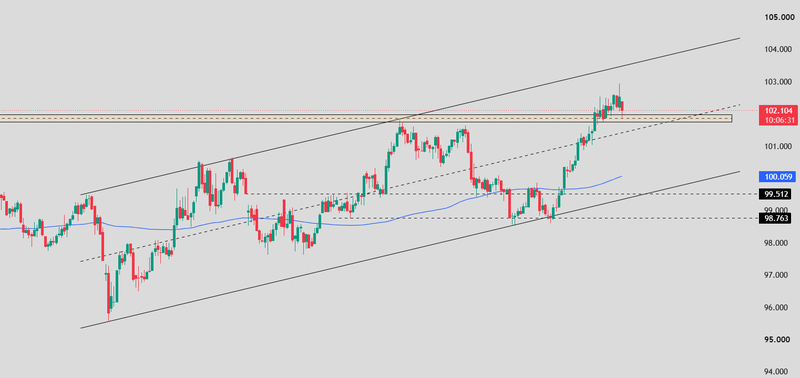
DXY is trading around 102.01 after failing to sustain its advance towards 103.00. The pullback puts the recent breakout under scrutiny. The broader structure remains bullish, but the next move depends on whether buyers can defend the former resistance zone and prevent the correction from developing into a deeper reversal.
The index has been advancing within a rising channel, with successive higher lows supporting the trend. Its break above 101.70–101.85 accelerated the rally towards 103.00, but the subsequent rejection suggests that selling pressure is increasing as the dollar approaches its recent highs.
The 101.75–101.90 area is now the key test
Holding above this zone would support the view that the decline is a retest of former resistance, now acting as support. A sustained move below it would weaken the breakout and shift attention towards the rising trendline around 101.00–101.30. The question is whether buyers can defend the breakout or whether the latest advance has run out of momentum.
Scenarios ahead
A recovery above 102.50 would put 102.80–103.00 back in focus. Clearing 103.00 would confirm renewed buying pressure and open the way towards 104.00–104.40, near the upper boundary of the rising channel.
Failure to hold 101.75 would raise the risk that the breakout is losing credibility. A break below the rising trendline would expose the moving average near 100.058, followed by 99.512 and 98.763. A sustained move beneath 100.058 would point to a deeper correction, although the longer-term uptrend would not necessarily be invalidated immediately.
Source: Trading view
Fundamental outlook
The latest inflation report initially lifted the dollar to an 18-month high as markets reassessed the likelihood of further Fed tightening. The rally then lost momentum as Treasury yields retreated and Fed officials left room to wait before raising rates again.
That shift in expectations in the rate is now central to the technical outlook. Persistent inflation could keep the prospect of a December hike alive and support the dollar, while weaker employment data or a further decline in yields could limit its recovery. The next US producer-price and retail-sales reports may help determine which risk carries more weight.
For now, the chart and the macro-outlook converge around the same question. Holding above 101.75 would preserve the breakout and leave room for another test of 103.00; losing that support would suggest that the dollar needs a deeper correction before its next sustained move.