
 Help
Help 
USD/JPY analysis: 152 support vs. 160 resistance
The Bank of Japan has started moving more quickly. It raised its policy rate to 1.25% on September 18, only seven weeks after the previous increase, marking the fastest pace of tightening in the current cycle. Earlier moves had generally been spaced much further apart.

BOJ raised rates to 1.25%, the highest in 31 years.
The September hike came less than two months after the previous move.
Seven policymakers backed the increase, while two dissented.
U.S. pressure and Japan's intervention efforts are adding another layer to the yen story.
The BOJ is running out of time to wait
For years, the BOJ could afford to move slowly because inflation was weak and deflation remained the bigger concern. That backdrop has changed.
Japan's inflation has moved closer to the BOJ's 2% target, while higher energy prices and yen weakness are pushing imported costs higher. The bank's latest decision reflects a growing willingness to deal with those risks before they become fully embedded in domestic prices. Reuters noted that the September increase was the second hike in three months, breaking the previous pattern of roughly semiannual moves.
That shift matters for the yen because markets no longer must wait six months for the next possible step.
Washington has become part of Japan's currency policy
Japan's yen problem is no longer purely domestic. The U.S. Treasury has pressed Tokyo to address persistent yen weakness, while the two countries carried out a coordinated yen-buying intervention in late July. Treasury Secretary Scott Bessent has argued that Japan needs monetary and fiscal policies that reduce the pressure on the currency.
Intervention can change the price quickly. It cannot fix the underlying interest rate gap. That is why higher Japanese rates matter more over time. If Japanese yields continue rising, the incentive to borrow yen and buy foreign assets becomes smaller. The result could be less demand for dollars and a broader unwind of yen-funded carry trades.
Takaichi's fiscal policy complicates the picture
The BOJ is moving toward tighter monetary policy while Prime Minister Sanae Takaichi is pursuing an expansionary fiscal agenda. Her government has backed large-scale spending plans aimed at investment and economic support, but those plans have also pushed Japanese bond yields higher and raised concerns about government borrowing.
That leaves Tokyo with two policies pulling in different directions
Higher rates are intended to contain inflation and support the yen. Higher government spending can keep demand stronger and put upward pressure on yields and prices.
The September decision shows the BOJ has a clear majority wanting to tighten. But Governor Kazuo Ueda offered no fixed timetable for the next increase, and the two dissenting votes show there is still concern that moving too quickly could weaken growth before domestic inflation fully warrants it.
For the yen, the next move will therefore depend on more than the size of the next BOJ hike. It will depend on whether Japan can align monetary policy, fiscal policy and currency intervention closely enough to change the economics of the yen trade.
Technical outlook
The sharp selloff has changed the short-term picture, but the longer trend is still holding for now. After failing near 164, USD/JPY broke below the steep rising trendline that had driven the previous rally and fell quickly into the 152.24–153.00 area. That zone has now produced a rebound toward 157, but the move still looks like a recovery from the selloff rather than a return to the old trend.
The 152.24–153.00 area is the level that matters most. It brings together the 126-day moving average, the longer-term rising trendline and previous demand. Holding there keeps the broader structure alive. On the upside, 160.45 is the first serious hurdle after becoming the main swing high before the intervention-driven decline.
Scenarios ahead
If buyers defend 152–153, the rebound can extend. A move above 157 would put more pressure on sellers, while a recovery through 160.45 would suggest the market is starting to look beyond the intervention shock and back toward the wider U.S.-Japan rate gap.
A break below 152.24 would change the picture. That would weaken the longer-term structure and put 150 back in focus. Below that level, the risk of a deeper decline would increase as traders continue reducing long-dollar positions and reassess expectations for further BOJ tightening.
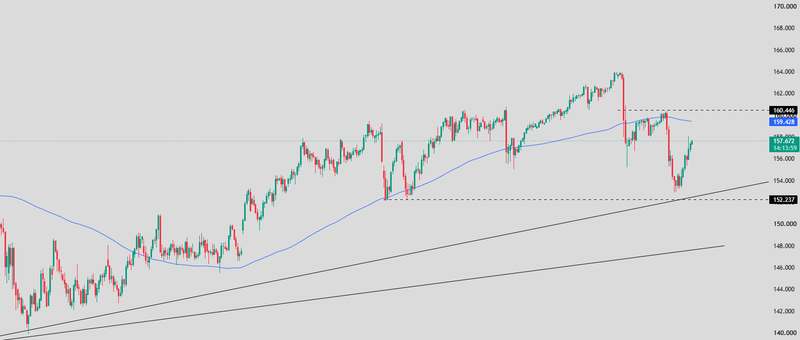
Source: Trading view


