Help
USD/JPY forecast: US CPI and BoJ rate hike expectations put 159.00 in focus
The interest rate gap between the United States and Japan remains wide, but markets are now considering the possibility that both central banks could raise rates in December. US inflation data and the Bank of Japan’s Summary of Opinions may determine which side of that trade gains more support.

Markets are pricing a roughly 78% probability of a fed rate hike in December.
Tuesday’s US CPI report could either strengthen or weaken that expectation.
Markets are pricing a roughly 71% probability of a BoJ rate hike in December.
A sustained break and close above 159.04 could push USD/JPY toward 160.40
Strong US data shifts the burden to inflation
The latest US labour data showed that the economy continues to absorb high interest rates better than expected. Strong payroll growth, firm working hours and resilient labour demand suggest that the Fed is under little pressure to support the economy through lower rates.
That has pushed the probability of a December hike toward 70%–80%. Tomorrow’s CPI report will determine whether this pricing is justified.
If inflation comes in above expectations, the Fed will have both sides of its argument: a labour market strong enough to withstand tighter policy and inflation that still requires action. That combination would likely lift Treasury yields and support the dollar, particularly against currencies backed by much lower interest rates.
A softer CPI report would challenge that view
Strong employment alone does not require another hike if price pressures are easing. Markets could then reduce their December expectations, pulling US yields lower and narrowing part of the advantage supporting USD/JPY.
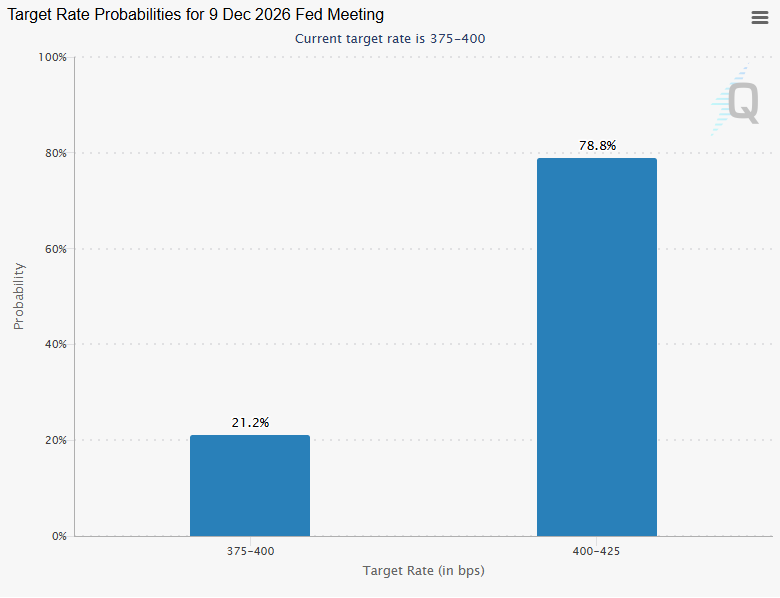
Source: CME Group
Higher Japanese inflation does not guarantee a BoJ hike
Japan’s inflation picture is more complicated. Governor Kazuo Ueda believes underlying inflation is around the BoJ’s 2% target, while wage growth is becoming more consistent with that level. He has also warned that rising energy costs could push consumer inflation higher into early next year.
But energy-driven inflation doesn’t automatically make a December hike more likely
Japan imports much of its energy, so higher prices increase inflation while also raising costs for households and businesses. This can weaken consumption and reduce real incomes. The BoJ therefore needs to decide whether inflation is being sustained by wages and domestic demand or is simply being pushed higher by another external cost shock.
This explains why Ueda continues to speak cautiously even as inflation risks move higher
The BoJ wants evidence that the wage-price cycle can maintain inflation near 2%, not just a temporary rise caused by energy. Ueda’s comment that 2% inflation has not yet become a social norm shows that the Bank is still uncertain about how firmly price-setting behaviour has changed.
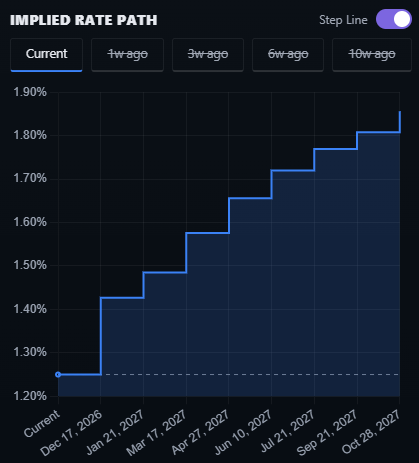
Source: Rate probability
Tuesday’s BoJ report may reveal the December debate
The BoJ’s Summary of Opinions, covering its October meeting, will show whether policymakers are becoming more concerned about waiting too long to raise rates. It is scheduled for release on Tuesday at 8:50 a.m. Japan time.
If several members argue that wage growth, underlying inflation and energy-related risks justify earlier action, markets may increase their expectations of a December hike. That would support the yen even if the BoJ continues to move gradually.
However, a cautious report focused on weaker consumption and the temporary nature of energy inflation would leave the interest rate gap largely unchanged.
Technical outlook
USD/JPY is trading near 158.11 as price continues to consolidate within a narrowing triangle formation. The pair has gradually recovered from the 153.00 region, establishing a series of higher lows, but the recovery has repeatedly struggled to overcome the descending resistance line that has guided prices lower from the 164.00 area.
The recent price action suggests that selling pressure has eased compared with the earlier decline, although buyers have yet to establish control.
Each retreat toward the rising support line has attracted renewed demand, while attempts to advance beyond 158.50–159.00 have met resistance.
This has left the pair trading within an increasingly narrow range, with a directional breakout becoming more important as price approaches the triangle's apex.
Scenario ahead
The immediate resistance area lies between 158.50 and 159.04, where the descending trendline and previous price highs continue to limit the upside.
A sustained break and close above 159.04 would weaken the bearish structure and indicate that buyers are beginning to overcome the selling pressure that has dominated previous rallies.
Under this scenario, USD/JPY could advance toward 160.40, a significant resistance level that previously attracted selling interest.
A move above 160.40 would provide stronger evidence of a broader bullish reversal, although that would require a separate confirmation rather than simply relying on the initial triangle breakout.
On the other hand, the rising trendline provides the first layer of support around 157.30–157.50, with its precise position depending on when price approaches it.
A break below this trendline would weaken the recent recovery structure and expose the horizontal support zone around 156.35–156.60.
This area has repeatedly attracted buyers and remains an important level in determining whether the recovery from 153.00 can continue.
If USD/JPY closes decisively below 156.35, the bearish scenario would gain further support, potentially opening the way toward 153.00, followed by the broader support at 152.24.
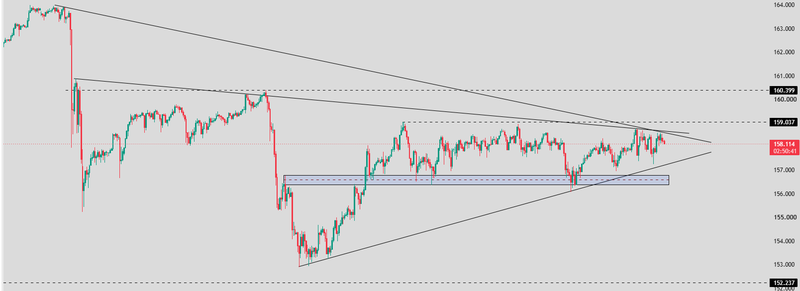
Source: Trading view