Help
WTI crude oil forecast: can supply risks push prices above $103?
WTI crude has recovered towards $99.31, with the rally supported by two developments that are reinforcing each other. Repeated attacks on vessels near the Strait of Hormuz are increasing the risk of further supply disruptions, while another substantial draw in US crude inventories points to tightening domestic availability.

18 vessel attacks have been recorded over the past two weeks.
US crude inventories fell by 4.93 million barrels in the week ending October 16.
WTI is again approaching the $100–$103 resistance zone near the upper boundary of the rising channel.
Crude exports have recovered, but the cost of supply remains elevated
The oil market is facing a more complicated supply picture than a simple disruption narrative suggests. Middle Eastern crude exports have recovered to more than 90% of their pre-war baseline, indicating that most crude flows have resumed. Yet oil prices remain elevated, with shipping, insurance and freight costs continuing to add a substantial premium to the cost of moving barrels through the region.
The disconnect matters because the recovery in export volumes does not mean the energy supply chain has returned to normal. Tankers may be moving again, but security risks, higher insurance premiums and more expensive freight can still raise the delivered cost of crude. Buyers are therefore paying not only for the oil itself, but also for the risks and logistics involved in securing it.
The pressure is also uneven across the energy market
While crude exports have largely recovered, refined products and liquefied natural gas shipments remain more constrained, with diesel supplies particularly vulnerable. That distinction matters for prices because crude oil availability alone cannot resolve shortages in products that require refining, specialized transport or functioning export infrastructure.
For WTI, the key question is whether elevated delivery costs and persistent constraints in refined products will sustain the broader energy risk premium, even as crude flows recover. A further rally would be harder to justify based on crude export disruption alone. It would require evidence that transport costs remain elevated, product shortages persist or fresh disruptions begin to reduce the volume of oil reaching buyers.
US inventory draws reinforce the pressure
Crude stockpiles fell by 4.93 million barrels, compared with expectations for a decline of 1.3 million barrels. The draw followed an 11.12-million-barrel reduction in the previous week.
Gasoline inventories fell by 2 million barrels, while distillate stocks declined by 2.6 million. The simultaneous reductions suggest that the pressure extends beyond crude storage, although weekly inventory changes can also reflect shifts in imports, exports, refinery activity and domestic demand.
The distinction matters because falling stocks do not automatically prove that global supply is insufficient. But consecutive large draws reduce the cushion available to absorb unexpected disruptions, particularly if fuel demand remains resilient. If shipments through the Strait become less reliable while inventories continue to decline, buyers may have less flexibility to wait for cheaper cargoes.
The next question is whether official US Energy Information Administration data confirm the API estimate and whether the draw reflects a sustained tightening in supply. A smaller draw or an unexpected build would weaken the immediate bullish argument. Confirmation would strengthen it, particularly if product inventories also remain under pressure.
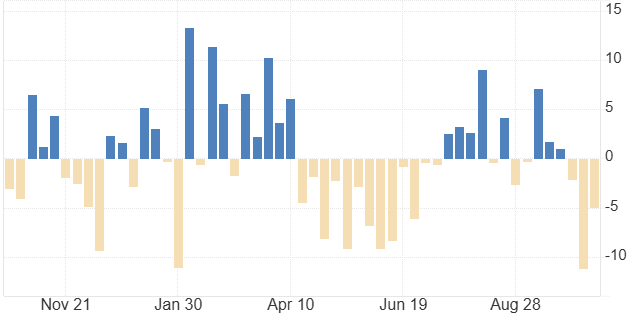
Source: API
Technical outlook
WTI’s recovery has improved the short-term chart structure. After retreating from the $93–$94 region and finding stronger support around $75–$76, oil broke above the former descending trendline and the $86–$87 resistance zone. The subsequent rally towards $106 was followed by a sharp correction, but buyers have since returned, forming a new sequence of higher lows.
At around $99.31, WTI is again approaching the $100–$103 resistance zone near the upper boundary of the rising channel. The short-term structure remains bullish while price holds above $96–$97, but the latest advance has not yet confirmed a sustained breakout.
A decisive move above $103 would suggest that buyers are absorbing selling pressure and that the supply-risk premium remains strong enough to extend the rally. Failure at this zone, by contrast, could leave WTI vulnerable to another correction.
Scenario ahead
If WTI holds above $96–$97 and breaks decisively through $100–$103, the rising channel would remain intact. The next target would be $105–$106, followed by a possible retest of the previous high if momentum continues.
However, if WTI fails to clear $100–$103 and falls below $96, the recovery would begin to lose momentum. The next level to watch would be $93.43. A decisive break below that support would weaken the bullish structure and expose $86–$87.
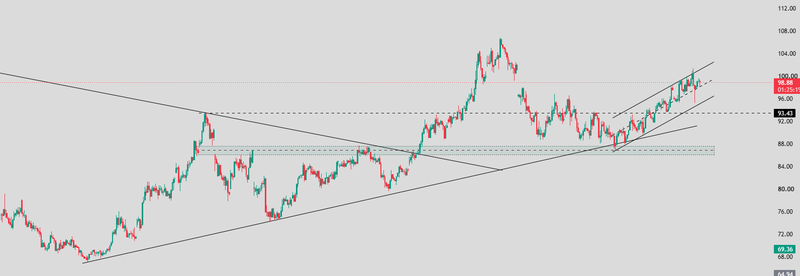
Source: Trading view
What could change the outlook?
The rally rests on a combination of physical supply risks and improving short-term momentum. But those forces can reverse. Credible progress towards de-escalation, safer shipping routes or a sustained recovery in oil flows could reduce the geopolitical premium. Meanwhile, elevated prices may eventually weaken consumption, placing a limit on how far crude can rise without further supply losses.
For now, $100–$103 is the decisive zone. A sustained breakout would strengthen the case for a move towards $105–$106. Rejection followed by a break below $96 would suggest the market needs to reassess the recovery. The direction of oil will ultimately depend on whether the threat to supply keeps worsening faster than demand adjusts.