Help
Help 
WTI Oil outlook: is the Hormuz risk Premium finally fading?
For months, traders were focused on how much supply could disappear if the Strait of Hormuz remained locked in crisis. Now the conversation is shifting toward how much of that fear was already priced into crude. Brent has pulled back from recent highs as diplomatic progress around Hormuz, a softer U.S. inventory picture and a more measured sanctions approach from Washington have started changing expectations. None of those developments has solved the broader conflict with Iran.
Iran and Oman are discussing a temporary shipping corridor and a joint mine-clearing plan for Hormuz.
Washington expanded sanctions on Iran but stopped short of targeting major Chinese banks.
U.S. crude inventories rose by about 4.2 million barrels, well above expectations.
Brent has fallen sharply as traders reduce some of the geopolitical premium built into prices.
Hormuz is finally giving traders something to price
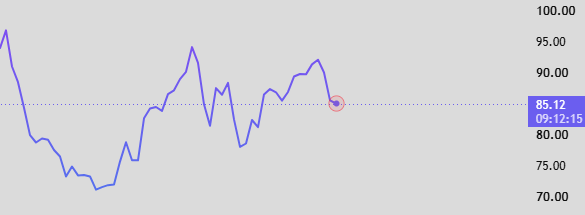
Brent has already given back roughly 6%, and the move says more about expectations than the headlines themselves. For the first time in weeks, traders have something concrete to work with.
Iran and Oman are discussing a temporary maritime corridor and a joint mine-clearing plan aimed at getting commercial shipping moving again through Hormuz. It is still far from a permanent solution, but it is a more practical development than another ceasefire statement.
The route has not returned to normal. Shipping remains disrupted, and Tehran continues tying a broader reopening to sanctions relief. Even so, the market no longer needs to price an immediate worst-case scenario. That has been enough for some of the war premium built into crude to start coming back out.
Source: Trading view
Washington changed the pressure without changing the message
The second shift came from the sanctions package. The Trump administration expanded its campaign against Iran, targeting dozens of individuals, companies and vessels linked to Tehran's financial networks. But one omission stood out more than the names on the list: major Chinese banks were left untouched.
That choice tells the market something
Washington is still tightening economic pressure, but it is avoiding the kind of secondary sanctions that could have escalated into a broader confrontation with China and disrupted global energy markets much more aggressively.
The message has become more calibrated
Instead of treating every new sanction as a step toward military escalation, traders are starting to separate economic pressure from immediate supply disruption.
The inventory surprise changed the balance
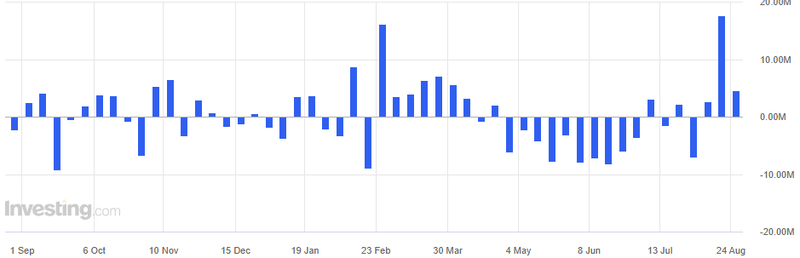
The supply picture also softened inside the United States. Crude inventories rose by roughly 4.2 million barrels for the week ending August 21, a much larger build than analysts had expected.
That matters because inventory data often changes how traders interpret geopolitical headlines. A tight inventory report would have reinforced fears that any disruption in Hormuz could quickly tighten supplies. A larger-than-expected build points in the opposite direction. It suggests the market has a little more room to absorb uncertainty than many traders had assumed.
The timing could hardly have been more important
Just as diplomatic headlines started reducing the geopolitical premium, the inventory data made it harder to argue that the physical market was running out of oil.
Source: Investing.com
The market is repricing risk, not abandoning it
The recent pullback should not be mistaken for a return to normal. Hormuz still carries roughly a fifth of global seaborne oil trade under normal conditions, and the negotiations remain temporary rather than permanent.
Traders are no longer pricing an imminent worst-case outcome
Instead, they are weighing three competing forces at the same time: a fragile diplomatic opening, continued economic pressure on Iran and a physical oil market that looks less constrained than expected after the latest inventory data.
That combination has started pulling the war premium out of crude
The next move is likely to depend less on another political statement and more on whether ships begin moving more freely through Hormuz. If the corridor turns into functioning traffic, the market could continue giving back some of its recent gains. If the talks stall or shipping comes under renewed pressure, the geopolitical premium could return just as quickly as it faded.
Technical outlook
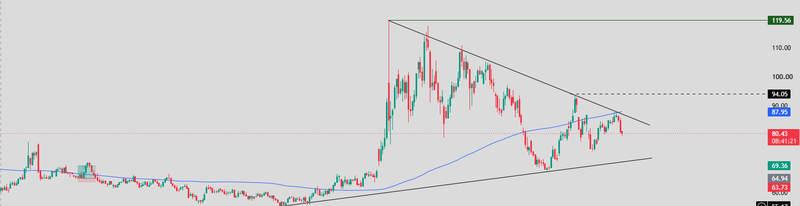
After falling from the 119.56 peak, the selloff has lost momentum. Instead of making fresh lows, the market has spent weeks trading between a falling trendline from the highs and a rising support line that has been building since the recovery from the 64-65 area. Neither side has managed to take control, and that has left crude trading in an increasingly tighter range.
Price sat at around 80.43, still below the 126-day moving average near 87.95. That is the level traders keep coming back to. Every rally has stalled before reclaiming it, which is why the broader recovery still needs another push before it starts to look more convincing.
The next move is becoming easier to define
A break above 87.95 would clear both the 126-day moving average and the descending trendline that has capped the market since the peak, bringing 94.05 into view as the next major level. On the other hand, if buyers lose control of the rising support line, attention shifts back to 69.36, with 64.94 remaining the bigger support that held during the previous recovery.
For now, the market is no longer trading the collapse from 119.56. It is trading the breakout that could decide whether crude starts building a broader recovery or slips back into another leg lower.
Source: Trading view