Help
Help Coffee: How to read Coffee market moves
Coffee futures trading is mainly built around Arabica and Robusta, traded on ICE Futures US and ICE Futures Europe. Understanding the market means knowing the contract details, price drivers and risk controls behind each variety.
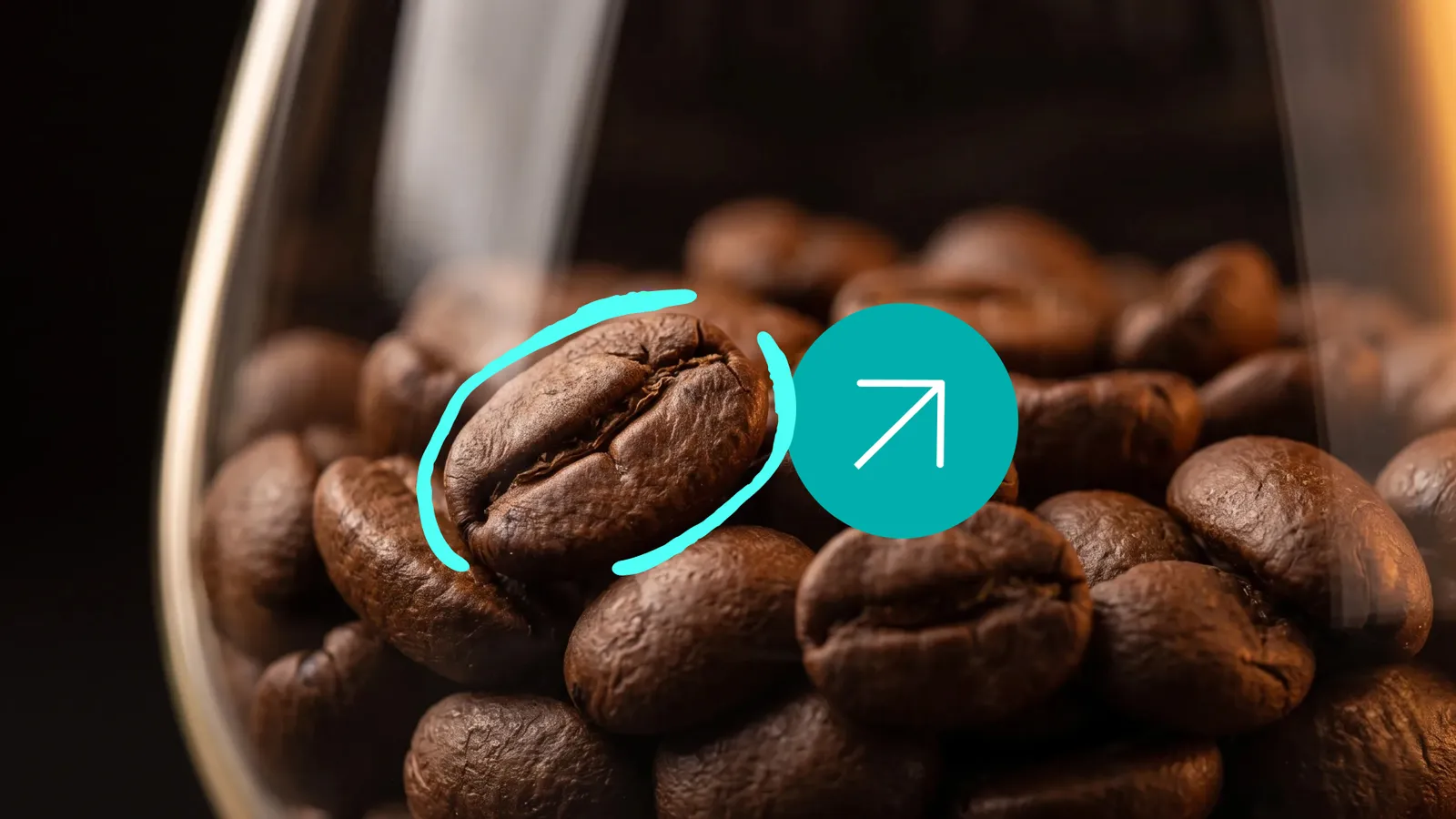
The Arabica (ICE Futures US) and Robusta (ICE Futures Europe) varieties are traded with specific ticker symbols and monthly delivery codes throughout the year.
Contract size, tick value and expiry dates are essential details for calculating position size and managing risk.
Poor weather in major producing countries, such as Brazil or Vietnam, can restrict supply and create sharp price volatility.
Currency instability in producing countries and global logistics disruptions can add further risk to the coffee market.
What is Coffee market trading?
Coffee trading is predominantly conducted through derivative financial instruments, specifically futures contracts. This domain represents a complex market ecosystem wherein price discovery is driven by the dynamic interaction of physical supply and demand dynamics, macroeconomic variables, regional climatic events, and central bank monetary policies.
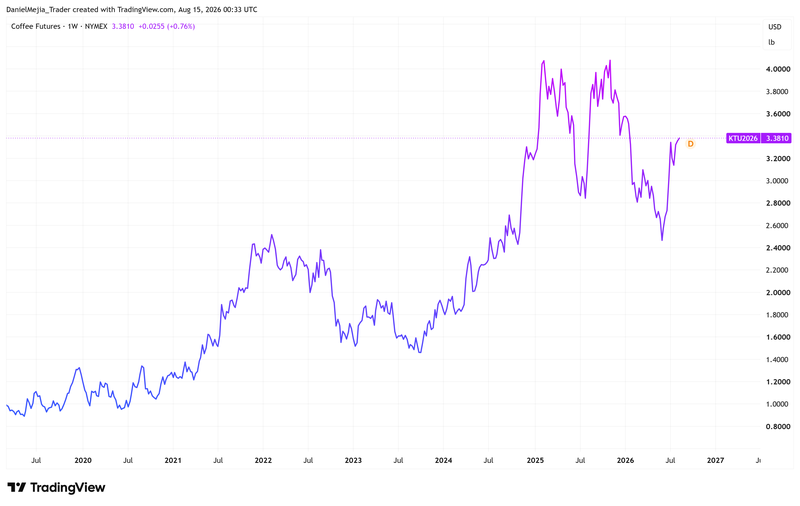
Figure 1. Coffee Futures KT (2020–2026). Source: Data from the NYMEX Exchange; Figure obtained from TradingView.
How are Coffee-linked futures contracts analysed?
Futures contracts are derivative financial instruments whose price movements are derived from changes in the valuation of an underlying asset. In this context, coffee futures contracts are fundamentally linked to the physical supply and demand balances of the global coffee market.
What types of Coffee contracts are there?
Coffee trading is categorized primarily by two commercial species: Coffea arabica (Arabica) and Coffea canephora (Robusta). The choice of futures contract corresponds directly to the specific variety traded and its inherent market characteristics. Arabica coffee exhibits a dominant production presence across the Americas—particularly within South America, Central America, and the Caribbean—where it represents the primary cultivated and exported variety. Conversely, Robusta coffee maintains a significantly higher relative market share across Asia and Oceania, most notably in nations such as Vietnam and Indonesia, where it plays a central role in regional agricultural output.
How to read a Coffee futures contract?
A derivative instrument's symbol varies depending on the coffee variety and the exchange upon which the underlying contract is listed. Two primary benchmarks define the international market: the benchmark Arabica coffee contract, traded under the ticker symbol KC on ICE Futures US (New York), and the Robusta coffee contract, traded under the ticker symbol RC on ICE Futures Europe (London).
By way of illustration, in the KTU26 contract listed on the NYMEX Exchange (a prominent benchmark), the standard nomenclature breaks down as follows: the commodity code (KT), the month of delivery (U, which denotes a September expiration), and the two-digit year code (26, indicating an expiration year of 2026).
Accurately identifying the delivery month is vital, as it designates the precise date upon which the contractual obligation to buy or sell matures, or the deadline by which a trader must roll a position forward to maintain exposure. Transitioning a position to a further-dated contract incurs an execution fee and spread differential known as the rollover cost. In active futures trading, these carrying costs represent a highly material consideration that directly impacts overall trading expenditure.
How to make profit or loss estimates in Coffee trading?
Formulating precise profit and loss projections for risk management depends entirely on the technical specifications of the contract being traded. For example, the NYMEX KTU26 contract represents a standardized size of 37,500 pounds, establishing a minimum price fluctuation (tick value) of $18.75. Understanding the exact tick value is fundamental in futures trading, as it provides the mathematical basis for setting target returns and defining maximum capital risk through stop-loss placement.
To illustrate, if a trader establishes a take-profit target 20 ticks away from the execution price, the projected financial gain equals $375.00 (18.75×20). Conversely, if the stop-loss order is placed 10 ticks from entry, the predefined risk of capital loss stands at $187.50 (18.75×10).
Crucially, definitive contractual parameters—including total contract size, tick increment, tick value, and settlement schedules—are governed by the explicit regulations of the host exchange. Consequently, prior to executing any trading strategy or calculating financial exposure, market participants must consult the official exchange specifications to ensure absolute mathematical accuracy.
What are the fundamentals of supply and demand that move the price of coffee?
Although broader macroeconomic trends and geopolitical developments periodically influence coffee futures, the primary structural drivers of this market remain tied to agricultural seasonality and weather patterns—the core physical determinants of supply and demand.
Major coffee-producing countries
Brazil stands as the world's leading producer of coffee, generating a predominant share of global Arabica output alongside an expanding market share in Robusta. Therefore, Brazilian production yields and export volumes exert a decisive influence on global supply availability and market pricing. Furthermore, according to agricultural data from the United States Department of Agriculture (USDA), four additional nations account for the majority of remaining global output: Vietnam, Colombia, Indonesia, and Ethiopia.
Climatological aspects
While various weather anomalies can compromise coffee yields, two environmental hazards present particularly severe threats to production. Firstly, the occurrence of frost poses a significant structural risk, as freezing temperatures cause severe damage to the vascular system of coffee trees, reducing both immediate harvests and multi-year productive capacity. Secondly, prolonged drought and abnormally high ambient temperatures cause flower and fruit abscission, drastically reducing crop yield potential. Additionally, excessive or torrential rainfall during harvesting periods can damage fruit quality and disrupt field logistics, further constraining effective market supply.
Macroeconomic and geopolitical aspects that can impact the price of coffee
Macroeconomic shifts that alter the exchange rates of primary coffee-exporting nations frequently induce substantial price volatility across global commodity markets.
For instance, if the Central Bank of Brazil (BCB) implements a restrictive monetary policy stance while the US Federal Reserve (Fed) maintains an expansionary stance, the resulting interest rate differential may lead to an appreciation of the Brazilian Real (BRL) versus the US dollar (USD). A stronger real increases the local-currency operational costs when translated back from US dollar-denominated export prices, effectively making Brazilian coffee more expensive for foreign buyers. This dynamic can dampen international demand, placing downward pressure on global coffee quotes. Conversely, a scenario of real depreciation offers an implicit price discount to international buyers, frequently stimulating global demand and supporting market activity.
Concurrently, geopolitical friction can severe maritime trade routes, triggering systemic supply shocks if transport bottlenecks and elevated freight logistics costs persist over extended periods.
Conclusion
Coffee futures trading demands a structured analytical approach that synthesises contract specifications with continuous monitoring of underlying physical fundamentals. Maximising trading efficiency while mitigating downside risk requires a clear understanding of how supply conditions across major origin nations respond to climatic shocks, foreign exchange fluctuations, and global supply chain vulnerabilities. Mastering these interconnected variables is essential for navigating this highly volatile commodity market successfully over the long term.
If you're interested in trading indices, foreign exchange, shares, or commodities, consider exploring the CFD contracts offered by Equiti Group. Please note that trading leveraged derivatives involves a high level of risk and may not be suitable for all investors.
FAQs
What are the two main varieties in coffee futures trading?
The commercial market is structured around two primary species: the Arabica variety, which serves as the benchmark contract on ICE Futures US, and the Robusta variety, which is traded on ICE Futures Europe. Both instruments utilize designated exchange tickers, monthly delivery codes, and standardized terms to facilitate international derivative trading.
Why is it crucial to understand contract specifications?
Mastering technical specifications—such as total contract size, minimum tick value, and expiration schedules—is foundational to effective capital and risk management. This knowledge allows traders to calculate precise financial outcomes, calculate tick values accurately, and manage leverage responsibility before entering a position.
How does the weather affect coffee prices?
Climatic conditions in major producing regions directly dictate global physical availability. Extreme weather events, such as unseasonal frosts or severe droughts in key origin countries, impair crop yields and diminish available export supplies, driving high historical volatility and upward pressure on futures pricing.
What other macroeconomic and logistical factors influence the market?
Fluctuations in key foreign exchange rates—most notably the Brazilian Real—and disruptions to international maritime logistics introduce structural volatility to the market. These variables alter local export margins, increase international transport costs, and directly impact final spot and futures valuations.