
 Help
Emaar properties stock: earnings, dividends and Dubai real estate
Emaar Properties is one of the largest companies listed on the Dubai Financial Market and the developer behind landmarks such as Burj Khalifa and Dubai Mall. Beyond these projects, Emaar has become an important stock for investors looking to gain exposure to Dubai's property market, population growth and wider economic performance.
Emaar reported AED 17.1 billion in net profit during the first nine months of 2026, compared with AED 14.6 billion in the same period last year.
Property sales reached AED 34.7 billion, while its revenue backlog stood at AED 158.8 billion at the end of September.
Emaar approved an additional dividend of AED 0.50 per share in November, following its AED 1 annual dividend paid earlier in 2026.
The stock trades at a relatively low price-to-earnings ratio of around 5.6 times.
What is Emaar properties?
Emaar Properties is a Real Estate Development Company based in Dubai, UAE and is listed on the Dubai Financial Market (DFM) with a ticker symbol EMAAR.
The company owns shopping malls and commercial and retail properties as well as hotels and entertainment centers. Outside of Burj Khalifa and the Dubai Mall, Emaar’s business is residential development, retail and leasing and hospitality.
Emaar as a stock is important to investors looking for exposure to the economy of Dubai as population growth leads to growth in the property market. Increase in businesses and foreign investment can lead to greater demand for housing and commercial properties.
Emaar can benefit from increased sales and rental income and spending in its shopping malls and hotels.
How does Emaar make money?
Emaar makes money through property sales and leasing of shopping malls and commercial properties, and through hotel and entertainment operations.
Property development and off-plan sales
Emaar is involved in the development of several master-planned communities in Dubai such as Dubai Hills Estate, Dubai Creek Harbour, Emaar South, and The Valley. These projects consist of residential, commercial and retail properties, as well as other facilities.
A key element of Emaar's business is the sale of residential and commercial properties on an 'off-plan' basis. In this case, the property is bought before it is constructed. Buyers pay a percentage of the sale price as an initial deposit, and the rest in installments based on the progress of the construction.
For example, if an apartment is sold off plan for AED 2 million, the buyer would pay a portion of that during the construction of the apartment, and the remainder based on the terms of the contract. From Emaar's perspective, these sales create a planned demand for the property and provide customer collections during the construction period.
However, the sale does not impact the company's financial statements the same way. Revenues are recognized in accordance with the construction progress (or other factors) and not simply at the time a sale contract is signed.
Rental income
Emaar also generates income from leasing of retail and commercial properties. Dubai Mall is one of Emaar's most popular retail destinations, with a variety of international brands and eateries.
Unlike revenue from sale of properties, leasing provides a steady stream of income. Shopping malls are less dependent on new residential sales to survive, and investors can focus on how close the shopping malls are to being fully occupied, how well the tenants are doing, and whether the tenants are renewing their leases.
If occupancy is strong and tenants are doing well, then it can support higher rental rates. Emaar's malls and commercial properties are significant because they provide an alternate source of income from property development.
Hospitality and entertainment
Emaar also owns and operates hotels, resorts and entertainment attractions, and the observation decks at the Burj Khalifa. These businesses are also beneficiaries of Dubai's tourism industry.
Why is Emaar's revenue backlog important?
Revenue backlog represents the value of property sales that has not yet been recognized as revenue. Emaar's backlog reached AED 158.8 billion at the end of September 2026, up 6% from the previous year.
For investors, this provides an indication of how much revenue the company may recognize as construction progresses and properties are delivered. For example, even if new property sales slow during a particular quarter, Emaar can continue recognizing revenue from projects sold in previous periods.
However, backlog is not the same as cash already received or guaranteed profit, construction costs, delivery schedules, cancellations and accounting recognition all affect how much eventually becomes earnings.
During the first nine months of 2026, Emaar launched 14 projects and recorded AED 34.7 billion in property sales.
How did Emaar perform in the first nine months of 2026?
Net profit for the first nine months of 2026 was AED 17.1 billion compared to AED 14.6 billion for the corresponding period in 2025. Revenue for the period was AED 37.5 billion, an increase of 13%, with EBITDA of AED 19.7 billion (2025: AED 16.6 billion).
Revenue from the group’s shopping malls, commercial leasing, hospitality and entertainment operations was AED 7.6 billion (2025: AED 7 billion). EBITDA for the same operations was AED 5.9 billion (2025: AED 4.5 billion) and represent 30% of the total EBITDA for the period.
Recurring revenue streams from malls, leasing, hospitality and entertainment are an important source of rental and operating income in addition to property sales.
However, these revenue streams are not completely sheltered from an economic slowdown. Decrease in consumer spending, tourism, and occupation level demand can affect the performance of these operations.
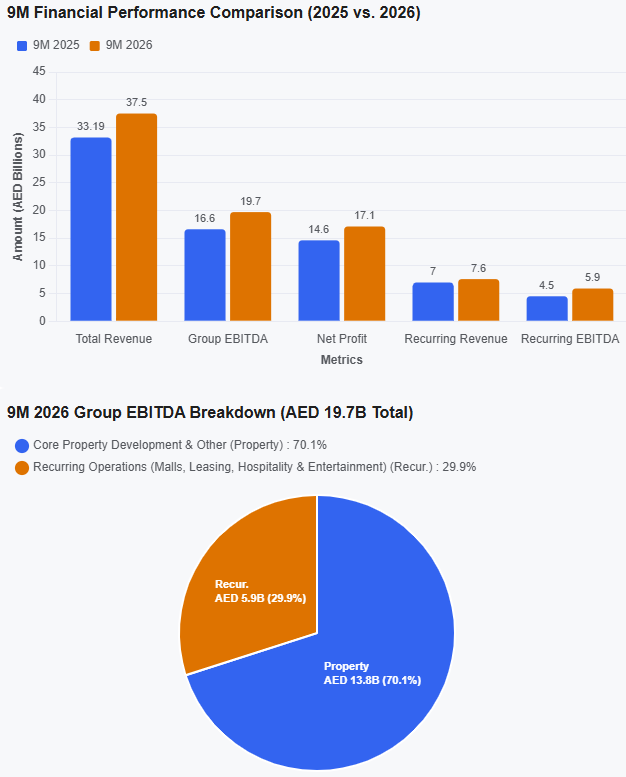
Source: Google
Why does Dubai's population growth matter for Emaar stock?
Dubai's population growth supports demand for residential properties, shopping malls and hotels, making it an important factor for Emaar's long-term performance.
Dubai's population reached 4.58 million at the end of 2025, an increase of 7.5% from the previous year.
As more people move to Dubai for employment, business and investment, demand for apartments, villas and residential communities can increase.
However, population growth does not always lead to higher property prices. The number of new homes entering the market, borrowing costs and affordability also affect property demand.
Why does Emaar stock react to geopolitical tensions?
Emaar is one of the large-cap stocks on the Dubai Financial Market. Therefore, it's affected by changes in geopolitical risks that affect other MENA (Middle East and North Africa) stocks.
Emaar is a defensive stock, meaning it retains value in bearish markets, even if geopolitical risks negatively affect the MENA region. Concerns of instability in the region may prompt foreign investors to sell their UAE stocks.
Not all selling pressure means the company’s operations have weakened. During sustained periods of geopolitical risks, Emaar's tourism, foreign property buying and business confidence could be negatively impacted.
Which in turn could raise borrowing costs and negatively affect the company’s operations and investments. It is important for investors to distinguish between company earnings and short-term movements in stock prices.
Is Emaar stock undervalued?
Emaar has a P/E ratio of around 5.6, meaning the market values the stock at around AED 5.60 for every AED 1 of trailing annual earnings. From this perspective, Emaar’s stock is relatively inexpensive when compared to some international property companies.
However, when considering international companies, various factors such as different markets, accounting practices, and business models need to be considered.
Emaar is in the property development business which is cyclical and the earnings can grow when property sales are strong and slow when the demand for housing weakens.
Therefore, a low P/E ratio may reflect the market's concern for the sustainability of the earnings.
How much dividend does Emaar pay?
Emaar pays regular dividends. It approved a special dividend in addition to the regular dividend. Both were paid in 2026.
The regular dividend per share for 2026 was AED 1 and the special dividend was AED 0.50 per share. The regular dividend represented an approximate yield of 8.2% on the share price of AED 12.22.
The total dividend for the year, including the special dividend, was AED 1.50 per share, which represented a yield of approximately 12.3%. The special dividend was one-time and will not be paid annually. Investors who purchased after the November 13, ex-dividend date, are not entitled to the special dividend.
What are the risks of investing in Emaar stock?
The main risks include a slowdown in Dubai's property market, rising construction costs, weaker foreign investment and regional geopolitical uncertainty.
A large increase in new housing supply could place pressure on selling prices, particularly if demand slows.
Emaar also faces execution risks across its development portfolio, delays in construction or higher material and labour costs could affect profit margins.
Interest rates matter as well; higher borrowing costs can reduce mortgage affordability and influence buyers' purchasing decisions.
Finally, a low earnings multiple and high dividend yield do not guarantee positive investment returns. Emaar's share price can fall even when its financial results remain profitable.
FAQs
What is Emaar Properties' stock symbol?
Emaar Properties trades on the Dubai Financial Market under the ticker EMAAR.
How much profit did Emaar make in 2026?
Emaar reported net profit of approximately AED 17.1 billion during the first nine months of 2026. Full-year results had not yet been released as of November 16.
What is Emaar's revenue backlog?
Emaar's property sales revenue backlog reached AED 158.8 billion at the end of September 2026. It represents contracted property sales that have not yet been recognized as revenue.
Does Emaar pay dividends?
Yes. Emaar paid AED 1 per share in April 2026 and approved an additional special dividend of AED 0.50 per share for November.
Why is Emaar stock linked to Dubai's economy?
Emaar develops residential communities, owns shopping malls and operates hospitality businesses. Its earnings are therefore affected by Dubai's population growth, property demand, tourism and consumer spending.


