Help
Help ICT 50% Rule explained in trading
The 50% Rule is one of the simplest ideas in ICT trading, yet it filters out some of the worst trades traders take. Many beginners see a bullish pattern and buy immediately, or spot a bearish setup and sell without asking a more important question: Is price expensive or cheap relative to the current dealing range?
The 50% level represents equilibrium inside a dealing range.
Price above 50% is considered premium, while price below 50% is considered discount.
CE and MT both use 50%, but they measure different price structures.
Candle bodies validate these levels more than wicks do.
Why the 50% Rule matters
Most traders focus on finding entries. Institutions focus on finding value. The 50% Rule bridges those two perspectives by treating the midpoint of a dealing range as the market's equilibrium.
Instead of asking whether price is simply moving higher or lower, ICT asks whether price has returned to a favourable location before entering. This mindset helps traders avoid buying after prices have already become expensive or selling after price has already become cheap.
The concept of equilibrium
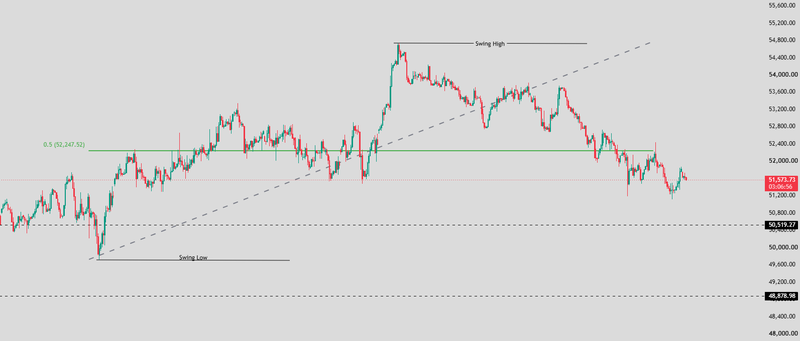
Equilibrium is the halfway point of a valid dealing range. Imagine market trading between a major swing low and a major swing high. The midpoint of that range represents fair value.
Price below equilibrium is considered discounted. Price above equilibrium is considered premium. The midpoint itself is not necessarily an entry level. It is the dividing line that tells traders which side of the market currently offers better value.
Source: Trading view
The institutional mindset
ICT teaches that institutions rarely chase price. Instead, they prefer buying after meaningful pullbacks and selling after meaningful rallies.
In a bullish environment, buying above equilibrium often means paying a premium for an asset that may still be retraced.
In a bearish environment, selling below equilibrium often means entering after much of the move has already happened.
Whether every institution literally follows this rule is less important than the practical lesson it teaches better entries usually come from waiting for price to return to value rather than chasing momentum.
The ultimate trade filter
One of the biggest advantages of the 50% Rule is how many unnecessary trades it removes. A bullish Fair Value Gap above equilibrium may still look attractive, but the rule encourages traders to wait for discount pricing instead.
Likewise, a bearish setup forming deep inside discount territory often loses its appeal because price has already travelled far from fair value.
This makes the 50% Rule less about predicting direction and more about improving trade quality.
The dealing range: Premium vs. discount
The 50% Rule only works after the dealing range is drawn correctly. Without a valid range, premium and discount lose their meaning.
Defining a dealing range
A dealing range should be built from a meaningful higher timeframe swing high and swing low. For a bullish market, many traders anchor the Fibonacci tool from the swing low to the swing high that created the current directional move.
For a bearish market, they reverse the process. The goal is not to measure every small pullback. The goal is to measure the impulse that defines the current market narrative.
Premium zone (Above 50%)
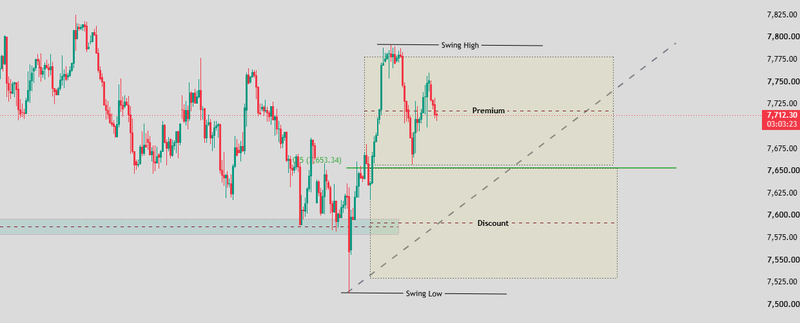
The premium zone sits above equilibrium. This is where price becomes relatively expensive compared with the current dealing range.
During bearish conditions, many ICT traders become more interested in short opportunities here because price has already rallied into higher-value territory for sellers.
A premium zone does not guarantee a reversal. It simply improves the context for bearish setups.
Discount zone (Below 50%)
The discount zone sits below equilibrium. This is where price becomes relatively cheaper inside prices becoming.
In bullish conditions, traders often prefer waiting for retracements into this area before looking for long positions. The deeper discount often creates cleaner entries than buying after an extended rally.
Source: Trading view
The golden rule
The most practical application is surprisingly simple. If a bullish setup forms inside premium territory, many ICT traders pass on the trade.
If a bearish setup appears deep inside discount territory, they often do the same. The setup itself may still work. The pricing context simply makes it less attractive.
Consequent Encroachment (CE) vs. Mean Threshold (MT)
One of the biggest sources of confusion is that both CE and MT use the 50% level. They are not the same thing. The difference comes from what they measure.
Consequent Encroachment (CE)
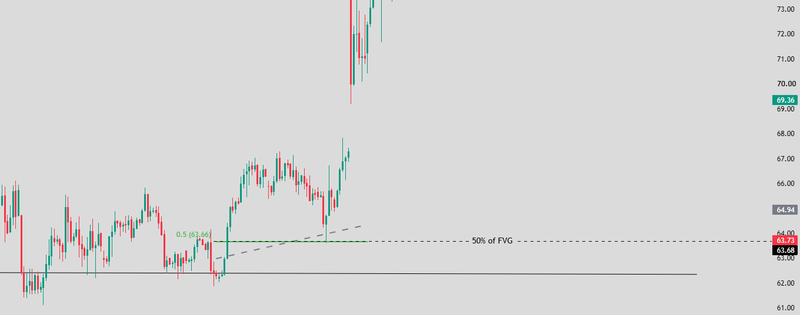
Consequent Encroachment is the midpoint of a Fair Value Gap. When displacement creates an imbalance, traders divide that gap in half.
That midpoint often becomes a highly reactive area because price frequently revisits part of the imbalance before continuing. Instead of expecting the entire Fair Value Gap to fill, many traders watch the CE first.
Source: Trading view
Why CE matters
Think of CE as the algorithm's first checkpoint. Price may react from the midpoint without filling the entire imbalance. This often creates earlier entries while keeping stops relatively tight.
Mean Threshold (MT)
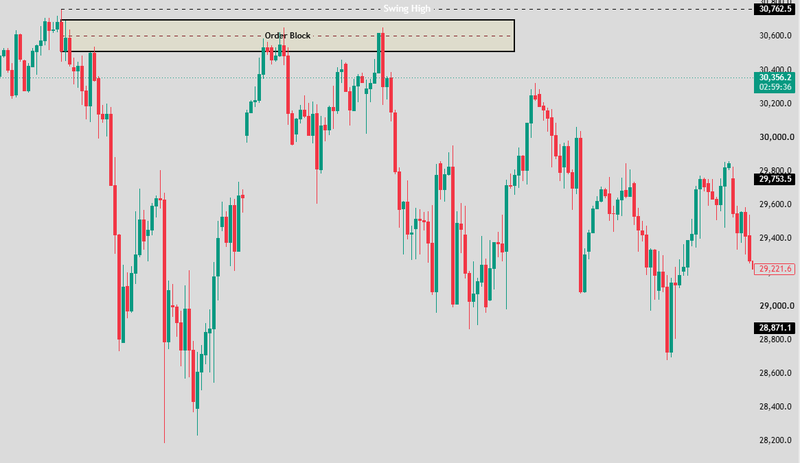
Mean Threshold measures something different. Instead of using the Fair Value Gap, MT measures the body of an Order Block.
The midpoint is calculated using the Order Block's body while excluding the wicks. This distinction matters because Order Blocks represent institutional origin zones rather than price inefficiencies.
Source: Trading view
Why MT matters
Many ICT traders expect price to react before reaching the opposite side of the Order Block. The Mean Threshold often becomes the balance point where buyers or sellers defend the zone.
CE vs. MT: The key difference
The easiest way to remember the distinction is to focus on the price structure being measured. CE measures the midpoint of an imbalance. MT measures the midpoint of an Order Block body. Both use the 50% principle. They simply apply it to different institutional arrays.
The sniper entry mechanic
Some ICT traders use CE and MT to refine entries rather than entering across the entire zone. Instead of buying anywhere inside a Fair Value Gap, they place a limit order near the Consequent Encroachment. Instead of using the full Order Block, they focus on the Mean Threshold.
The advantage is straightforward
A more precise entry often allows a tighter stop-loss while improving the potential Risk-to-Reward ratio. The important point is that precision should never replace confirmation.
A perfect CE or MT level still becomes stronger when it aligns with displacement, market structure, and higher timeframe liquidity.
Candle body vs. wick closures
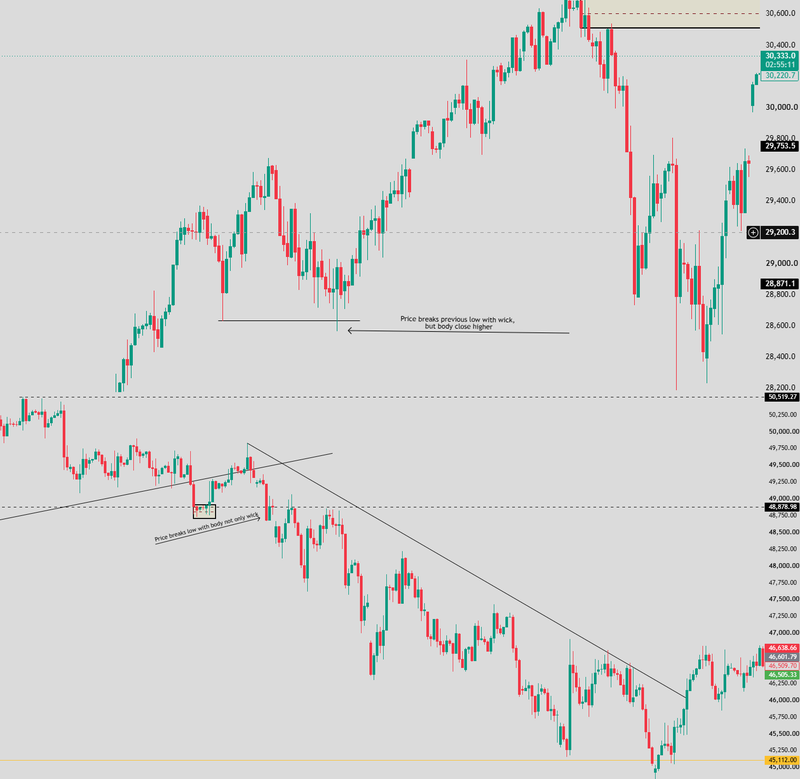
One of the most useful ICT nuances involves how candles interact with these 50% levels. Wicks do the damage; bodies tell the story Price often pushes beyond CE or MT with a wick. That alone does not invalidate the setup.
The wick may simply represent another liquidity sweep before price continues. The candle body carries more weight because it shows where the market accepted price. This is why many ICT traders tolerate temporary wick violations while remaining cautious about body closes beyond the level.
When the setup begins failing
The warning sign appears when the candle body closes decisively beyond the CE or MT. At that point, the institutional array begins losing credibility. Instead of treating the level as active support or resistance, traders begin watching for a Market Structure Shift or a broader change in order flow.
The difference is subtle but important. A wick tests the level. A close body suggests the market has started accepting prices beyond it.
Source: Trading view
Risks of the 50% Rule
The biggest misconception is treating every 50% level as an automatic entry. The rule works best as a filter, not as a standalone signal.
One common mistake is drawing the dealing range incorrectly. If the higher-timeframe swing points are wrong, premium and discount become misleading.
Another risk is ignoring market structure. A perfect discount retracement still becomes weaker if bullish displacement never appears.
News events create another challenge because high-impact releases can push candle bodies beyond CE or MT before normal market behaviour returns.
Finally, traders should avoid forcing CE and MT onto every Fair Value Gap or Order Block. The strongest reactions usually happen when these levels align with liquidity, displacement, and the broader higher-timeframe narrative.
The safest approach is to let the 50% Rule improve trade selection rather than expecting the midpoint itself to reverse the market every time.
FAQs
What is the ICT 50% Rule?
The ICT 50% Rule is a trading concept that divides a dealing range into Premium and Discount zones using the midpoint of the range. It helps traders decide whether price is relatively expensive or cheap before looking for an entry.
What does the 50% level mean in ICT?
The 50% level represents Equilibrium, or fair value, within a dealing range. Price above it is considered premium, while price below it is considered discount.
What is the difference between Premium and Discount in ICT?
Premium is the upper half of a dealing range where bearish setups are generally favoured, while Discount is the lower half where bullish setups are generally preferred.
How do you draw the ICT 50% Rule?
Draw a Fibonacci retracement between a valid higher timeframe swing high and swing low that defines the current dealing range. The midpoint of that range becomes the 50% Equilibrium level.