Help
Help 
ICT vs SMC explained: what traders need to know
ICT and SMC are two of the most discussed approaches in modern price action trading. Both focus on liquidity, market structure, institutional behaviour, and the idea that price often moves in ways that trap impatient traders before moving toward a more important target.

ICT stands for Inner Circle Trader and refers to a specific trading methodology.
SMC stands for Smart Money Concepts and is a broader way of reading liquidity and market structure.
Both approaches focus on liquidity, order flow, market structure, and trap traders.
What is ICT?
ICT stands for Inner Circle Trader. It is a trading methodology built around liquidity, time, market structure, and price delivery.
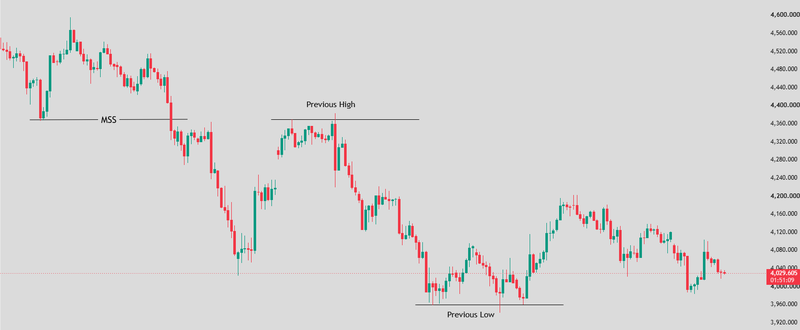
ICT traders do not just look for support and resistance. They ask where liquidity is sitting, which side of the market looks trapped, and whether price is moving during a time window where a stronger move is more likely. This is why ICT traders often talk about fair value gaps, order blocks, liquidity pools, market structure shifts, optimal trade entries, kill zones, and the power of 3.
The main idea is that price does not move randomly. It often moves toward areas where orders are resting. These areas can be previous highs, previous lows, equal highs, equal lows, or obvious breakout zones. ICT traders try to map where that liquidity is and how price may behave before reaching it.
ICT can be useful because it gives traders a detailed way to read the chart. But that same detail can become a problem. The method has many terms, rules, and conditions. A beginner can easily start thinking every candle is a clue and every small move has a hidden meaning. That usually leads to overthinking.
Source: Trading view
What is SMC?
SMC stands for Smart Money Concepts. It is a broader way of reading price action through the behaviour of larger market participants.
The idea behind SMC is that banks, funds, institutions, and other large players need liquidity to enter and exit positions. They cannot always buy or sell large sizes at one price without moving the market. So, SMC traders focus on where liquidity is likely to be sat and how price may move toward those areas.
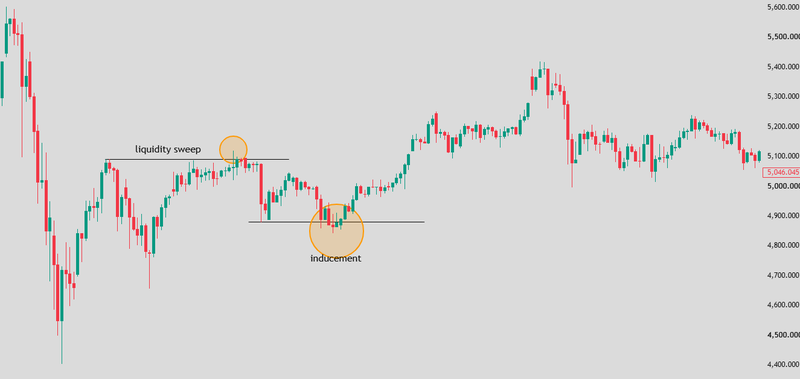
SMC often includes market structure, break of structure, change of character, order blocks, liquidity sweeps, inducement, imbalance, fair value gaps, and premium or discount zones.
What makes SMC popular is that it feels closer to how markets move. Instead of asking only whether an indicator is overbought or oversold, the trader asks better questions. Where are buyers trapped? Where are sellers trapped? Where are stops likely placed? Did price really accept the breakout, or was it only a sweep?
Source: Trading view
Difference between SMC and ICT
SMC covers the broad ideas: liquidity, structure, order blocks, inducement, imbalances, and smart money behaviour. Traders can use these ideas in many different ways. That flexibility can be helpful, but it can also make SMC vague if the trader does not define the rules clearly.
ICT uses many of the same ideas, but with its own structure, terminology, timing models, and setups. ICT traders often pay more attention to kill zones, session timing, liquidity draws, fair value gaps, market maker models, and specific price delivery patterns.
A simple way to think about it is this: SMC explains the market through smart money behaviour. ICT gives a more detailed rulebook for how that behaviour may appear on the chart. That is why two traders can look at the same setup, and both talk about liquidity, but trade it differently. One trader may use a simple SMC view and wait for a sweep and structure shift. Another may wait for a specific ICT model during a specific session window.
Both traders may be reading the same market. They are just using different levels of detail. The risk with SMC is being too loose. The risk with ICT is becoming too complicated.
Shared concepts between SMC and ICT
SMC and ICT share the same foundation. Both try to read price through liquidity and structure rather than relying only on traditional retail indicators.
The language may change, but the core idea is similar: price often moves toward liquidity, reacts around important zones, and creates traps before the cleaner move develops.
That is why many traders mix the two. Some use SMC structure with ICT entries. Others use ICT concepts but explain them with simpler SMC language. The label matters less than the process. What matters is whether the trader understands why a level matters and what would prove the idea wrong.
Liquidity
Liquidity is one of the most important ideas in both ICT and SMC.
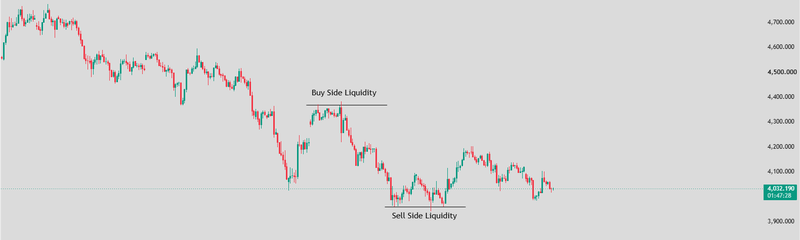
Liquidity usually sits where other traders place stops or breaks out orders. That can be above equal highs, below equal lows, around previous swing points, or near clean support and resistance levels.
This is why price often pushes just beyond an obvious level before reversing. It is not always a true breakout. Sometimes it is a sweep. The market moves into that area, triggers orders, and then turns the other way.
Source: Trading view
Order blocks
Order blocks are zones where traders believe larger buying or selling activity may have entered the market.
In both ICT and SMC, traders often watch these areas when price returns to them. The idea is that if price reacted strongly from a zone before, that zone may matter again later.
But the mistake is marking every candle as an order block. A useful order block needs context. It should fit the market structure, appear near liquidity, and ideally come before or after a strong displacement move.
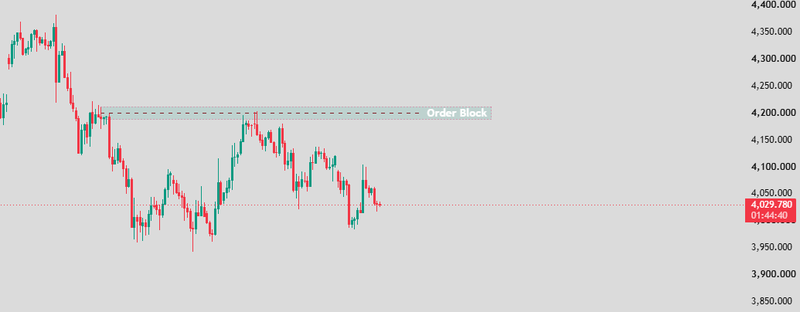
Source: Trading view
Fair value gaps and imbalance
Fair value gaps, also called imbalances, are areas where prices moved quickly and left inefficient price action behind.
Traders watch these zones because price may return to them before continuing. The logic is that a strong move can leave behind an area where trading was thin, and the market may revisit it later.
But a fair value gap is not automatically a trade. It becomes more useful when it comes to the trend, liquidity, market structure, and a clear reason for price to react there.
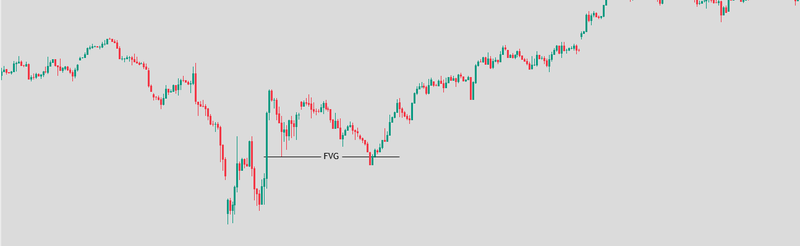
Source: Trading view
Market structure
Market structure is the backbone of both approaches.
Traders look at whether price is making higher highs and higher lows, lower highs and lower lows, or starting to shift direction. In SMC, traders often use terms like break of structure and change of character. ICT traders may describe similar ideas through market structure shifts.
Without structure, everything becomes random. A sweep, order block, or fair value gap means much less if the trader does not know whether the market is trending, ranging, reversing, or building liquidity.
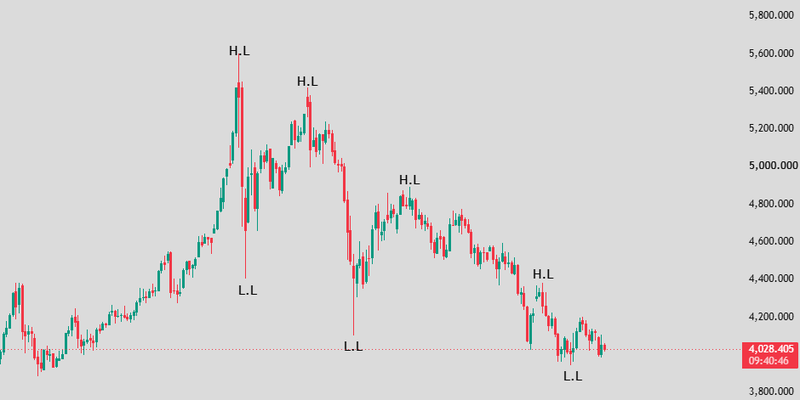
Source: Trading view
Displacement
Displacement means a strong, clean move away from a level.
Both ICT and SMC traders care about displacement because it can show that one side of the market has taken control. A weak break is easy to ignore. A strong move with clear candles and momentum tells a different story.
Displacement often gives more weight to a setup, especially after a liquidity sweep or a reaction from an important zone.
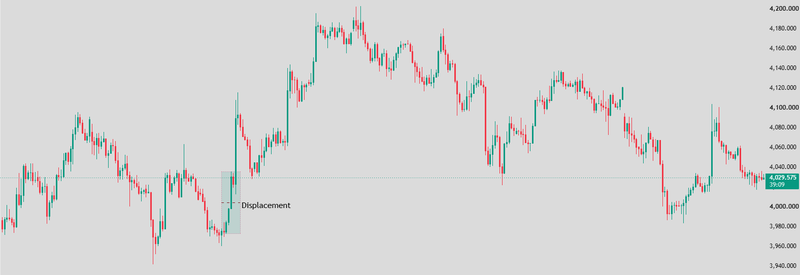
Source: Trading view
Inducement
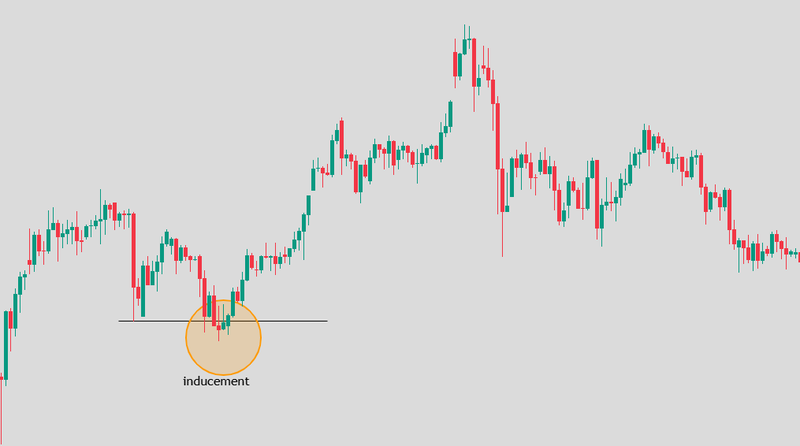
Inducement is the move that attracts traders into the market before price moves against them.
For example, price may break above a clean high and attract buyers, only to reverse and move lower. Or price may break below a clean low and attract sellers, then turn higher.
This is one of the most useful ideas in both ICT and SMC because it teaches traders not to chase the first obvious move. The cleanest setup on the chart is often the one designed to pull traders in too early.
Source: Trading view
Which one should traders choose?
SMC may be easier if you want a cleaner framework. It can help you understand market structure, liquidity sweeps, order blocks, and inducement without getting lost in too many terms at once. For many traders, this is a better starting point because it teaches the main market logic in a more flexible way.
ICT may be better if you want a detailed model. It can give more structure around timing, session behaviour, liquidity draws, and entry logic. But it usually requires more patience. Traders who jump into ICT too quickly can get overwhelmed because there are many terms and setups to understand.
A practical path is to start with the shared basics. Learn liquidity first. Learn market structure. Learn how inducement works. Learn the difference between a real breakout and a failed breakout. Learn how price reacts around previous highs and lows. Once that foundation is clear, ICT concepts become easier to understand.
The wrong choice is trying to learn everything at once. That usually leads to confusion. A trader starts marking every order block, every fair value gap, every sweep, every CHOCH, and every session level. The chart becomes crowded, and the decision-making becomes worse.
FAQs
What is ICT in trading?
ICT stands for Inner Circle Trader. It is a trading methodology that focuses on liquidity, timing, market structure, and how price moves toward specific targets. ICT traders use concepts such as fair value gaps, order blocks, market structure shifts, kill zones, and power of 3. The goal is to understand where liquidity is sitting and how price may move toward it.
What is SMC in trading?
SMC stands for Smart Money Concepts. It is a way of reading price action through liquidity, market structure, and the behaviour of institutions and larger market participants. SMC focuses on where stop orders may be sitting, liquidity sweeps, order blocks, imbalances, and breakout traps that can push retail traders into poor decisions.
What is the difference between ICT and SMC?
The main difference is that SMC is a broader framework that explains the market through liquidity and smart money behaviour, while ICT is a more detailed methodology with specific terms, timing models, and entry concepts. SMC can be simpler and more flexible, while ICT can offer more precise rules, but may feel complex for beginners if learned too quickly.
Is ICT better than SMC?
Not necessarily. ICT is not always better than SMC, and SMC is not always better than ICT. The better choice depends on how a trader thinks and trades. Traders who want a cleaner framework for liquidity and structure may prefer SMC. Traders who want a more detailed model for timing and entries may prefer ICT. Clear rules and risk management matter more than the label.
Can ICT and SMC be used together?
Yes. Many traders use ICT and SMC together because both share key ideas such as liquidity, market structure, order blocks, and liquidity sweeps. A trader may use SMC to understand the bigger picture, then use ICT concepts to refine timing or entries. The key is not to overload the plan with too many terms and no clear rules.