Help
Help Infrastructure investing: key factors and market drivers
Infrastructure investment drives essential services, being commonly characterised by inelastic demand, predictable cash flows, and natural inflation hedging through regulated contracts. Investors typically participate via private or listed markets.

Infrastructure encompasses essential assets with inelastic demand and stable cash flows, although it faces high barriers to entry and regulatory risks.
It serves as a natural hedge against inflation by adjusting contractually defined revenue and passing operational cost increases on to the end user.
Listed infrastructure provides liquidity alongside greater volatility; conversely, private funds rely on discounted cash flow valuations, focusing on asset-level performance metrics.
Stock market instruments, such as ETFs and REITs, facilitate portfolio diversification, although they remain sensitive to shifts in interest rates.
What is infrastructure investing?
Infrastructure investment is an asset management strategy aimed at funding and constructing essential services necessary for the proper functioning of society and the sustained execution of economic activity. Consequently, investment in infrastructure is considered a fundamental pillar of global economies, typically accounting for a substantial weight of a nation's gross domestic product (GDP).
While the assets targeted by infrastructure investment are diverse, they typically encompass transportation networks, utility facilities, waste and water management systems, digital infrastructure, energy interconnections, and social housing developments.
Inelasticity of demand and monopolistic position
Demand for infrastructure assets tends to be inelastic. Regardless of the broader economic cycle—whether in expansion or contraction—essential societal services must continue to operate and be maintained, as they are indispensable to daily life.
However, infrastructure investment rarely takes place within a framework of free competition. High initial capital requirements, geographical constraints, and exclusive concessionary regulatory frameworks create formidable barriers to entry. This dynamic generates the risk of natural monopolies or highly restricted competitive environments. Such market concentration introduces operational and systemic risks, as dominant firms exert substantial influence over pricing, while poor management or predatory practices can threaten the stability of the broader economic system.
Cash flow stability and financial visibility
Infrastructure projects tend to generate long-dated cash flows with a high degree of predictability. This durability, coupled with the underlying inelasticity of demand, allows investors to model underwriting assumptions with a relatively low margin of error. Provided that project revenues and operational costs remain stable, key valuation metrics—such as the internal rate of return or the capital payback period—exhibit a higher probability of fulfilment compared to other asset classes.
Nevertheless, infrastructure assets carry distinct risks. Regulatory risk is particularly prominent, as shifts in legislation or public policy priorities following a change in government can materially impair project viability. Such disruptions typically manifest through altered concession terms, unexpected regulatory mandates, permitting delays, or the early revocation of operating licenses.
Inflation protection mechanisms
A defining feature of infrastructure investment is its capacity to serve as an intrinsic hedge against inflation. This mechanism functions because concession contracts frequently incorporate periodic revenue adjustment clauses monitored by regulatory bodies.
An analysis by KKR & Co. highlights that when broader economic inflation elevates asset replacement costs, operators can offset these pressures through contractually linked revenue increases. Consequently, operators pass rising operational expenses directly to the end user, thereby preserving underlying operating profit margins.
Public vs. private infrastructure
Investors primarily access infrastructure through two distinct channels: the listed infrastructure market and private unlisted funds. Although both vehicles share the same underlying asset base, their valuation dynamics and volatility profiles differ significantly.
Valuation mechanisms and volatility smoothing effect
Listed infrastructure offers superior liquidity, as these public assets are accessible to global investors, thereby mitigating entry and exit friction. However, because these instruments trade within the stock market, they are exposed to macroeconomic shifts, geopolitical developments, and broader market sentiment. Consequently, listed assets exhibit higher price volatility due to their implicit relationship with public equity indices.
Conversely, private infrastructure funds exhibit lower liquidity, as investment access is restricted to institutional or qualified investors. This illiquidity dampens short-term price volatility, as private fund valuations are anchored in asset-specific fundamentals rather than daily market sentiment. Discounted cash flow (DCF) models serve as the primary valuation methodology, allowing managers to evaluate long-term operational performance metrics rather than macroeconomic market noise.
Investment vehicles and traded instruments
Investors can gain exposure to infrastructure through several exchange-traded instruments. The most prominent vehicles include Exchange-Traded Funds (ETFs), Real Estate Investment Trusts (REITs), and securitised project-finance assets.
Institutional allocation to infrastructure has expanded steadily because the asset class historically demonstrates a low correlation with traditional equities, enabling portfolio managers to enhance diversification strategies.
Exchange-traded vehicles
Exchange-Traded Funds (ETFs) offer diversified exposure by bundling equities across related sub-sectors, such as construction, civil engineering, raw materials, and regulated utilities. These funds generally benefit from public sector capital expenditure on public works, providing broad, indirect access to the infrastructure ecosystem.
Real Estate Investment Trusts (REITs) enable public trading of physical, income-generating infrastructure assets on a global scale. Investing through REIT structures allows market participants to access large-scale real estate and infrastructure yields without committing the substantial upfront capital required for direct asset acquisition. As a result, investors capture value through capital appreciation alongside regular dividend distributions funded by underlying rental income.
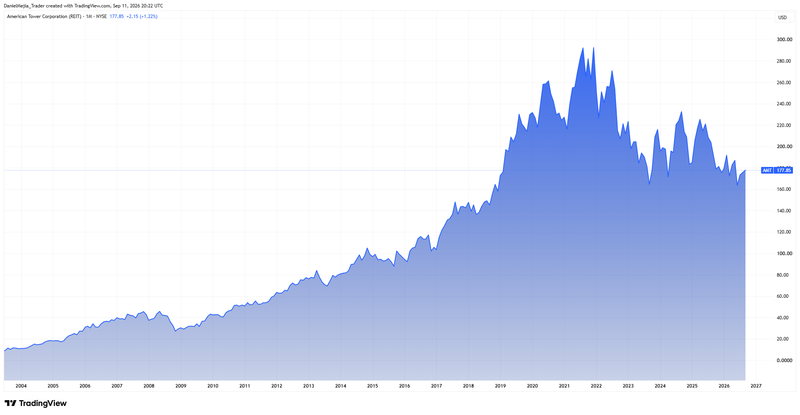
Figure 1. American Tower Corporation (REIT Example). Source: Data from the NYSE Exchange; Figure obtained from TradingView.
Macroeconomic risks, interest rate sensitivity, and market environment
Exchange-traded infrastructure assets are sensitive to macroeconomic fluctuations, geopolitical events, and monetary policy shifts, as these external factors drive overall market sentiment and alter market-implied asset valuations.
Sensitivity to interest rates
Because infrastructure assets are valued based on their long-dated cash flows, rising interest rates directly impact their perceived intrinsic value. Higher discount rates reduce the present value of future cash flows, compressing overall asset valuations. Furthermore, higher central bank reference rates elevate sovereign bond yields, driving capital outflows from listed infrastructure equities toward fixed-income alternatives offering more competitive risk-adjusted returns.
Conclusion
Infrastructure investing represents a strategic pillar that combines financial stability, inflation protection, and portfolio diversification. While listed vehicles such as REITs and ETFs offer liquidity and operational flexibility, investors must manage exposure to interest rate sensitivity, regulatory shifts, and oligopolistic market structures. Ultimately, navigating the distinct dynamics of public and private markets is essential for optimising long-term risk-adjusted returns and mitigating portfolio volatility.
If you're interested in trading indices, foreign exchange, shares, or commodities, consider exploring the CFD contracts offered by Equiti Group. Please note that trading leveraged derivatives involves a high level of risk and may not be suitable for all investors.
FAQs
What is infrastructure investment and why is it critical to the economy?
It is an investment strategy focused on funding and maintaining essential services vital to economic and social stability, including transportation networks, water management, energy grids, social housing, and digital infrastructure. It is critical to economic performance because it underpins productive capacity and constitutes a major component of national Gross Domestic Product (GDP).
Why do infrastructure projects offer financial stability and protection against inflation?
Infrastructure assets benefit from inelastic demand, which generates predictable, long-duration cash flows. They provide inflation protection because concession contracts frequently incorporate regulatory revenue-adjustment clauses. This allows operators to pass operational cost increases onto the end user, safeguarding operating profit margins.
What is the main difference between listed and private infrastructure?
Listed infrastructure operates in public stock markets, offering high liquidity but subjecting assets to broader market volatility and sentiment. Private infrastructure is restricted to institutional investors, which insulates the asset class from short-term stock market fluctuations.
How do interest rates affect listed infrastructure assets?
Rising interest rates increase the discount rate applied to future cash flows, reducing the present value of the underlying assets. Additionally, higher yields on risk-free government bonds make fixed-income instruments more attractive, driving capital away from listed infrastructure assets and depressing their market valuations.