Help
Help 
Liquidity, liquidity voids and liquidity runs explained
Liquidity is one of the most important concepts in financial markets. It helps explain why prices can move smoothly through some areas, accelerate sharply through others, and sometimes return to previously traded zones.

Market liquidity refers to how easily orders can be bought or sold without causing a large change in price.
Buy-side and sell-side liquidity is often built around obvious highs, lows and other levels where traders place stop and pending orders.
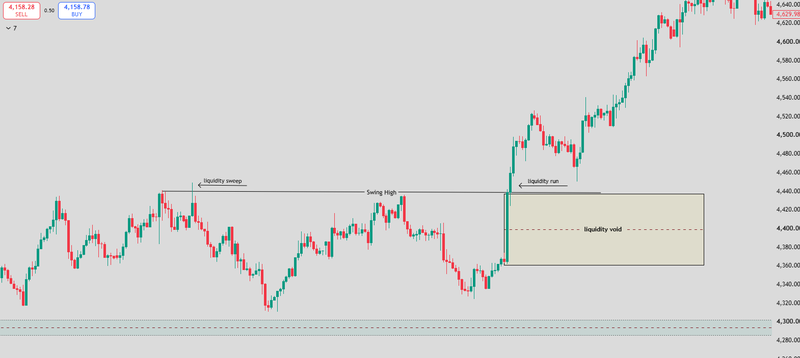
A liquidity void is a wide area created by a fast, one-directional move with limited overlap, while a liquidity run occurs when prices take liquidity and continue in the same direction.
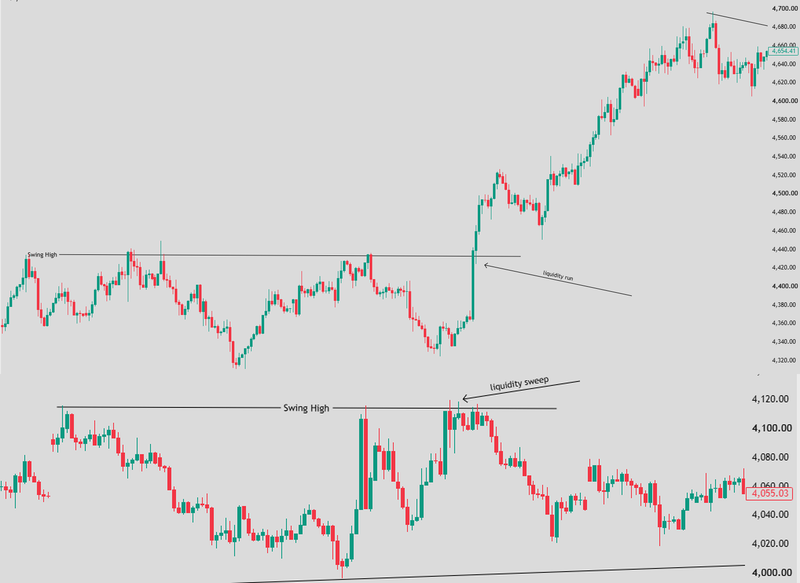
The key difference between a liquidity run and a liquidity sweep is what happens after liquidity is taken: continuation suggests a run, while a sharp reversal suggests a sweep.
What is market liquidity?
Market liquidity refers to how easily an asset can be bought or sold without causing a large change in its price. A highly liquid market has enough buyers and sellers to absorb transactions relatively efficiently, while a less liquid market can experience larger price movements when sizeable orders enter or leave.
This is why liquidity matters to traders
Price does not move simply because someone wants to buy or sell. Transactions need opposing orders. When there is enough liquidity around the current price, buying and selling can take place without forcing the market to move significantly to find the next available orders.
Why is liquidity important to large institutions?
The relationship between liquidity and large orders becomes particularly important when looking at institutional trading.
A retail trader can often enter or exit a small position without having a meaningful effect on the market. A large institution managing a substantial position faces a different challenge. Trying to execute a very large order immediately can move the market against the institution and increase the average execution price.
Large participants therefore need sufficient opposing orders to execute substantial positions more efficiently. This is one reason institutional traders pay close attention to liquid markets and why areas containing significant order flow can become important.
liquidity pools
This is also where the idea of liquidity pools enters technical analysis. Traders look for areas where orders are likely to be concentrated and then observe how price behaves when it reaches those areas.
A normal retail chart does not show exactly where every institutional order is located. Liquidity mapping is therefore an interpretation of market structure and likely order placement, rather than a direct view of institutional order flow.
Where does liquidity usually sit?
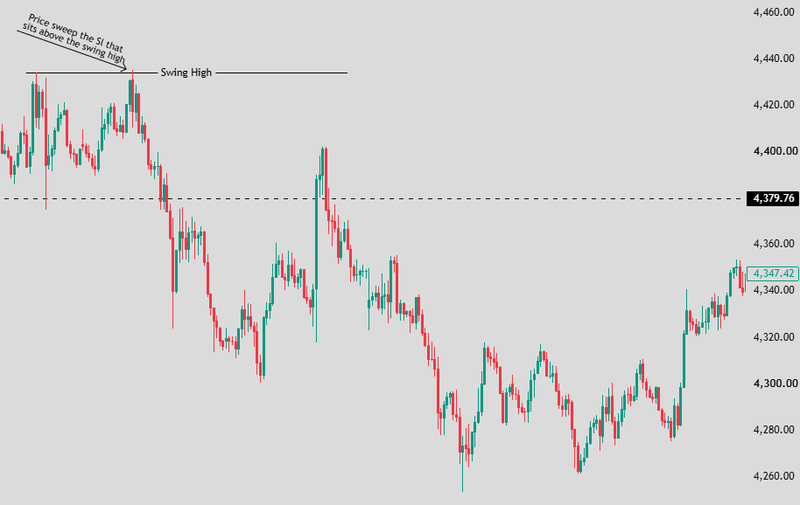
Previous swing highs and lows are among the most obvious examples. A trader holding a short position may place a stop-loss above a previous high, while a breakout trader may place a buy-stop in the same area. This creates the possibility of several buy orders being concentrated above the high.
The same principle applies below a previous low. Long traders may place their stop-losses underneath the low, while break-out traders may place sell-stop orders below it. These areas are commonly described as buy-side and sell-side liquidity.
Source: Trading view
What is buy-side liquidity?
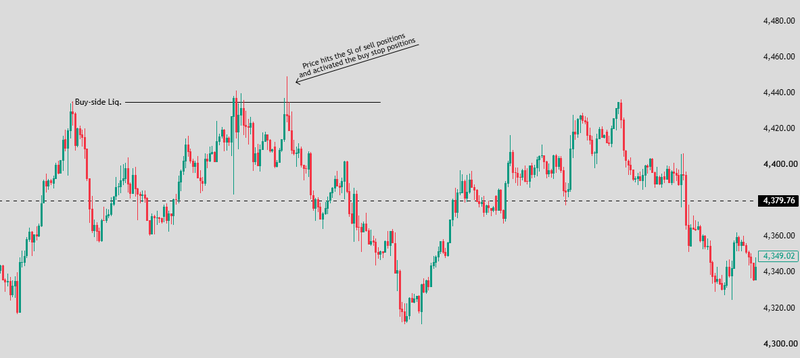
Buy-side liquidity generally refers to buy orders located above an obvious high. Stop-loss orders from short positions and buy-stop orders from breakout traders can both contribute to this pool of potential orders.
When price moves above the high, these orders can be triggered. The important question is what happens next.
If price breaks above the level and continues higher, the move may represent a liquidity run. If price briefly moves above the high and then reverses sharply, traders may interpret the move as a liquidity sweep.
Source: Trading view
What is sell-side liquidity?
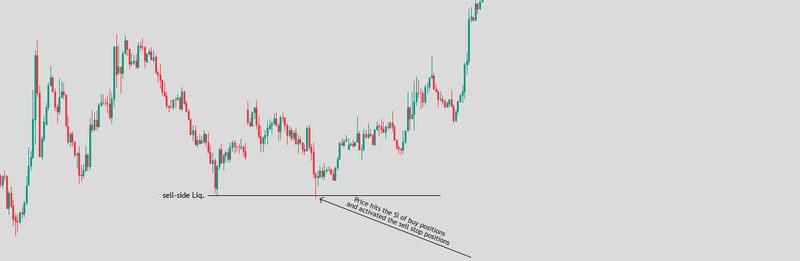
Sell-side liquidity generally refers to sell orders located below an obvious low. Stop-losses from long positions and sell-stop orders from traders expecting a breakdown can accumulate beneath visible lows. When price reaches that area, these orders can be triggered.
Again, the initial move below the low does not tell the whole story. The reaction afterward is what helps traders determine whether the market is continuing lower or rejecting the move.
Source: Trading view
What is a liquidity void?
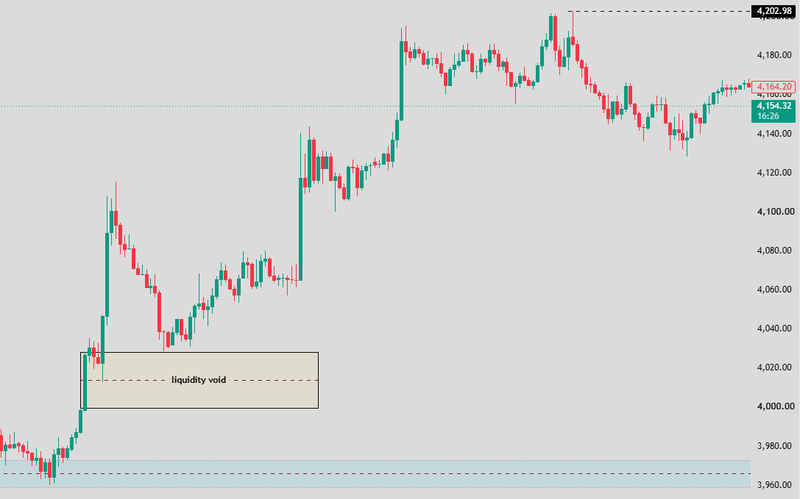
A liquidity void is a broad price area created by a rapid, one-directional movement in which price travels through the range with relatively little overlap or retracement.
On a chart, a liquidity void can appear as several large consecutive candles moving strongly in one direction. The candles often have limited overlapping wicks, giving the move a visually clean and aggressive appearance.
The concept is based on the idea that price moved through the area quickly rather than spending much time trading back and forth between buyers and sellers.
This makes a liquidity void different from a normal consolidation range. A consolidation shows repeated two-way trading, while a void is associated with rapid expansion.
Source: Trading view
How can traders identify a liquidity void?
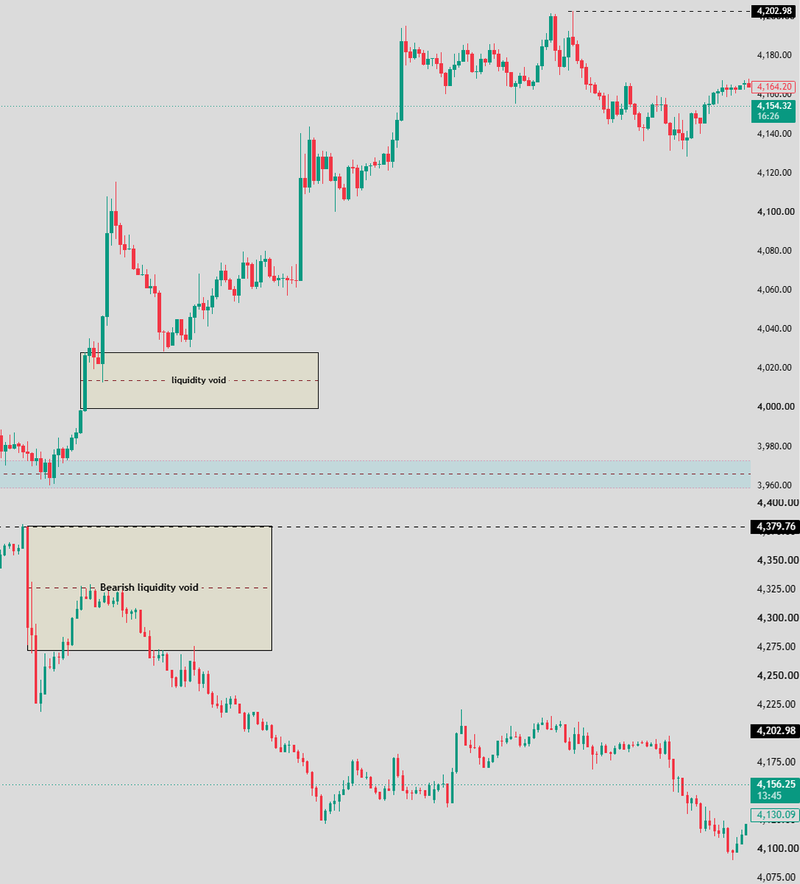
A bullish liquidity void may develop when several large bullish candles push price rapidly higher. A bearish liquidity void can form when consecutive bearish candles drive price sharply lower.
The candles do not need to look identical, but the overall movement should show clear directional expansion with relatively little overlap.
News releases, market opens and major breakouts can all produce these types of moves. This is why context matters when identifying a liquidity void. Not every large candle automatically represents a meaningful inefficiency.
Source: Trading view
Is a liquidity void the same as a Fair Value Gap?
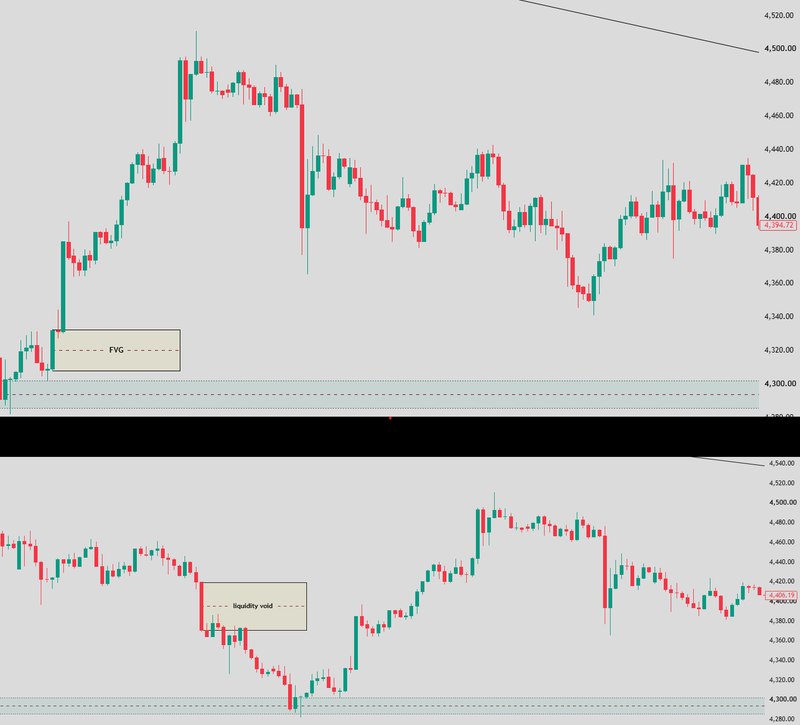
A Fair Value Gap is generally a smaller three-candle imbalance, while a liquidity void can describe a much broader area created by an aggressive price movement. A single liquidity void can contain several Fair Value Gaps within the larger move.
The two concepts are therefore related, but they operate on different scales. A trader may identify the broader void first and then use the Fair Value Gaps inside it to study where price could potentially be retraced.
Source: Trading view
What is a liquidity run?
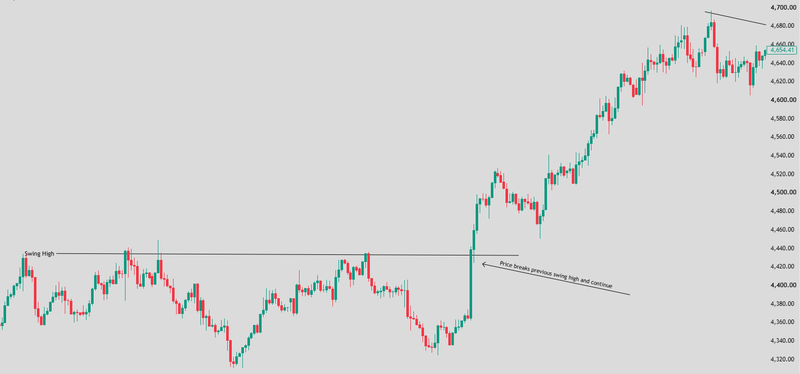
A liquidity run occurs when price reaches an obvious liquidity pool, takes the available orders and continues aggressively in the same direction.
Imagine a market that has been trending higher and approaches a previous swing high. Price breaks above the high and triggers buy-side liquidity. Instead of rejecting the breakout, buyers continue to push price higher.
Source: Trading view
What is the difference between a liquidity run and a liquidity sweep?
The difference is primarily the reaction after liquidity is taken. A liquidity sweep occurs when price moves through an obvious high or low, triggers the orders around that level and then reverse back in the opposite direction.
A liquidity run occurs when prices are at the same type of level but continue in the direction of the breakout.
This is why the initial breach can be misleading. Now price moves above a high, traders cannot immediately know whether it is a sweep or the beginning of a continuation.
The subsequent price action provides confirmation
For example, gold may trade below a previous high and then suddenly push above it. If price quickly falls back below the high and sellers take control, the move may develop into a liquidity sweep.
Source: Trading view
Liquidity void vs liquidity run: what are the key differences?
A liquidity void and a liquidity run describe different parts of market behaviour. A liquidity void focuses on the area created by rapid price movement. It tells traders that price travelled through a range quickly and with relatively little two-way trading.
A liquidity run focuses on the continuation of price after liquidity has been taken. It describes what happens when the market breaks through an obvious liquidity pool and keeps moving.
The two can occur together
For example, a market can break above a previous high, trigger buy-side liquidity and continue higher in a strong expansion. The continuation beyond the high can be viewed as a liquidity run, while the aggressive price movement created during that expansion may leave a liquidity void behind.
Source: Trading view
What are the risks of trading liquidity concepts?
Liquidity concepts can provide a useful framework for understanding price action, but they do not reveal the market's intentions with certainty.
A trader cannot see every stop-loss, pending order or institutional position on a standard chart. A visible high may attract orders, but the exact amount of liquidity around that level is unknown.
Liquidity voids also create a common source of confusion. Price may return to rebalance a void, but it may also continue trending without revisiting it.
The same applies to liquidity runs. A breakout can initially look strong before reversing, particularly around major economic releases or periods of extreme volatility.
There is also a risk of entering too early. Traders may anticipate a sweep before the level is taken or assume a breakout will continue before the market has shown acceptance above or below the level.
The objective is not to predict every move. It is to understand where liquidity may be concentrated and then observe how price behaves when that liquidity is reached.
FAQs
What is market liquidity?
Market liquidity refers to how easily an asset can be bought or sold without causing a significant change in its price. Higher liquidity generally means the market can absorb larger transactions more efficiently.
What is buy-side liquidity?
Buy-side liquidity refers to buy orders that may be concentrated above obvious highs. These can include stop-loss orders from short positions and buy-stop orders from breakout traders.
What is sell-side liquidity?
Sell-side liquidity refers to sell orders that may be concentrated below obvious lows. These can include stop-loss orders from long positions and sell-stop orders from traders expecting a breakdown.
What is a liquidity void?
A liquidity void is a broad area created by a rapid price movement in which there is relatively little candle overlap or two-way trading. It can be wider than an individual Fair Value Gap.
What is a liquidity run?
A liquidity run occurs when price takes liquidity around an obvious high or low and continues moving in the same direction with sustained momentum.