Help
Understanding the debasement trade
The debasement trade responds to the deterioration of fiat currencies caused by a combination of macroeconomic pressures. Faced with the erosion of purchasing power and the risk of sovereign default, investors shelter their capital in independent assets such as gold, silver, and Bitcoin.

The debasement trade protects wealth by acquiring safe-haven assets that do not depend on the solvency or monetary decisions of a government.
The expansion of the M2 money supply and the accelerated issuance of debt in the United States have created inflationary pressures and a macrostructural deterioration following the COVID-19 crisis.
The combination of high sovereign debt and high interest rates increases interest payments, persistently widening the fiscal deficit.
Gold, silver, and Bitcoin stand out as key alternatives to diversify wealth in the face of the loss of value in fiat currencies.
What is the debasement trade?
The debasement trade is an investment strategy that consists of acquiring assets that protect capital against the loss of value in fiat currencies, resulting from the deterioration of macroeconomic management within a nation.
As governments accumulate debt, demonstrate difficulties in controlling their fiscal deficits, or expand their money supply—thereby contributing to the emergence of inflationary cycles—investors increasingly question the sustainability of a nation's currency and debt market. This arises because severe macroeconomic imbalances could ultimately force a government into default or insolvency regarding its debt obligations.
Consequently, portfolio managers allocate capital to physical commodities such as gold or silver, as well as digital assets like Bitcoin. These assets are distinctive because they do not rely directly on the solvency, governance, or discretionary decisions of any sovereign state.
Macrostructural catalysts: a case study from the United States
The resurgence of the debasement trade strategy highlights the structural economic instability of the twenty-first century across developed economies that have reliant their growth on the continuous issuance of sovereign debt. This instability stems from the accumulation of fiscal and monetary imbalances, which have generated growing apprehension among institutional investors regarding the long-term capacity of these countries to service their debt obligations.
Monetary expansion
Monetary expansion across Western nations has contributed significantly to periods of high inflation, which became particularly pronounced following the COVID-19 crisis in 2020.
In the United States, according to data published by the Federal Reserve Bank of St. Louis (FRED), the M2 money supply rose from $4.6 trillion in January 2000 to $23.3 trillion by August 2026—an increase of approximately 406%. However, the most acute surge occurred between March 2020 and March 2021, when the money supply expanded from $15.5 trillion to $20.1 trillion, representing a 29% increase in a single year.
This substantial expansion was driven by a combination of critical factors: quantitative easing (QE) by the Federal Reserve; increased debt issuance by the US Department of the Treasury to fund household stimulus and maintain public expenditure; and heightened credit creation by commercial banks aimed at stimulating an economy slowed by population lockdowns. These lockdowns disrupted global supply chains, precipitating a sharp rise in inflation as aggregate demand—which remained relatively constant—far outpaced restricted aggregate supply.
Consequently, this elevated inflation became a central driver of structural economic changes, as the Federal Reserve failed to return inflation to its 2% target over a period exceeding five years. In this environment, while geopolitical tensions such as the Russia–Ukraine and US–Iran conflicts put upward pressure on prices via energy markets, the 2020 monetary expansion served as the catalyst preceding broader macroeconomic stress, including higher debt servicing costs and expanding fiscal deficits.
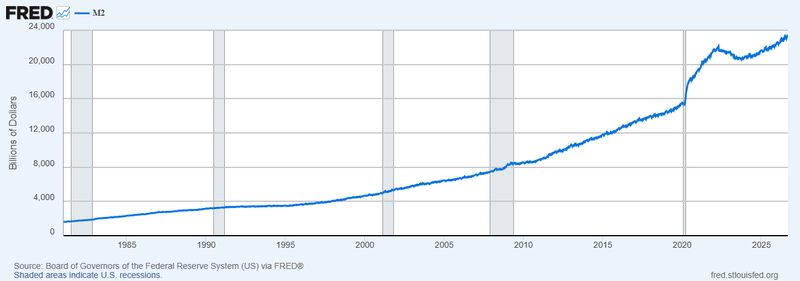
Figure 1. Board of Governors of the Federal Reserve System (US), M2 (1981-2026). Source: Figure retrieved from FRED, Federal Reserve Bank of St. Louis.
Rising revels of indebtedness and cost of debt
Continuing with the United States as an illustrative case, sovereign debt has reached historical highs. Data from FRED indicates that total public debt reached $39.46 trillion by the second quarter of 2026, bringing the total debt-to-gross domestic product (GDP) ratio to approximately 121%.
Furthermore, during the period under review, the Federal Reserve maintained a predominantly restrictive monetary policy stance to combat persistent inflationary pressures. This created a high interest rate environment relative to recent historical benchmarks, with the Federal Funds Target Rate standing at 4% in October 2026.
As a result, the combination of extensive debt volumes and elevated benchmark rates has substantially increased net interest payments required to service public debt. This scenario has exerted severe pressure on the US fiscal balance, as debt servicing costs have become an increasingly component of federal expenditure.
Persistence of fiscal deficits
A fiscal deficit describes a macroeconomic condition in which government expenditure exceeds revenue during a given fiscal period. Persistent or expanding fiscal deficits are suboptimal, as governments must finance the shortfall either through additional debt issuance or through structural spending cuts, such as reductions in social programmes or public infrastructure investment.
In the case of the United States, Congressional Budget Office (CBO) data shows that the fiscal deficit reached 5.8% of GDP at the close of fiscal year 2025—a notable milestone well above the historical average of 3%. This growing structural deficit is primarily attributable to rising allocations within the federal budget for net interest payments on national debt, combined with federal revenues failing to grow in tandem with broader economic expansion.
Key assets in the debasement trade
Although various asset classes can be integrated into debasement trade strategies, three primary assets stand out due to the persistent institutional demand they generate: gold, silver, and Bitcoin.
Gold
Gold is globally recognised as a primary store of value. Its natural geological scarcity and absence of counterparty risk make it a highly valued asset with intrinsic worth, widely used as a reserve asset, safe haven, and hedge against inflation.
Unlike sovereign debt securities, holding physical gold entails no risk of default by a government or corporate entity. Consequently, it retains value even if a government becomes insolvent—an event that typically triggers severe devaluation in the fiat currency in which those sovereign bonds are denominated.
Silver
Silver is similarly valued as a dual-purpose asset. Demand for silver is driven both by its role as a monetary reserve asset—given its status as a precious metal—and by substantial industrial demand, particularly in technology manufacturing and electronics. Because of these factors, the prices of gold and silver tend to exhibit a strong positive correlation over extended periods, making silver an effective alternative for hedging against sovereign credit risks.
Bitcoin
Bitcoin has increasingly been adopted by institutional investors within debasement trade framework as a novel alternative asset during periods of fiat currency debasement and rising fiscal uncertainty. Its fixed maximum supply, enforced by a decentralized protocol resistant to unilateral alteration, prevents governments from discretionarily expanding its issuance.
These structural characteristics position Bitcoin as a viable alternative to traditional financial assets and a compelling candidate for portfolio diversification against risks inherent to the fiat monetary system. However, its historical price volatility and relatively short track record mean it cannot yet be classified as a guaranteed hedge against inflation or sovereign default, as the asset remains susceptible to drawdowns during periods of severe global financial stress.
Conclusion
The resurgence of the debasement trade underscores growing market concern regarding unsustainable monetary and fiscal imbalances within developed economies. The accumulation of record sovereign debt, compounded by high interest rates and persistent inflation, threatens the long-term stability of fiat currencies. In this macroeconomic landscape, traditional assets such as gold and silver, alongside digital alternatives like Bitcoin, have established themselves as essential tools for capital preservation and portfolio diversification against the structural decline of the traditional monetary system.
If you're interested in trading indices, foreign exchange, shares, or commodities, consider exploring the CFD contracts offered by Equiti Group. Please note that trading leveraged derivatives involves a high level of risk and may not be suitable for all investors.
FAQs
What is the debasement trade strategy?
It is an investment approach focused on acquiring real or scarce assets to protect capital against the loss of purchasing power in fiat currencies. The strategy arises when rapid growth in public debt, persistent fiscal deficits, and excessive monetary expansion undermine investor confidence in the long-term financial stability of governments and sovereign bond markets.
What factors triggered inflation in the US from 2020 onwards?
The primary catalyst was the unprecedented expansion of the M2 money supply. This resulted from Federal Reserve quantitative easing, heightened Treasury debt issuance to fund public spending, and expanded commercial bank credit. This rapid influx of liquidity stimulated aggregate demand at a time when global supply chains were severely constrained by pandemic-related restrictions.
How do high debt levels and interest rates impact the fiscal deficit?
The convergence of elevated public debt and higher benchmark interest rates sharply increases the cost of servicing sovereign debt. As a result, a larger share of the federal budget must be allocated to net interest payments, which structurally expands the fiscal deficit over time.
Which assets feature prominently in this strategy, and what are their key attributes?
Gold, silver, and Bitcoin are the primary assets in this strategy. Gold offers geological scarcity and zero counterparty risk; silver combines reserve asset qualities with industrial utility; and Bitcoin provides a programmatically capped supply within a decentralized network free from sovereign control.