Help
Help 
What is copy trading & how to copy expert traders
Copy trading is an investment method that lets you mirror the trades of experienced investors automatically. When the trader you follow opens or closes a position, the action is copied to your account based on the amount you have allocated.

Copy trading allows investors to automatically mirror another trader’s positions in real time.
Most platforms show key data such as past returns, trading history and maximum drawdown.
One of the reasons copy trading has become popular is the flexibility it offers.
What is copy trading?
Copy trading is an investment service that allows investors to automatically replicate another trader's positions in real time. Instead of researching every market opportunity themselves, investors choose an experienced trader often called a strategy provider and allow the platform to mirror that trader's activity inside their own account.
Whenever the strategy provider opens a new trade, adjusts an existing position or exists in the market, the same action is carried out automatically in the follower's account. Position sizes are normally adjusted according to the amount of capital each investor has allocated, allowing both large and small accounts to follow the same strategy proportionally.
One of the defining features of copy trading is that investors remain in control of their accounts. They decide who to follow, how much money to allocate, whether to copy multiple traders, and when to stop copying altogether.
The Evolution of Copy Trading
Long before automated platforms existed, traders regularly shared market ideas through online forums, newsletters and chat rooms. Investors could read market analysis and attempt to replicate trades manually, but execution often became a challenge. By the time many investors entered the market, prices had already moved.
As trading platforms became more sophisticated, brokers introduced social trading networks that displayed traders' historical performance, risk profiles and trading activity. Investors could observe how experienced traders approached the market rather than relying solely on written analysis.
Instead of manually following trade recommendations, investors could connect their accounts directly to strategy providers. Every trade would then be replicated automatically, removing delays and reducing the need for constant market monitoring.
How does copy trading work?
The journey begins by browsing a list of available strategy providers. Most platforms display information such as historical returns, trading history, maximum drawdown, average holding period, preferred asset classes and overall risk level.
From that point onward, the platform automatically mirrors eligible trades in proportion to the investor's allocation. If the strategy provider opens a position on EUR/USD, gold or the Nasdaq 100, the same position is opened automatically in the follower's account.
Importantly, investors are not locked into a strategy. They can increase or reduce their allocation, stop copying a trader, close individual positions manually or diversify by following multiple traders simultaneously.
Automation simplifies execution, but responsibility remains with the investor. Choosing suitable traders, reviewing performance and monitoring risk are still essential parts of successful copy trading.
Markets suited to copy trading
One reason copy trading has become so popular is its flexibility. Rather than being limited to a single market, investors can follow strategies across multiple asset classes depending on their investment objectives.
Forex
The foreign exchange market remains one of the most active areas for copy trading. High liquidity, relatively low transaction costs and 24-hour weekday trading create frequent opportunities for strategy providers. Many traders specialize in major currency pairs such as EUR/USD, GBP/USD and USD/JPY, making forex one of the most widely copied markets.
Indices
Global indices such as the S&P 500, Nasdaq 100, FTSE 100 and DAX attract investors seeking exposure to broader market trends instead of individual companies. Index-focused traders often build strategies around macroeconomic developments, earnings seasons and central bank policy.
Stocks
Some strategy providers concentrate on individual companies, selecting opportunities based on earnings growth, industry trends or long-term investment themes. Investors interested in technology, healthcare, financials or energy can often find traders specialising in those sectors.
Commodities
Gold, silver, crude oil and natural gas are also popular among copy traders. Commodity prices frequently respond to inflation expectations, geopolitical events and supply-demand dynamics, offering opportunities that differ from traditional equity markets.
Cryptocurrencies
Digital assets have become one of the fastest-growing segments of copy trading. Bitcoin, Ethereum and other cryptocurrencies trade around the clock and often experience larger price swings than traditional financial markets. While this volatility can create opportunities, it also increases investment risk, making careful trader selection particularly important for crypto-focused strategies.
How to choose a copy trading platform
The platform you choose plays a much bigger role than simply connecting you to other traders. It determines how transparent the available information is, how reliably trades are copied, what risk controls are available, and ultimately how comfortable you feel investing over the long term. With dozens of copy trading platforms available today, comparing them carefully before opening an account is worthwhile.
Regulation
The first consideration should always be whether the broker operates under the supervision of a recognized financial regulator. Regulation cannot eliminate investment risk, but it does establish standards around client fund protection, operational procedures, and transparency. Trading through a regulated broker also provides greater confidence that the platform follows established compliance and reporting requirements rather than operating without oversight.
Reputation matters
A platform's reputation is built over time. Investors should look beyond marketing material and evaluate how long the broker has operated, the markets it serves, customer support quality, platform stability, and overall client experience. Consistent execution and reliable infrastructure become especially important during periods of high market volatility, when delays or interruptions can affect copied trades.
Look for risk management controls
Good platforms allow investors to decide exactly how much capital to allocate, adjust allocations whenever needed, pause copying, manually close positions, or stop following a trader entirely. These controls help investors adapt their portfolios as market conditions or personal investment objectives change.
Analytics make better decisions possible
Modern copy trading platforms increasingly provide portfolio analytics that allow investors to monitor performance over time. Being able to review returns, drawdowns, asset allocation and overall exposure helps investors understand whether their portfolio remains aligned with their own risk tolerance instead of relying solely on recent profits.
Equiti copy trader
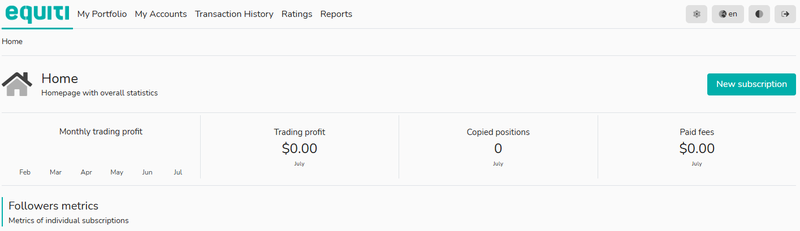
One example of a modern copy trading solution is Equiti Copy Trader, which combines automated trade replication with tools designed to help investors make more informed decisions.
The platform enables clients to browse experienced strategy providers, compare their historical performance and allocate capital according to their own investment objectives. Investors remain in full control of their accounts throughout the process, with the flexibility to increase or reduce allocations, pause copying or stop following a strategy whenever they choose.
Rather than focusing only on returns, Equiti Copy Trader provides access to performance statistics and historical trading data that help investors evaluate how different strategies have behaved under varying market conditions.
Because investors often have different financial goals, the platform also makes it possible to diversify across multiple strategy providers instead of relying on a single trader. Following traders with different approaches and preferred markets can help build a more balanced portfolio while reducing dependence on one individual strategy.
Source: Equiti Copy Platform
How to evaluate and choose a trader to copy
Selecting the right trader is arguably the most important decision in copy trading. While impressive returns naturally attract attention, successful investing is rarely about finding the trader who generated the biggest profits over the past month.
Don't chase the highest returns
One of the most common mistakes among beginners is assuming that the best-performing trader will continue producing exceptional returns indefinitely.
Unusually high returns sometimes reflect unusually high risk. A trader may achieve outstanding short-term gains by using significant leverage or concentrating heavily in a single asset, but those same decisions can also lead to substantial losses when markets move against them.
Look for consistency
Economic conditions change, interest rates rise and fall, geopolitical events create volatility, and investor sentiment shifts over time. A trader who has demonstrated steady performance across different market environments often inspires more confidence than someone whose results rely on a handful of exceptional trades.
Reviewing performance over several months or preferably years can provide valuable insight into how a trader manages changing conditions.
Understand the trader's risk profile
Most copy trading platforms assign a risk score based on factors such as leverage, position sizing, portfolio volatility and trading behaviour. While no rating system is perfect, risk scores offer a useful starting point when comparing different traders.
Equally important is maximum drawdown, which measures the largest decline experienced before the portfolio recovered. Investors with lower risk tolerance may feel more comfortable following traders who produce steady returns while keeping drawdowns relatively moderate.
Choose a strategy that matches your objectives
Some focus on short-term opportunities through day trading or scalping. Others prefer swing trading, holding positions for several days or even weeks. Likewise, some specialise in currencies while others concentrate on indices, commodities, stocks or cryptocurrencies.
Diversify your exposure
Rather than placing all available capital behind one strategy provider, many experienced investors spread their capital across several traders with different market specialisations and trading styles.
Diversification cannot eliminate losses, but it can reduce dependence on any single trader's performance while creating a more balanced investment portfolio.
Benefits of Copy Trading
Copy trading has become increasingly popular because it combines technology with accessibility. Rather than replacing traditional investing, it gives investors another way to participate in financial markets while maintaining control over their accounts.
Make investing more accessible
For many beginners, the biggest challenge isn't opening a trading account—it's knowing where to begin.
Copy trading lowers that barrier by allowing investors to participate in financial markets without needing years of trading experience. Instead of building a strategy entirely from scratch, investors can learn while following experienced market participants.
Although understanding financial markets remains valuable, copy trading provides a practical starting point for those who are still developing their knowledge.
Saves time
Successful trading often requires continuous research.
Economic calendars, earnings reports, inflation data, central bank announcements and geopolitical developments all have the potential to move markets within minutes.
Not everyone has the time to monitor those events throughout the day. Copy trading automates much of the execution process, allowing investors to remain active in the markets without spending hours analyzing charts every week.
Supports diversification
Instead of relying on one investment style, investors can allocate capital across several traders who specialize in different markets. One trader may focus on forex, another on commodities, while a third concentrates on US equities or cryptocurrencies.
Diversifying across multiple strategies can help reduce concentration risk while creating broader market exposure.
FAQs
What is copy trading?
Copy trading is an investment method that allows you to automatically replicate the trades of an experienced investor. When the trader you follow opens, modifies or closes a position, the same action is carried out in your account based on the amount of capital you've allocated.
Is copy trading suitable for beginners?
Yes. Copy trading can be a good starting point for beginners because it allows them to participate in financial markets while learning from more experienced traders. However, beginners should still understand the risks involved and only invest money they can afford to lose.
Which markets can you copy trade?
Depending on the platform, copy trading is available across a variety of markets, including forex, stocks, stock indices, commodities, cryptocurrencies and other CFD products.
Can I stop copying a trader at any time?
Yes. Most copy trading platforms allow you to stop copying a trader whenever you choose. You can usually close copied positions, change your allocation or switch to another strategy provider at any time.