Help
Help What is the Fed's dual mandate?
The Federal Reserve guides the US economy through its dual mandate: price stability and maximum employment. To assess economic conditions, it monitors PCE inflation, the unemployment rate, and real GDP, adjusting reference interest rates and its balance sheet to contain inflationary pressures or stimulate economic growth.

The Fed’s dual mandate seeks to balance price stability and maximum employment to guide economic growth.
To assess the economy, the Fed primarily monitors the PCE inflation, the unemployment rate, and the real GDP rate of change.
The Fed raises interest rates to moderate inflation by making credit more expensive, or reduces them to revive consumption and investment during economic slowdowns.
Through its balance sheet, the Fed injects liquidity by purchasing assets or withdraws monetary stimulus by letting its securities mature during restrictive cycles.
Which are the main objectives for the Federal Reserve?
The Federal Reserve (Fed) is governed by two main mandates: price stability and maximum employment. These core monetary policy objectives differentiate the US central bank from many other global central banks, where price stability tends to be the primary or sole focus.
Price stability objective
The Federal Open Market Committee (FOMC) maintains an explicit long-run inflation target of 2%, established so as not to distort the consumption, saving, and investment decisions of US households and businesses. This objective is considered a neutral benchmark where the growth of the real economy can continue to expand without triggering inflationary or deflationary spirals over time.
On the one hand, if inflation accelerates considerably (an inflationary spiral), it poses significant risks to the general population as purchasing power declines. This severely impacts consumption and investment patterns, disproportionately affecting low-income households that face subsistence pressures.
On the other hand, deflationary spirals (falling price levels) tend to erode corporate profit margins because selling prices must decrease to clear accumulated inventories. This often leads to job losses as companies seek to cut operational costs.
Maximum employment objective
The FOMC defines maximum employment as the highest level of employment that the economy can sustain without generating elevated inflationary pressures. Unlike the inflation target, employment variables do not correspond to a single, fixed numerical metric that the central bank seeks to maintain permanently. Instead, the Federal Reserve analyses contextual structural factors—such as labour force demographics, education levels, technology adoption, and labour market regulations—that influence the labour market.
So long as an expanding level of employment does not exert excessive upward pressure on wage growth and broad price levels, it is considered a healthy and sustainable employment environment.
Economic indicators monitored by the Federal Reserve
While the Federal Reserve constantly analyses various economic metrics to gauge broader conditions, it focuses with particular emphasis on three core indicators intrinsically linked to its dual mandate of price stability and full employment. These key indicators form the core foundation of the central bank’s official economic projections: the Personal Consumption Expenditures (PCE) Price Index, the unemployment rate, and the Gross Domestic Product (GDP) growth rate.
Personal Consumption Expenditures (PCE) Price Index
The Personal Consumption Expenditures (PCE) Price Index is the Fed’s preferred inflation metric because it encompasses a broader scope and a more accurate weighting of US household expenditure compared to the Consumer Price Index (CPI). In this context, the PCE index better reflects dynamic consumer behaviour, such as substitution effects when relative prices change.
Unemployment rate
The unemployment rate measures the proportion of the economically active population actively seeking work but unable to secure employment. While full employment might conceptually be viewed as a state with an exceptionally low unemployment rate, the Fed evaluates broader cyclical and structural factors to determine whether the labour market is stable or experiencing underlying stress.
Gross Domestic Product (GDP) growth rate
Economic growth is fundamentally measured through changes in Gross Domestic Product (GDP). A expanding economy typically exhibits positive growth rates across both year-on-year and quarterly periods. The Federal Reserve continuously tracks GDP performance to analyse consumption, investment, and productivity trends across the US economy, complementing its assessment of inflation containment and maximum employment.
The Fed’s main monetary policy tools
Although the Federal Reserve’s monetary policy toolkit is extensive and continually evolving, two key instruments are monitored closely by market participants due to their substantial impact on the real economy: interest rate decisions and balance sheet adjustments.
Interest rate decision
The Federal Reserve seeks to influence consumption and investment behaviour by raising or lowering its reference interest rate (the federal funds rate). If inflation rises above acceptable levels, the central bank raises interest rates to increase the cost of credit throughout the banking system. Consequently, consumer spending tends to moderate due to higher interest rates on personal loans and mortgages. Simultaneously, corporate investment in productive projects tends to decelerate as the cost of capital increases. Additionally, during such monetary tightening cycles, allocation toward fixed-income investments often increases as yields become more attractive, decreasing consumption.
Conversely, when the economy enters contractionary or stagnant periods, the Federal Reserve lowers interest rates to encourage consumption and capital expenditure through cheaper financing, whilst discouraging capital allocation to fixed income as yields decline.
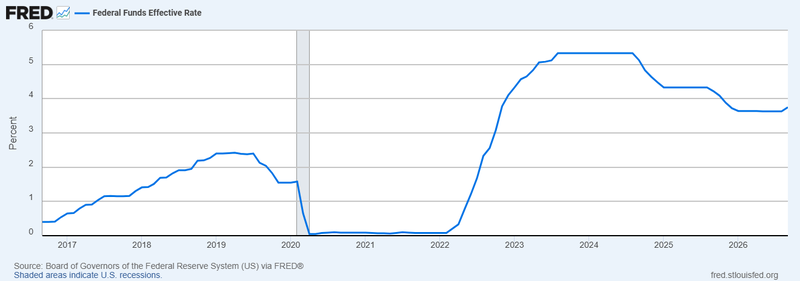
Figure 1. Board of Governors of the Federal Reserve System (US), Federal Funds Effective Rate, retrieved from FRED, Federal Reserve Bank of St. Louis
Balance sheet adjustment
The Federal Reserve can inject liquidity and ease financial conditions across the economy by purchasing substantial quantities of US Treasuries and agency mortgage-backed securities (quantitative easing). These asset purchases expand commercial bank reserves and reduce the supply of these assets in the open market, putting downward pressure on longer-term yields and stimulating credit creation, investment, and consumption.
However, if the economy operates near full capacity and aggregate demand expands faster than aggregate supply, an overly expansionary monetary stance can exacerbate inflationary pressures.
In a high-inflation environment, the Fed can adopt a tighter monetary policy stance by shrinking its balance sheet (quantitative tightening). This is primarily achieved by allowing maturing securities to roll off without reinvesting the proceeds, though direct asset sales are also possible. By downsizing its portfolio and withdrawing monetary stimulus, the Fed tightens financial conditions, dampens aggregate demand, and assists in restoring price stability.
Conclusion
The Federal Reserve’s dual mandate distinguishes the US central bank through its explicit, balanced commitment to both price stability and maximum sustainable employment. By systematically evaluating key indicators such as PCE inflation, the unemployment rate, and GDP growth, the Fed adjusts its policy interest rate and balance sheet composition. These monetary policy tools allow the central bank to mitigate inflationary pressures, support economic expansion, and preserve financial stability across the United States.
If you're interested in trading indices, foreign exchange, shares, or commodities, consider exploring the CFD contracts offered by Equiti Group. Please note that trading leveraged derivatives involves a high level of risk and may not be suitable for all investors.
FAQs
What is the Federal Reserve’s dual mandate and what differentiates it from other central banks?
The dual mandate consists of two statutory objectives: achieving price stability (anchored by a long-run 2% inflation target) and fostering maximum sustainable employment. Unlike many other global central banks whose mandates prioritise price stability almost exclusively, the Fed concurrently weighs labour market conditions to avoid distortions in the saving, consumption, and investment decisions of households and firms.
Why does the Fed prefer the PCE Price Index over the CPI to assess inflation?
The Federal Reserve prefers the PCE Price Index because it provides broader coverage of consumer expenditures and adjusts for consumer substitution behaviour (when consumers switch to cheaper alternatives as prices rise). This offers a more comprehensive and dynamic representation of actual inflation trends than the fixed-basket methodology of the Consumer Price Index (CPI).
How do interest rate decisions affect the real economy?
When confronting inflationary pressures, the Fed raises its policy interest rate to elevate borrowing costs, which tempers consumer demand and slows corporate capital investment. Conversely, during periods of economic stagnation or recession, the Fed lowers interest rates to provide cheaper credit, stimulating aggregate demand and reviving economic activity.
How does the Federal Reserve use its balance sheet to adjust liquidity in the financial system?
The Fed purchases government and agency securities to inject liquidity into the banking system, lower long-term yields, and encourage borrowing. To curb inflation, it adopts a restrictive stance by reducing its balance sheet size—primarily by allowing maturing assets to roll off without reinvestment or through direct asset sales—thereby withdrawing monetary stimulus and tightening broader financial conditions.