
 Support
Brent oil tops $100 as Hormuz shutdown keeps markets on edge
Brent crude traded above $100 a barrel after one of the wildest weeks in oil-market history, as investors braced for further turmoil with Iran signaling it intends to keep the Strait of Hormuz effectively closed. The supply shock has already forced governments to look at emergency measures, while traders continue to price in the risk of a prolonged disruption to crude, gas and fuel flows.

Brent held above $100 as the Hormuz disruption deepened.
Iran signaled it wants the strait to remain shut.
Washington broadened a temporary waiver for Russian oil purchases.
The supply shock is stoking fresh inflation fears worldwide.
Oil holds above $100 after a historic week of volatility
Brent crude remained above $100 a barrel on Friday after one of the most turbulent weeks the market has seen in years, with traders still struggling to price the scale and duration of the supply disruption caused by the near-closure of the Strait of Hormuz.
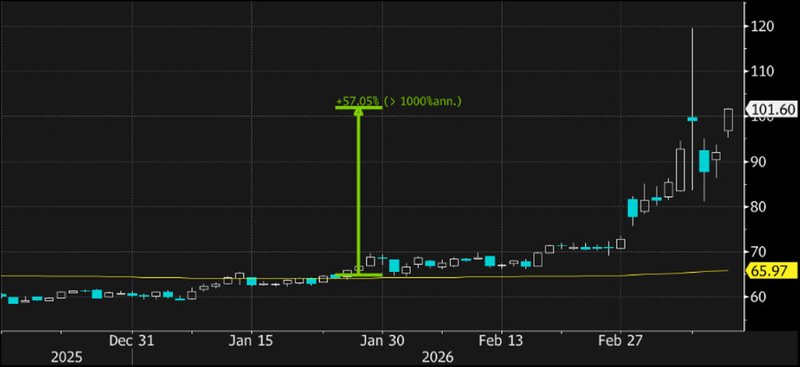
Source: Bloomberg
The global benchmark swung sharply after surging 9.2% in the previous session, while West Texas Intermediate hovered near $97. The move capped a week of violent price action, as investors tried to assess whether the shock would remain temporary or develop into a broader energy crisis with lasting consequences for growth and inflation.
Iran hardens its position on Hormuz
The latest leg higher came after Iran’s new supreme leader, Mojtaba Khamenei, said Iran would seek to ensure that the key shipping route for crude and natural gas remained closed. That message reinforced fears that the disruption is no longer a short-lived military risk but a deliberate pressure point in the conflict.
The Strait of Hormuz is one of the world’s most important energy chokepoints. A near-halt in tanker traffic through the passage has already started choking off shipments of crude, liquefied natural gas and refined products such as diesel, sending prices sharply higher and rattling governments and central banks alike.
Washington turns again to Russian barrels
In an effort to contain the surge in energy prices, the United States issued a second temporary waiver allowing the purchase of Russian oil. The latest measure applies to cargoes loaded before March 12 and is broader than the earlier waiver that had effectively allowed India alone to step up purchases.
The move shows how urgently Washington is trying to free up supply wherever it can. The strategy is simple enough: if Gulf flows are constrained, then alternative barrels have to move faster. But the market also knows that Russian waivers are only a partial relief valve in a system now facing a far bigger disruption.
The biggest supply shock in modern oil trading
The International Energy Agency warned that the current disruption is the largest supply shock in the history of the global oil market. That is a big statement, and not one the agency throws around casually. It underlines just how central Hormuz is to the global energy system.
This is why the crisis has gone far beyond a regional conflict. What began as a geopolitical and military escalation is now becoming a global pricing event, with the potential to reignite inflation pressures, squeeze consumers and raise costs for industry and transport across multiple continents.
It is as the most important oil-supply disruption since the shocks of the 1970s. The comparison is not just dramatic theater. It reflects the fact that the market is confronting a combination of physical supply risk, shipping paralysis and policy uncertainty all at once. That cocktail tends to make oil traders reach for the panic button very quickly.
Tanker traffic slows to a trickle
Shipping conditions in the waterway continue to deteriorate. Reports that Iran has begun laying mines in the strait have only added to the danger, making any commercial transit through the route far more hazardous.
Since the conflict began, vessel traffic through Hormuz has slowed to a trickle. Even with discussions about possible US naval escorts, the market remains skeptical that safe passage can be restored quickly. Clearing mines during active conflict is not a neat logistical exercise. It is a high-risk military operation, and shipowners know it.
That is why traders are not reacting only to headlines about diplomacy or military promises. They are watching the physical flow of ships, and right now the signal from that front remains deeply troubling.
Emergency measures may slow the rise, not stop it
The IEA and major consuming nations have already moved toward releasing emergency reserves in an attempt to cool the market. That may help cap some of the panic and keep prices from spiraling into truly extreme territory in the near term.
But reserve releases are a cushion, not a cure. They can buy time, ease immediate shortages and calm speculative excess. They cannot fully replace a sustained disruption in one of the most important maritime corridors in the world.
That is the uncomfortable truth confronting policymakers. They can soften the shock, but they cannot easily neutralize it while the strait remains effectively closed.
Volatility is now the market’s default setting
WTI has traded in a weekly range of roughly $43, the widest since the pandemic-era collapse when prices briefly turned negative. Brent has also swung in an extraordinary band, highlighting how unstable pricing has become.
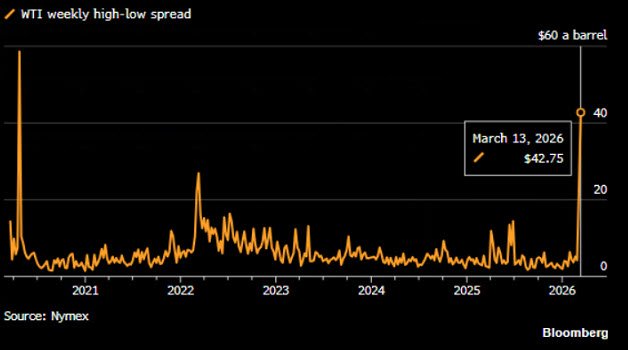
Source: Bloomberg
Those moves are being amplified by flows from options markets, exchange-traded products and broader speculative positioning. Once volatility reaches these kinds of levels, the market stops trading on neat fundamentals alone and starts feeding on its own instability. That is when price gaps get larger, headlines hit harder and conviction disappears.
For now, traders appear to see a broad range near $85 to $105 as plausible while the conflict remains unresolved. That is a very wide band, but the market is basically admitting that it does not yet know where equilibrium lies.
Inflation fears are rising again
The longer this shock persists, the more it threatens to bleed into the global economy. Higher crude means higher fuel bills, more expensive transport, rising input costs and renewed inflation anxiety just as many central banks had started to believe the worst of the price cycle was behind them.
That is why the oil story is no longer just about commodities. It is about monetary policy, consumer confidence and the risk that a geopolitical war becomes an economic one.
For now, Brent above $100 is the market’s blunt message: until there is real clarity on flows through Hormuz, traders will keep pricing in fear. And fear, as usual, is expensive.


Oil at $100 is where geopolitics turns into inflation — fast, brutal and global.