
 Support
EU weighs €93 billion US tariff response after Trump’s Feb. 1 threat
The European Union is preparing to revive retaliatory tariffs on up to €93 billion of US goods as it tries to deter President Donald Trump from imposing a new 10% levy on eight European countries from Feb. 1 — a dispute that has quickly broadened from trade into geopolitics and alliance politics.

EU officials are discussing reactivating suspended tariffs covering €93B of US goods.
Trump threatened a 10% levy from Feb. 1, rising to 25% in June without a Greenland deal.
Brussels is weighing escalation tools, including the anti-coercion instrument.
The EU is also moving to freeze a pending trade deal ratification.
Brussels dusts off a ready-made retaliation package
EU representatives from the bloc’s 27 member states began talks Sunday on how to respond if Trump proceeds with his tariff plan. The most immediate option is already built: the EU has approved retaliatory tariffs on €93 billion of US products, but suspended implementation. If Washington triggers new duties in early February, the EU can move to reintroduce the countermeasures.
The measures would target a mix of politically sensitive and high-value industrial items, including aircraft, US-made cars and bourbon, according to people familiar with the discussions.
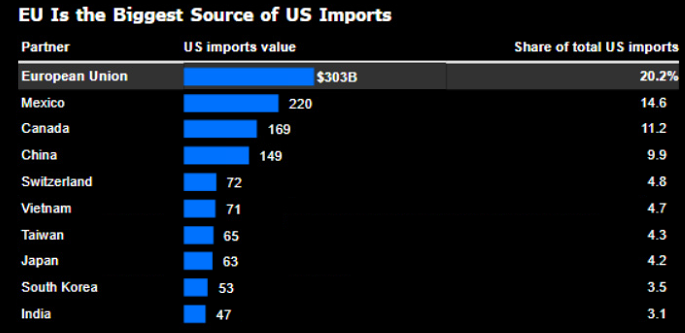
Source: Bloomberg
Trump’s Greenland demand pulls allies into the tariff blast radius
Trump on Saturday threatened 10% tariffs from Feb. 1 on goods from Denmark, Norway, Sweden, France, Germany, the UK, the Netherlands and Finland, with the rate set to rise to 25% in June unless there is a deal tied to the “purchase of Greenland.” The threat followed those countries’ plans for limited NATO-related planning activity in Greenland, a semi-autonomous Danish territory.
European leaders struck a harder tone. UK Prime Minister Keir Starmer called the comments “completely wrong,” Sweden’s Ulf Kristersson rejected what he described as blackmail, and France’s Emmanuel Macron labeled the threat “unacceptable,” while signaling support for a more forceful EU trade response.
The trade deal gets pulled into the line of fire
The EU’s most concrete near-term move is political rather than procedural: Brussels is preparing to halt approval of a trade deal agreed last July, which still requires ratification by the European Parliament. The European People’s Party, the largest parliamentary group, indicated it would join others in blocking the deal.
The agreement itself was controversial inside Europe, with critics arguing it leaned heavily toward Washington. Under its terms, the EU agreed to remove nearly all tariffs on US products, accepted 15% duties on most EU exports to the US, and absorbed 50% tariffs on steel and aluminum — a rate that has since been broadened to cover more downstream products containing those metals.
Anti-coercion instrument: the “big hammer” Brussels rarely touches
Beyond tariff retaliation, EU officials are weighing additional countermeasures — and Macron’s push to activate the anti-coercion instrument raises the stakes. The tool has never been used and was designed to deter or respond to attempts to pressure EU policy through trade restrictions.
In practice, it could open the door to steps beyond tariffs — including restrictions linked to market access, public procurement, investment limits, or other targeted measures. The message would be blunt: if the dispute is framed as coercion, the EU wants the option set to expand.
Markets may have to price a second tariff shock
The timing is awkward for investors. European equities have outperformed as money rotated into regional winners — from defense and miners to chip-equipment makers — supported by expectations of stronger German fiscal spending, lower rates and improving profits.
A fresh US-EU tariff spiral risks puncturing that optimism. Bloomberg Economics estimates that if Trump follows through with the full 25% threat, exports from the targeted countries to the US could drop by up to 50%, with Germany, Sweden and Denmark among the most exposed.
Washington’s message: leverage, not compromise
US Treasury Secretary Scott Bessent signaled little concern over European threats to freeze the trade deal, describing Trump’s approach as strategic leverage and arguing Europe ultimately depends on US security guarantees.
That framing collides directly with the EU’s current political need: to show solidarity with Denmark and the targeted member states — and to convince markets it has both the willingness and the tools to respond.
What happens next
EU leaders are set to meet in Brussels later this week, with diplomacy still positioned as the first line of defense. But the EU is simultaneously preparing a retaliation package designed to be switched on quickly — and debating whether Trump’s Greenland-linked tariff threat crosses the threshold from trade friction into outright coercion.


