
 Support
BoJ Holding rates now, but markets eye tightening ahead
Attention is turning to the upcoming policy decision from the Bank of Japan, where markets expect interest rates to remain unchanged for now. Still, there is growing anticipation that policymakers may begin to lean more hawkish, as external pressures particularly a weaker yen and rising energy costs.

Participants begin to price in the possibility of a rate hike as early as May.
Government has begun releasing oil from its emergency reserves in an effort to stabilise supply and limit price spikes.
Total exports rose 4.2% year-on-year in February.
Holding for now, watching closely
Bank of Japan is expected to keep rates unchanged as it continues to assess how external pressures are feeding into the domestic economy. Policymakers have remained cautious about moving away from their long-standing accommodative stance, particularly given that wage growth and domestic demand are still developing gradually. Any premature tightening could risk slowing the recovery while conditions remain uneven.
At the same time, the backdrop is shifting. A weaker yen and higher energy costs are adding pressure to import prices, and if these trends persist, it may become increasingly difficult for the central bank to justify maintaining ultra-loose policy for much longer. The longer inflation remains elevated due to external factors, the more pressure builds for a policy adjustment, even if domestic conditions are not fully aligned.
That puts greater emphasis on the tone of the upcoming decision. Markets are increasingly expecting a slightly more hawkish tone, even if rates are left unchanged this week, with some participants beginning to price in the possibility of a rate hike as early as May. If policymakers sound more concerned about inflation risks or the impact of currency weakness, it could be seen as an early signal that the policy stance is starting to shift. Even without immediate move, that kind of messaging may gradually push expectations toward tightening and influence market positioning in the months ahead.
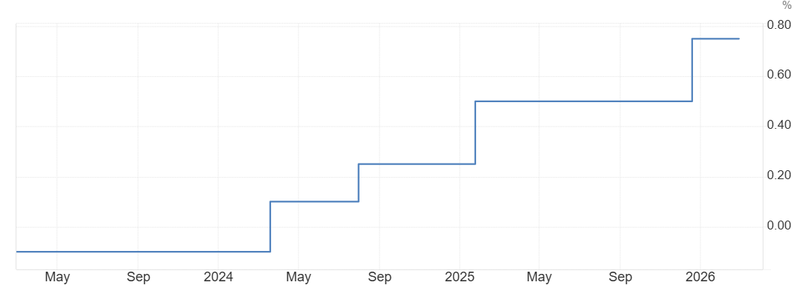
Source: Bank of Japan
Rising external pressures on inflation
Japan’s inflation outlook is becoming increasingly tied to global developments. The ongoing tensions in the Middle East, particularly disruptions linked to the Strait of Hormuz, have pushed oil prices higher, adding pressure to import costs. For Japan, which relies heavily on energy imports, this creates a direct channel into domestic inflation.
In response, the government has begun releasing oil from its emergency reserves in an effort to stabilise supply and limit price spikes. While this can provide short-term relief, it does little to address the broader issue of sustained energy costs if geopolitical tensions persist. For policymakers, this raises the risk that inflation could remain elevated for longer than previously expected, even if domestic demand remains relatively soft.
Export strength offers support
Total exports rose 4.2% year-on-year in February, beating expectations of a 1.6% increase and marking a steady recovery in outbound demand. Growth was supported by stronger shipments of machinery, automobiles, and electronic components, particularly to key markets such as China and the United States. This suggests that, despite global uncertainty, demand for Japanese goods remains relatively stable, helping to cushion the broader economy.
A weaker yen has played a central role in this trend, improving price competitiveness for Japanese exporters and supporting overseas sales. For many large manufacturers, the currency move has helped offset softer domestic conditions and rising input costs. However, this dynamic comes with trade-offs. The same weak yen is pushing up the cost of imports, especially energy and raw materials, which feeds directly into higher input costs for businesses and higher prices for consumers.
As a result, while export strength is providing a buffer for growth, it is also contributing to inflation pressures at home. If energy prices remain elevated and the yen stays under pressure, the benefit from exports may increasingly be offset by rising import costs, leaving the overall impact on the economy more balanced than it first appears.
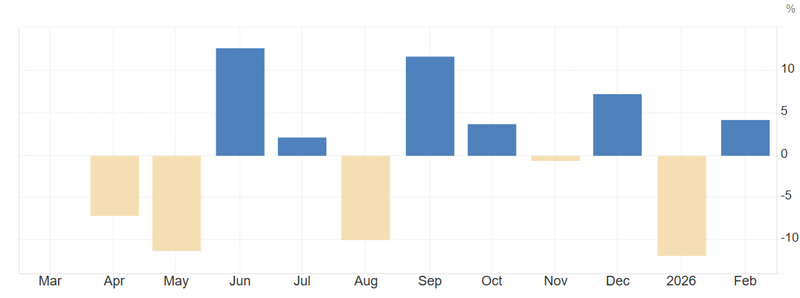
Source: Ministry of Finance, Japan


