
 Support
Japan’s inflation momentum tests the BoJ
Japan’s inflation dynamics are moving back to the center of policy discussions as the country navigates a rare period of sustained price growth. After decades of near-zero inflation, policymakers are now assessing how rising consumer prices, currency weakness, and fiscal developments interact with the broader economic outlook.

Core inflation has been fluctuating around the 2%.
Government revenue projections show a 5.3 trillion yen increase for fiscal year 2026.
Stronger wages support inflation expectations around BOJ’s 2% target.
Inflation momentum remains above historic norms
Japan’s inflation gradually easing but still reflecting a clear shift from the country’s long deflationary past. Inflation started close to 4% in early 2025, moderated toward around 3% through the middle of the year, and is projected to slow further to roughly 2.1% by December and about 1.5% in early 2026.
According to Shinichi Uchida Himino, Japan is now genuinely experiencing inflation through rising consumer prices something that was largely absent for much of the past two decades. The Bank of Japan is paying particular attention to movements in the yen, which has remained relatively weak against the dollar. Currency depreciation raises the cost of imports such as energy, food, and raw materials, feeding directly into consumer prices.
While inflation is gradually cooling, it still sits near levels not seen consistently in Japan for many years. For policymakers, the challenge now is to ensure that price growth stabilizes around the 2% target in a sustainable way. Wage growth, corporate pricing power, and exchange-rate movements will likely determine whether inflation remains stable or fades again as the economy moves into 2026.
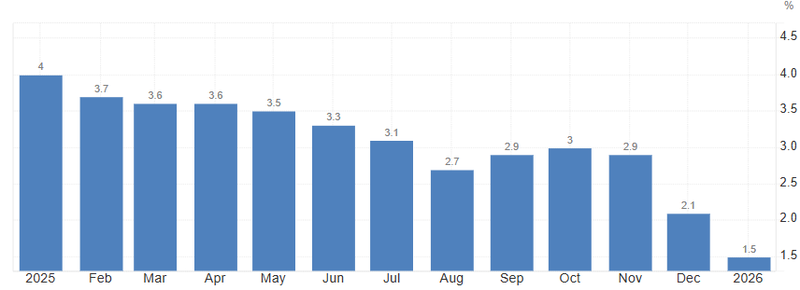
Source: Ministry of Internal Affairs & Communications
Fiscal developments and wage growth
At the same time, Japan’s fiscal picture is evolving. Government revenue projections show a 5.3 trillion yen increase for fiscal year 2026, equivalent to roughly 7% growth compared with FY2025. Officials have stated that most of this increase reflects organic expansion in the tax base rather than major new tax hikes.
In theory, this pace of revenue growth appears stronger than what Japan’s macroeconomic fundamentals alone would imply. With inflation running around 2–3% and real GDP growth trending close to 1%, nominal GDP growth would typically fall in the 3–4% range. The Cabinet Office itself expects nominal GDP growth of about 3.4% in FY2026, broadly consistent with these assumptions.
However, the revenue increase suggests something stronger may be occurring beneath the surface.
Part of the jump can be explained by policy changes. The government has rolled back several special tax breaks while increasing tourism-related taxes and raising certain visa and residency fees. These measures together may contribute roughly 1.5 trillion yen in additional revenue.
The remaining 3.8 trillion yen, around 4.8% growth in the underlying tax base appears tied to stronger corporate profits and rising wages.
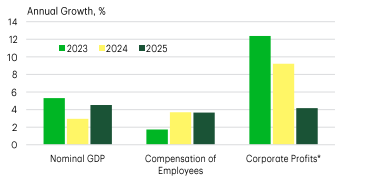
Source: economics.td
Wage growth
In an inflationary environment, wages and corporate earnings can grow faster than overall GDP. Japan has recently shown signs of exactly that pattern.
Corporate profits have outpaced nominal GDP growth over the past three years, while wage negotiations particularly the annual spring “Shunto” wage talks have produced some of the largest pay increases in decades. These trends are feeding directly into higher income tax and corporate tax revenues.
Stronger wages support consumption and help anchor inflation expectations around the BOJ’s 2% target, something the central bank has struggled to achieve historically. At the same time, if inflation accelerates too quickly due to currency weakness or energy prices, the Bank of Japan may be forced to tighten policy more aggressively than currently anticipated.


