
 Support
BoJ, BoE, ECB hold rates; Energy prices volatile amid geopolitical uncertainty
The central banks of Japan, the United Kingdom, and the Eurozone maintained their current interest rates following their respective monetary policy meetings, though all three cautioned that resurgent energy prices could exert renewed upward pressure on inflation. Simultaneously, crude oil benchmarks experienced a highly volatile session following a significant escalation in the US–Israel–Iran conflict.

Bank of Japan (BoJ) maintained its benchmark rate at 0.75%, signalling a readiness to adopt a more restrictive stance should inflationary pressures persist.
The Bank of England (BoE) held rates steady at 3.75%, noting that the MPC remains ready to act if the conflict in the Middle East persists and energy prices pressure inflation.
The European Central Bank (ECB) kept its key rate at 2.15%, indicating that future policy shifts will remain data-dependent, focusing on price stability and regional growth.
Global benchmarks Brent and WTI saw heightened volatility as the intensifying conflict in the Middle East threatened critical LNG export capacity in Qatar.
BoJ, BoE, and ECB maintain rates while citing rising risks from energy costs
The Bank of Japan (BoJ), the Bank of England (BoE), and the European Central Bank (ECB) have all elected to leave their benchmark interest rates unchanged, citing profound uncertainty regarding potential inflationary shocks stemming from volatile energy markets. Since 28 February, coordinated military actions by the United States and Israel on Iranian territory have led to a sharp escalation of hostilities in the Middle East. Consequently, global policymakers are increasingly apprehensive about the repercussions for global inflation and broader economic stability should the conflict remain protracted.
The Bank of Japan held its short-term interest rate steady at 0.75% but adopted a hawkish tone, suggesting that restrictive measures may be necessary if Middle Eastern tensions continue to drive prices higher. According to reports from Reuters, Governor Kazuo Ueda stated that BoJ members are currently prioritising upside risks to inflation over downside risks to economic growth. While he remained non-committal regarding the timing of future hikes, he noted that ongoing government stimulus should continue to support domestic activity. In response, 10-year Japanese Government Bond (JGB) yields rose by 7.3 basis points to 2.28%, while the Japanese yen appreciated by 1.25% to ¥157.76 against the US dollar.
Concurrently, the Bank of England maintained its benchmark rate at 3.75%. The Monetary Policy Committee (MPC) reached a unanimous 9–0 decision, reflecting a strong internal consensus regarding the primacy of inflation risks. The BoE highlighted the systemic threats posed by the Middle East crisis and affirmed its readiness to act if required. Although the bank did not explicitly signal imminent hikes, a "higher-for-longer" restrictive stance remains the baseline. With UK inflation currently at 3%—the highest among major Western economies—the BoE faces a particularly complex outlook. Following the announcement, 10-year UK government yields climbed 12.9 basis points to 4.86%, and the British pound appreciated by 1.17% to $1.3430.
Lastly, the European Central Bank kept its benchmark rate at 2.15%. The ECB indicated that its Governing Council is closely monitoring the interplay between growth and inflation risks resulting from the regional conflict. The bank emphasised that future policy trajectory will depend heavily on the duration of hostilities and the subsequent impact of energy costs on consumer price indices. The ECB’s tone was notably the most neutral of the three banks. While the euro appreciated by 1.05% to $1.1578, 10-year Eurozone sovereign yields remained largely unchanged.
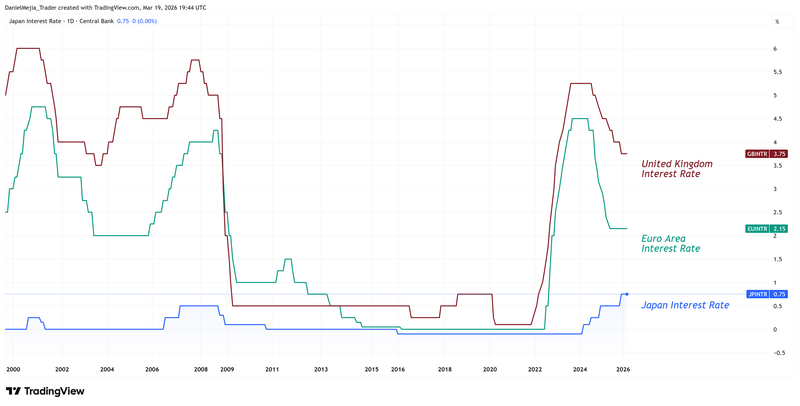
Figure 1. Japan, United Kingdom, and Europe Interest Rates (2000–2026). Source: Data from the Bank of Japan, the Bank of England, and the European Central Bank; Ow analysis conducted via TradingView.
US–Israel–Iran conflict intensifies, raising concerns over energy infrastructure disruptions
Reports from Reuters indicate that Iranian strikes have targeted major liquefied natural gas (LNG) facilities in Qatar, reportedly disabling approximately 17% of the nation’s export capacity and severely damaging critical energy infrastructure. These strikes follow US military actions against Iranian energy assets, triggering a cycle of retaliatory attacks across the Middle Eastern energy corridor. This escalation marks a significant shift in the conflict’s scenario, threatening deeper disruptions to the global economic recovery.
In the commodity markets, the Brent crude futures contract (BRNK6) rose by 1.18% to $108.65 per barrel during a highly volatile session. In contrast, the WTI futures contract remained steady with high volatility, closing at $93.70 per barrel as traders weighed the regional supply risks.
