
 Support
Gold and precious metals gain as US–Venezuela tensions grow
Precious metals and energy prices climbed as tensions between the United States and Venezuela intensified, driving a higher geopolitical risk premium and prompting investors to seek safe havens. Oil markets reacted to the prospect of disruptions to Venezuelan exports, while US manufacturing activity remained weak, with the ISM PMI again below the 50 threshold.

Heightened geopolitical tensions between the United States and Venezuela have catalysed a significant appreciation across major precious metals.
Concerns regarding potential disruptions to global supply chains—given the scale of Venezuela’s crude reserves—have exerted upward pressure on oil prices.
The US ISM Manufacturing PMI has once again fallen short of market estimates, signalling a continued contraction within the sector.
Precious metals regain value amid seek refuge from US-Venezuela tensions
The demand for safe-haven assets has intensified following a dramatic escalation in the diplomatic and military standoff between Washington and Caracas. Over the recent weekend, US special forces executed a large-scale military intervention in Caracas that resulted in the capture of Venezuelan President Nicolás Maduro. According to multiple market commentaries, this action represents the most significant direct US military intervention in the region since the 1989 invasion of Panama.
Geopolitical analysts have characterised the current environment as a definitive turning point in international relations, noting that the breach of traditional sovereignty norms has injected immense uncertainty into global markets. Furthermore, President Donald Trump has utilised official channels to suggest potential future actions against Colombia and Mexico, citing the combat of narcotrafficking as a primary justification. This rhetoric has further heightened the risk premium associated with Latin American stability.
In response to these developments, capital flows have rotated aggressively into the precious metals as a hedge against systemic instability. The gold futures contract (GCG26) appreciated by approximately 2.82%, closing at $4,451 per ounce. Similarly, the silver contract (SIH26) experienced a volatile surge of 7.94% to reach $76.65 per ounce. Other industrial precious metals followed suit: platinum (PLJ26) rose by 6.93% to $2,285, while palladium (PAH26) climbed 4.38% to settle at $1,765 per ounce.
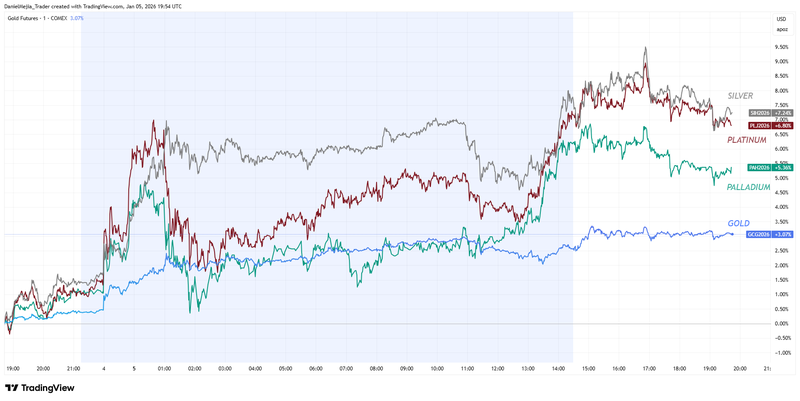
Figure 1. Gold, Silver, Platinum, & Palladium future contracts (intraday performance). Source: Data from the COMEX Exchange; Own analysis conducted via TradingView.
Oil prices rise on supply chain vulnerabilities
Crude oil benchmarks rose in tandem with precious metals, driven by fears of supply disruptions in Latin America. The Brent crude futures contract (BRNH26) appreciated by 1.66% to $61.76 per barrel, whilst the West Texas Intermediate (CLG26) contract rose by 1.74% to approximately $58.32 per barrel.
The market’s immediate reaction reflects the risk that US military control over Venezuelan territory could disrupt global crude flows, given that Venezuela possesses the most extensive proved oil reserves globally. While President Trump has indicated that the United States intends to oversee the management of these reserves to ensure regional stability, the international community remains divided on the long-term implications for the energy sector. Market participants continue to evaluate the potential for retaliatory actions or further destabilisation within OPEC+ dynamics.
US ISM manufacturing PMI records sustained contraction
Data released by the Institute for Supply Management (ISM) reveals that the US manufacturing sector remains under pressure. The Manufacturing PMI retreated from 48.2 in November to 47.9 in December, missing the consensus forecast of 48.3. This marks the lowest reading since late 2024. As the index remains below the 50.0 threshold, it confirms a sustained contraction in manufacturing activity—a trend exacerbated by the continued implementation of trade tariffs which have disrupted industrial value chains.
While the broader US economy continues to show pockets of strength, particularly in the services sector, the manufacturing industry is struggling with deteriorating margins and declining new orders. The divergence between resilient services sectors and a weakening industrial base remains a focal point for monetary policy considerations in early 2026.
Key economic events this week
Monday
- US: ISM Manufacturing PMI
Tuesday
- Germany: Inflation Rate (YoY)
Wednesday
- European Union: Inflation Rate (YoY)
- US: ISM Services PMI
- US: JOLTs Job Openings
- Canada: Ivey PMI
Thursday
- Australia: Balance of Trade
- Japan: Consumer Confidence
Friday
- China: Inflation Rate (YoY)
- Germany: Balance of Trade
- US: Non Farm Payrolls
- US: Unemployment Rate
- US: Michigan Consumer Sentiment
- Canada: Unemployment Rate
