
 Support
BoE warns of rising financial risks, but pound remains firm
The Bank of England has issued warnings regarding British financial risks stemming from elevated valuations of AI-related companies and pressures on sovereign debt markets.

The Bank of England cited rising risks to financial stability arising from high asset valuations and riskier investment exposures.
The BoE highlights geopolitical tensions, U.S. trade unpredictability, and stress in sovereign debt markets as significant sources of risk.
A significant market correction could occur should companies heavily investing in AI deliver lower-than-expected results.
BoE identifies financial risks from AI valuations and risky lending
According to data from its semi-annual Financial Stability Report, the Bank of England (BoE) perceives risks within the British financial system due to high valuations in the artificial intelligence (AI) sector, as well as in venture capital investments. According to Reuters, the primary sources of risk cited by the BoE include geopolitical tensions, the fragmentation of trade markets, and pressures on sovereign debt markets.
Governor Andrew Bailey noted that enthusiasm for the results of AI has pushed valuations in US equity markets to considerably elevated levels, comparable to those observed during the dot-com bubble. Furthermore, the Governor mentioned that, in the event of a significant asset correction, substantial losses could be incurred, potentially placing financial stability at risk.
Meanwhile, a portion of the risk cited regarding the sovereign debt market relates to the leveraged activity employed by hedge funds within the bond repurchase (repo) market. The Reuters report highlights that, should liquidity evaporate unexpectedly, hedge funds could be pressured to liquidate their positions, which would in turn exert pressure on the sovereign debt market.
While this serves as a significant warning, the British pound remained unchanged, trading near the 1.3209 level.
Technical analysis of the GBP/USD pair
From a technical perspective, the British pound versus the US dollar pair remains within a bullish channel pattern but is currently trading below its long-term moving averages. Key observations include:
- Trend context. In the long term, the GBP/USD pair maintains its bullish channel pattern; however, it is trading below its 50, 100, and 200-period moving averages. In the short term, the pair is forming a consolidation structure (range), primarily between 1.3100 and 1.3700.
- Resistance levels. Should the resistance at 1.3317 (coinciding with the 200-day moving average) be breached to the upside, the next significant ceiling is 1.3411 (the Point of Control in the volume profile). A decisive break above these levels would suggest a potential extension into higher price zones.
- Support levels. Should the support at 1.3056 (short-term support) be breached to the downside, the next relevant floor is 1.2959 (the lower boundary of the bullish channel). A loss of the 1.2959 zone would increase the probability of a deeper correction.
- Momentum indicators and volume. The MACD and RSI indicators are currently exhibiting neutral momentum. However, the volume profile indicates a significant distribution near the structural resistance of 1.3600, which may suggest a possible distribution phase.
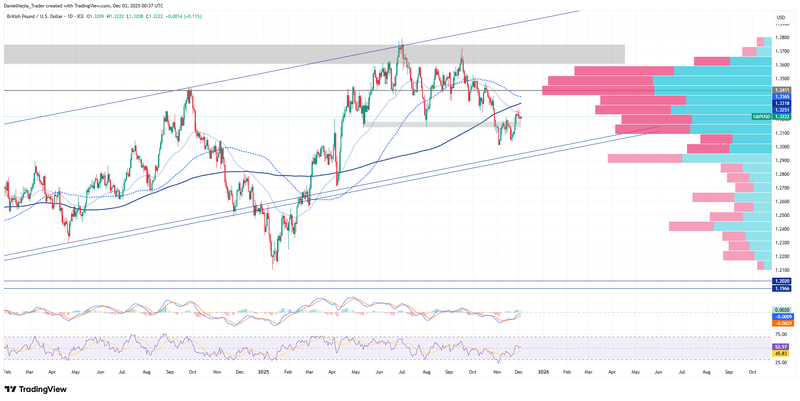
Figure 1. GBP/USD pair (2024-2025). Source: Data from the Intercontinental Exchange (ICE); own analysis conducted via TradingView.


