
 Support
Brent breaks key technical resistance following geopolitical escalation
The Brent crude futures contract is currently testing a prominent technical ceiling, underpinned by a significant escalation of geopolitical tensions in the Middle East. Following a coordinated US-Israeli strike on Iranian territory on Saturday, 28 February, Tehran retaliated with missile and drone attacks targeting Israeli territory and US military installations across the region.

Brent futures appreciated by 6.68% at the market close, following the coordinated military action that has intensified the conflict across the Middle East.
Energy-linked commodities, including gasoline and natural gas, closed with notable gains amid mounting concerns over potential supply chain disruptions.
The surge in oil prices has triggered a test of critical technical levels, potentially signalling a breakout from a long-term bearish pattern.
Oil prices rally amid significant geopolitical escalation in the Middle East
The geopolitical risk premium has increased substantially following the coordinated US-Israeli operation against Iranian territory initiated on Saturday, 28 February. In response, Tehran launched missile and drone strikes against Israel and US military bases situated throughout the Middle East. Furthermore, Iran has announced the closure of the Strait of Hormuz—a strategic maritime chokepoint through which approximately 20% of the global oil and liquefied natural gas (LNG) supply transits.
According to reports from Reuters, over 150 vessels are currently anchored near the Strait of Hormuz, heightening fears that supply chain disruptions could be more severe than initial estimates. Analysts suggest that if the conflict prolongs or escalates further, it could evolve into a broader regional conflict.
Regarding the market reaction, the Brent futures contract (BRNK26) rose by 6.68% to $77.74 per barrel, while the West Texas Intermediate (WTI) contract (CLJ26) increased by 6.38% to $71.25 per barrel. Traders and hedgers are actively seeking cover against potential supply shocks caused by the closure of the Strait of Hormuz, as well as logistical disruptions in Middle Eastern nations currently involved in the hostilities.
Other energy markets have also seen prominent appreciations, given the region's status as a critical exporter of hydrocarbons. The natural gas futures contract (NGJ26) appreciated by 6% following the escalation, while the gasoline futures contract (RBJ26) has accumulated a 5% gain over the same period.
Technical analysis of the Brent futures contract (BRNH26)
From a technical perspective, while the Brent futures contract has historically maintained a bearish trend, price action is currently challenging a key resistance level. Key observations include:
- Trend Context: Despite the presence of a long-term descending channel, Brent is currently trading above its 50, 100, and 200-day Simple Moving Averages (SMAs). The price is attempting to surpass a critical technical ceiling, driven by rising bullish strength fuelled largely by the geopolitical risk premium.
- Resistance Levels: If the immediate resistance levels near $77.40 and $81.00 per barrel are decisively breached, the next significant technical target is $90.00—a prominent psychological barrier. A sustained move above $90.00 would signal a possible trend reversal and potential extension into higher price territories.
- Support Levels: Should a market correction occur, immediate support is identified at $77.40 per barrel. If this level fails to hold, the next structural floor sits at the $70.00 psychological level. A breach of the $70.00 zone would significantly increase the probability of a deeper market correction.
- Momentum Indicators: The Moving Average Convergence Divergence (MACD) is ascending following a bullish divergence, signalling a strengthening of upward momentum in the short term.
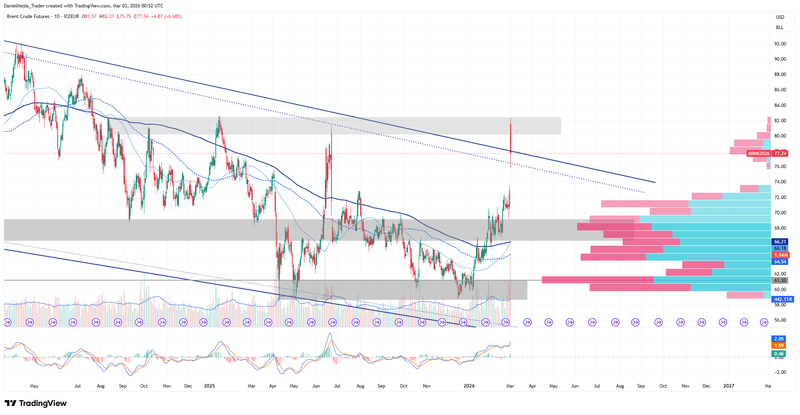
Figure 1. Brent futures contract BRNH26 (2024–2026). Source: Data from the ICE-EUR Exchange; own analysis conducted via TradingView.


