
 Support
Copper between strength and slowdown
China remains the anchor of global copper demand, but its role is evolving. In previous cycles, higher prices often triggered a familiar response: weaker domestic consumption and increased refined exports from Chinese smelters. This time, that elasticity appears lower.

Key signal is whether infrastructure and energy investment translate into sustained physical demand rather than inventory accumulation.
Forecasts suggest around 475kt of demand in 2026, up roughly 110kt year-on-year.
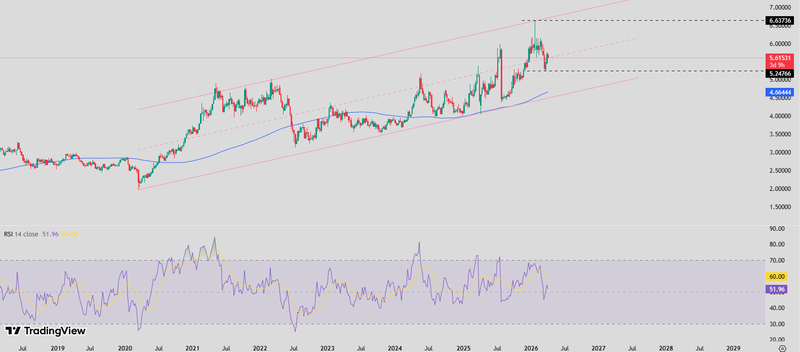
The key zone is 5.2–6.6. A break above 6.6 would reopen the path toward 7.0.
China demands less elastic, more supportive
China remains the anchor of global copper demand, but its role is evolving. In previous cycles, higher prices often triggered a familiar response: weaker domestic consumption and increased refined exports from Chinese smelters. This time, that elasticity appears lower. Grid investment, property stabilization efforts and industrial policy are keeping demand more resilient, even at elevated prices. That reduces the likelihood of China acting as a swing exporter and instead positions it as a steady absorber of supply, the key signal is whether infrastructure and energy investment translate into sustained physical demand rather than inventory accumulation. If it does, the usual supply relief mechanism may not materialize.
New demand: AI, data centres and electrification
What makes this cycle different is the layering of new demand drivers. Data centres expansion linked to AI and high-performance computing is emerging as a non-traditional but fast-growing source of copper demand. Forecasts suggest around 475kt of demand in 2026, up roughly 110kt year-on-year. While still small relative to total demand, its growth is rapid and geographically concentrated, tightening regional supply conditions.
At the same time, electrification continues to scale. Electric vehicles require two to four times more copper than internal combustion engines, while renewable energy systems and grid upgrades are structurally copper-intensive. These trends are not sensitive to short-term price movements, they are policy-driven and capital-intensive, making demand more persistent.
Supply constraints slow, rigid, and lagging
Against this demand backdrop, supply remains the limiting factor. The International Copper Study Group projects a refined copper deficit of around 150,000 tonnes in 2026, reflecting ongoing constraints. New mining capacity is slow to come online, with long project timelines, regulatory hurdles and declining ore grades all acting as structural bottlenecks. Even when prices rise, supply response is delayed, limiting the market’s ability to rebalance quickly.
Into Q2 this creates an asymmetric setup. Downside risks are tied to global growth slowdowns, but upside risks are structurally driven by persistent demand and constrained supply. Copper is increasingly behaving less like a cyclical industrial metal and more like a strategic resource, where tightness can persist even without strong global growth.
Technical outlook
Copper is trading in a long-term ascending channel, with price respecting higher lows and riding above the rising moving average. The recent pullback from the 6.6–6.7 area has brought copper back toward mid-channel support near 5.2–5.3, a level that now acts as a key pivot. This is not a breakdown it is a compression phase within an ongoing trend. RSI around neutral reinforces that momentum has cooled rather than reversed. Structurally, as long as price holds above the 4.6–4.7 region major support and trend base, the broader bullish trend remains intact.
The rejection near the upper channel signals exhaustion at the margin. This aligns with what we see in flows and macro: copper is no longer being chased aggressively, but neither is it being abandoned. Instead, the market is transitioning into a more two-sided phase. Buyers are stepping in on dips, but with less urgency. This typically reflects a shift from momentum-driven positioning to valuation and macro-driven positioning.
Into Q2, copper is likely to trade within a defined range rather than extend immediately higher. The key zone is 5.2–6.6. A break above 6.6 would reopen the path toward 7.0, supported by structural demand. However, failure to hold 5.2 would expose a deeper retracement toward 4.6, where long-term buyers are likely to re-engage.
Source: Trading View


