
 Support
Energy shock rewrites the EUR/USD story
EUR/USD is sitting at a critical level. Price is currently hovering near the 1.14007 support zone after being rejected from a broader downside trendline, suggesting that upside momentum has stalled.

Inflation staying above target while growth remains fragile.
U.S. enters this phase from a stronger position. Its domestic energy capacity provides a buffer.
The 126-period moving average near 1.1198 adds another layer of importance to this area.
Inflation isn’t cooling, it’s rotating
The latest Eurozone inflation print may have come slightly below expectations, but the market is misreading the signal if it interprets that as a clean disinflation trend. Headline HICP at 2.5% and core at 2.3% still sit above the European Central Bank’s 2% target, and more importantly, the composition of inflation is shifting rather than fading.
What’s happening beneath the surface is rotation. Energy is reasserting itself as the primary driver, and that changes the policy implications entirely. Unlike demand-driven inflation, energy-led price pressures are external, volatile, and harder for central banks to control.
This is where the Middle East dynamic becomes critical the recent oil move is not yet fully reflected in the data, which means the current inflation prints are likely understating what’s coming. If energy remains elevated, the next rounds of data could show a reacceleration rather than continued cooling.
ECB from cautious to cornered
Recent remarks from Christine Lagarde and Philip Lane suggest policymakers are aware of this shift, even if they are not fully committing to a response yet.
The challenge is no longer just inflation it is the combination of inflation staying above target while growth remains fragile. That’s a far more complex environment than the one the ECB faced during the initial tightening cycle.
If energy continues to push inflation higher, the ECB risks falling behind the curve again. But tightening policy into a weak growth environment carries its own risks, particularly for an economy already showing signs of slowdown.
This leaves the ECB in a tightening bias without full conviction. It is not comfortably hawkish it is being pushed in that direction.
The Fed at waiting phase
Comments from John Williams reinforce the key issue energy shocks hit both sides of the mandate. They push inflation higher while simultaneously weighing on growth.
However, the U.S. enters this phase from a stronger position. Its domestic energy capacity provides a buffer, meaning the immediate impact is more inflationary than contractionary. That gives the Federal Reserve slightly more flexibility in how it responds.
Still, the timing problem remains. Inflation from energy shocks takes months to filter into official data. What markets are reacting to now is forward-looking, while the Fed is still anchored to backward-looking indicators.
This creates a gap between pricing and policy. If inflation begins to rise again in the data, the Fed may be forced to shift more aggressively than it currently signals.
Technical outlook
EUR/USD is sitting at a critical level. Price is currently hovering near the 1.14007 support zone after being rejected from a broader downside trendline, suggesting that upside momentum has stalled.
The 126-period moving average near 1.1198 adds another layer of importance to this area. A break below would signal that the market is beginning to price a stronger dollar scenario, likely driven by renewed Fed tightening expectations.
At the same time, the longer-term structure from the 1.0500 lows remains intact. As long as those base holds, the broader trend cannot yet be considered reversed.
What this creates is a compression zone price is tightening between structural support and macro uncertainty.
If the U.S. is forced back into a tightening phase while the ECB hesitates due to growth concerns, the divergence would favor the dollar. In that case, EUR/USD would likely break below support, with momentum accelerating to the downside.
But if energy continues to push Eurozone inflation higher, forcing the ECB into a more decisive hawkish shift while the Fed remains cautious, the euro could find support and potentially move higher.
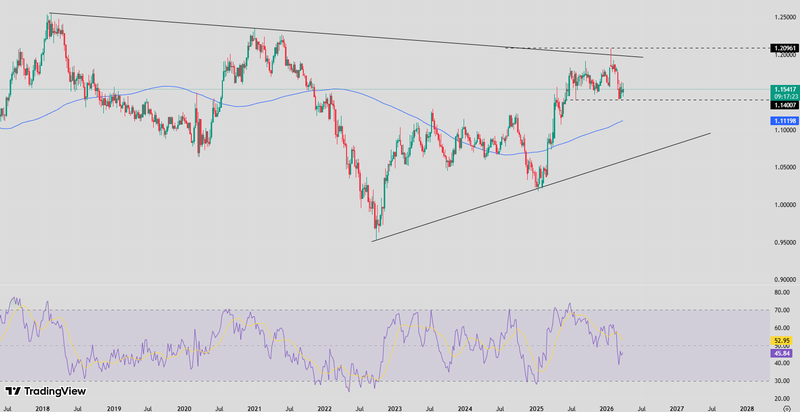
Source: Trading View


