
 Support
Euro drops as rising energy prices cloud economic outlook
The EUR/USD pair has depreciated amidst escalating concerns regarding inflationary pressures, primarily driven by rising energy costs stemming from the US-Israel-Iran conflict. Market participants are increasingly wary of the potential impact on the Eurozone's recovery as geopolitical tensions threaten to destabilise global energy supplies.

ECB policymaker Joachim Nagel stated in a Reuters interview that the central bank remains prepared to act decisively should energy price volatility push inflation rates above the target.
European economies remain highly susceptible to fluctuations in energy costs due to their significant reliance on imported fuel sources.
While the EUR/USD pair maintains its long-term upward trajectory, it is currently testing critical support levels within its short-term bullish channel.
ECB considers inflation risks amid rising energy prices
Joachim Nagel, a prominent member of the European Central Bank (ECB) Governing Council, indicated in a recent interview with Reuters that the ECB will respond decisively and in a timely manner if energy prices exert upward pressure on Eurozone inflation. Although the current inflation rate in the Eurozone stands at 1.9%—comfortably close to the ECB’s 2% mandate—a prolonged conflict in the Middle East could fundamentally shift the central bank's economic projections if energy price increases are sustained.
The central bank intends to maintain a rigorous evaluation of inflationary risks, as policymakers suggest it is currently premature to establish definitive long-term forecasts. Future monetary policy adjustments will remain highly contingent upon the performance of energy markets and their broader impact on the European economy. European nations remain particularly vulnerable to price spikes in crude oil and liquefied natural gas (LNG) due to their structural energy dependency.
Technical analysis of the EUR/USD pair
From a technical perspective, the EUR/USD pair retains an overall bullish posture, although it is currently testing a critical technical juncture within its short-term structure. Key observations include:
- Trend Context: Over the long term, the EUR/USD pair has preserved a bullish market structure characterised by a series of higher highs and higher lows. However, the price is currently trading beneath the 50, 100, and 200-day Simple Moving Averages (SMAs). In the short term, the Euro is testing significant support at the base of an ascending channel pattern.
- Resistance Levels: Should the immediate short-term resistance at $1.1860 be breached, the next significant technical ceiling is identified at $1.2113—a level that marks the upper boundary of the short-term bullish channel. A decisive breakout above this zone would signal the potential for an extension toward higher price territories.
- Support Levels: If the $1.1588 support level is compromised, the next relevant floor is located at the $1.1230 structural pivot point. A breach of the $1.1230 zone would significantly increase the probability of a deeper market correction.
- Momentum Indicators: The Moving Average Convergence Divergence (MACD) indicates a prevailing downward trend following a bearish divergence developed over recent months. Concurrently, while the Relative Strength Index (RSI) is approaching oversold territory, it has yet to signal an extreme exhaustion point on the downside.
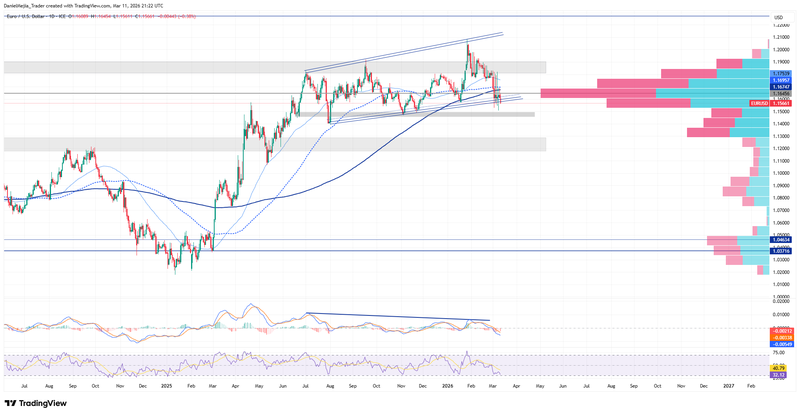
Figure 1. EUR/USD pair (2024–2026). Source: Data from the Intercontinental Exchange (ICE); own analysis conducted via TradingView.


